On this date in 1872, four days after he was deposed as President of Peru, Jose Balta was summarily shot by the would-be dictatorship of Tomas Gutierrez.
Balta (English Wikipedia entry | Spanish) made his name as a soldier, an ironic background for a martyr to constitutional government.
(Notably, it was under Balta’s administration that unprincipled American railroad speculator Henry Meiggs got his prolific track-building operations going in Peru. Basically, the government took all the capital it raised on its guano-export contract — appropriate source — and plowed it into Meiggs’ well-hyped railroads, whose returns rarely justified the outlay to construct them. Wealthy and influential at his zenith, this adventurer was widely considered culpable for the disastrous state of the Peruvian economy by the time of his 1877 death, since in the interim the guano market had crashed and Peru found itself buried in debt it would ultimately default on. Oh, and: reason Meiggs was in Peru? He had to flee California after perpetrating a real estate scheme.)
Back to Balta. The soldier-President was adamant about an orderly departure from office (with a handover to an opposition party*) when his term came up in 1872, but others around him were less keen on constitutional precedents when there was power to be kept or lost.
On July 22, 1872, War Minister Tomas Gutierrez and his brother, Col. Silvestre Gutierrez, arrested the president. Tomas Gutierrez proclaimed himself dictator.
He was surely expecting a more appropriately cowed reaction from the country than he got: the President-elect got away on a warship, whose crew declared for him; the Peruvian Congress passed a resolution outlawing the Gutierrez coup; and the public reaction against him was chilly enough that someone gunned down Silvestre Gutierrez in a railway station on July 26.
News of this turn for the worse reached brother Marcelino, who had (ex-)President Balta in his charge at Callao … and Marcelino had Jose Balta immediately shot. This event meets the definition of an execution better by its circumstances than by its ceremony, since there was none of the latter; Balta was simply blasted while lying sick in bed, perhaps even still asleep, and not with the least sense of occasion.
And by no standard did it meet the usurpers’ definition of utility.
Neither of the remaining two Gutierrezes would outlive Jose Balta by so much as a day, and news of Balta’s murder only helped fan the incipient uprising: both were killed by mobs as the would-be dictatorial party collapsed in the hours ahead. All three of Tomas, Silvestre and Marcelino wound up on lampposts in Lima (and then burned to ashes in a public square) as recompense for their four days’ sovereignty.
As one report given out in North America recounted it:
The events of the past week will forever be remembered in Peruvian history. The spectacle of a Constitutional President deposed and imprisoned by a military usurper; of a Congress dispersed at the point of the bayonet, after the members, irrespective of partisan feeling, had united in signing a solemn protest, declaring the new officers of the so-called Government criminals and outlaws; of an entire country gathering together its strength to repel the attack made upon its liberties and legal rights; of the rising of the people when their indignation could no longer be restrained on the news of the cowardly assassination of Balta by the Dictator; of the triumph of moral force and justice over bayonets and a bastard cause; of the terrible vengeance of the populace on their tyrants; of the final re-establishment of peace, order and good government. This wonderful series of events has been witnessed by Lima in the space of five days. The Peruvian people have nobly vindicated their name and their national honor; the country is now on a firmer basis, and presents greater hopes for prolonged tranquility, prosperity and progress than it has for many years past.
(Not exactly. The economy, as mentioned, crashed in the 1870s, and there was a successful coup in 1879.)
* The guy set to succeed Balta was Manuel Pardo — not to be confused with Mariano Prado, whom Balta had supplanted.
On this date in 1570, Russian tsar Ivan IV Grozny — Ivan the Terrible — carried out one of his most infamous and horrible atrocities with hundreds executed on Red Square.
Ivan the Terrible, by Viktor Vasnetsov. (Cropped image; click for the full painting.)
We find ourselves in 1570 almost a quarter-century into the reign of this complicated, frightening figure. It is the oprichnina, the bloodiest spell of Ivan’s authority: years of torture, purges, and political violence vividly symbolized by the tsar’s black-clad personal Gestapo, the oprichniki.
“Children of darkness,” the exiled noble Kurbsky called these dreadful Praetorians. “Hundreds and thousands of times worse than hangmen.”
A dangerous time to draw breath, but a particularly dangerous time for any boyar, men of the feudal nobility whom Ivan set his iron hand to mastering. This, after all, was the historical task of monarchs at this time, and it was everywhere accomplished with bloodshed.
Already stung by the defection — and subsequent nasty correspondence — of one such noble, Andrei Kurbsky, Ivan was downright paranoid about disloyalty during the long-running Livonian War against Muscovy’s western neighbors, Poland, Lithuania and Sweden.
Ivan became ever readier to equate dissent with treason and to ascribe his military reverses to conspiracies on the part of his aristocratic commanders, rather than to the shortcomings of his war-machine in general. A vicious circle thus emerged – of military failures; suspected treachery; the suspects’ fear of condemnation and liquidation, and flight abroad.*
The innocent have nothing to fear!
Taking it into his head that the ancient, rival city of Novgorod — one of the cradles of Russian civilization — was scheming to deliver itself to the newly-formed Polish-Lithuanian Commonwealth, Ivan led an army there that in early 1570 massacred thousands of Novgorodians.**
He wasn’t done yet.
Returning to Moscow with his blood up, Ivan subjected his numerous Novgorodian prisoners to a savage regimen meant to uncover the extent of their nefarious doings. And it wasn’t long before the locals (who were, after all, just as suspect in Ivan’s eyes) got swept up in it, too. Politically-motivated magistrates with torture-induced confessions and denunciations did the dreadful things they always do.
This date in 1570 turned out to be the affair’s crowning carnival of barbarism.
“The Russian capital had seen many horrors in its time,” wrote Soviet-era historian A.A. Zimin (cited in this biography of Ivan IV). “But what happened in Moscow on 25 July, in all its cruelty and sadistic refinement, outdid all that had gone before and can perhaps be explained only by the cruel temperament and the sick imagination of Ivan the Terrible.”
Ivan Viskovaty (English Wikipedia link | French) had been one of Russia’s leading men on foreign affairs for a generation, as well as a longstanding ally of the tsar.
Nevertheless, he would be the first and most prominent victim on Red Square this date. Viskovaty’s rival Andrei Shchelkalov, who succeeded Viskovaty as the foreign affairs minister, neatly stitched up the senior diplomat for being in on the Novgorod “plot” as well as more exotic schemes to hand over southern cities to Turkey and the Khanate.
On July 25, in the middle of the market-place, eighteen scaffolds were erected, a number of instruments of torture were fixed in position, a large stack of wood was lighted, and over it an enormous cauldron of water was placed. Seeing these terrible preparations, the people hurried away and hid themselves wherever they could, abandoning their opened shops, their goods and their money. Soon the place was void but for the band of opritchniks gathered round the gibbets, and the blazing fire. Then was heard the sound of drums: the Tsar appeared on horseback, accompanied by his dutiful son, the boyards, some princes, and quite a legion of hangmen. Behind these came some hundreds of the condemned, many like spectres; others torn, bleeding, and so feeble they scarce could walk. Ivan halted near the scaffolds and looked around, then at once commanded the opritchniks to find where the people were and drag them into the light of day. In his impatience he even himself ran about here and there, calling the Muscovites to come forward and see the spectacle he had prepared for them, promising all who came safety and pardon. The inhabitants, fearing to disobey, crept out of their hiding-place, and, trembling with fright, stood round the scaffold. Some having climbed on to the walls, and even showing themselves on the roofs, Ivan shouted: “People, ye are about to witness executions and a massacre, but these are traitors whom I thus punish. Answer me: Is this just?” And on all sides the people shouted approval. “Long live our glorious King! Down with traitors! Goiesi, Goida!”
Ivan separated 180 of the prisoners from the crowd and pardoned them. Then the first Clerk of the Council unrolled a scroll and called upon the condemned to answer. The first to be brought before him was Viskovati, and to him he read out: “Ivan Mikhailovich, formerly a Counsellor of State, thou hast been found faithless to his Imperial Highness. Thou has written to the King Sigismund offering him Novgorod; there thy first crime!” He paused to strike Viskovati on the head, then continued reading: “And this thy second crime, not less heinous than thy first, O ungrateful and perfidious one! Thou hast written to the Sultan of Turkey, that he may take Astrakhan and Kazan,” whereupon he struck the condemned wretch twice, and continued: “Also thou hast called upon the Khan of the Krim Tartars to enter and devastate Russia:† this thy third crime.” Viskovati called God to witness that he was innocent, that he had always served faithfully his Tsar and his country: “My earthly judges will not recognize the truth; but the Heavenly Judge knows my innocence! Thou also, O Prince, thou wilt recognise it before that tribunal on high!” Here the executioners interrupted, gagging him. He was then suspended, head downwards, his clothes torn off, and, Maluta Skutarov, the first to dismount from his horse and lead the attack, cut off an ear, then, little by little, his body was hacked to pieces.
The next victim was the treasurer, Funikov-Kartsef, a friend of Viskovati, accused with him of the same treason, and as unjustly. He in his turn said to Ivan, “I pray God will give thee in eternity a fitting reward for thy actions here!” He was drenched with boiling and cold water alternately, until he expired after enduring the most horrible torments. Then others were hanged, strangled, tortured, cut to pieces, killed slowly, quickly, by whatever means fancy suggested. Ivan himself took a part, stabbing and slaying without dismounting from his horse. In four hours two hundred and been put to death, and then, the carnage over, the hangmen, their clothes covered with blood, and their gory, steaming knives in their hands, surrounded the Tsar and shouted huzzah. “Goida! Goida! Long live the Tsar! Ivan for ever! Goida! Goida!” and so shouting they went round the market-place that Ivan might examine the mutilated remains, the piled-up corpses, the actual evidences of the slaughter. Enough of bloodshed for the one day? Not a bit of it. Ivan, satiated for the moment with the slaughter, would gloat over the grief of the survivors. Wishing to see the unhapy wives of Funikov-Kartsef and of Viskovati, he forced a way into their apartments and made merry over their grief! The wife of Funikov-Kartsef he put to the torture, that he might have from her whatever treasures she possessed. Equally he wished to torture her fifteen-year-old daughter, who was groaning and lamenting at their ill fortune, but contented himself with handing her over to the by no means tender mercies of the Tsarevich Ivan. Taken afterwards to a convent, these unhappy beings shortly died of grief — it is said.
Thanks to this sort of wholesale purging, Ivan the Terrible became in the 20th century something of an allegorical shorthand for Joseph Stalin, whose ownreignofterror was a touchier subject for direct commentary. By that same token, and capturing the multifaceted meaning of the word Grozny, (both awful and awe-inspiring) Soviet patriotic mythology co-opted Ivan and his allegedly farsighted cruelty as a state- and nation-builder.
Sergei Eisenstein’s Ivan the Terrible — a planned trilogy of films of which only two were completed, due to Stalin’s distaste for his greatest director’s interpretation — captures a view of Ivan IV Grozny from the shadow of wartime Stalinist Russia. (The two extant films can be seen in their entirety on YouTube, and are well worth the watching.)
The more conventional take is that, especially by his later years, the guy’s tyrannical paranoia had metastasized enough to send him plum off his rocker. In 1581, that favorite son who had accompanied Tsar Ivan to Novgorod, and to Red Square on this date, piqued his father’s rage during an argument — and in a fury, Ivan struck him dead.
Detail view (click for the full, gorgeous canvas) of Ilya Repin‘s emotional painting of Ivan the moment after he has mortally wounded his son. Incited to his own act of lunacy by the tsar’s riveting madman expression, iconographer and Old Believer Abram Balashov slashed these faces with a knife (image) in the Tretyakov Gallery in 1913.
The capable young heir’s senseless death effectively spelled the end for Russia’s Rurikid Dynasty descended from the half-mythical Norse founder of Rus’, Rurik. That argument from order and progress in favor of Ivan’s ferocity inconveniently runs up against the fact that what he actually bequeathed to the next generations of Russians was the rudderless, war-tornTime of Troubles, when rival claimants struggled for the throne.
Ivan IV is sure to remain a controversial, compelling figure for many a year to come. Released just a few months ago as of this writing, and in a time when Ivan comparisons are coming back into vogue for the ominous contemporary Russian state, Pavel Lungin’s Tsar (review) mounts a gory critique of its subject.
* Jonathan Shepard, book review in The Historical Journal, vol. 25, no. 2 (June 1982).
** Novgorod by 1570 was not as important as it had once been, but Ivan’s sack massively depopulated the city, essentially destroying its remaining strength as an independent commercial center.
† The allied Ottoman Turks and Crimean Khanate did in fact devastate Russia (and pillage Moscow) the very next year.
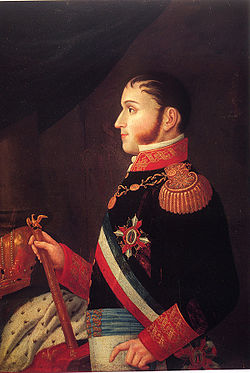
On this date in 1824, the Mexican officer who had made himself emperor was shot at the village of Padilla.
Iturbide‘s military acumen saw him through a meteoric rise in the service of what was then New Spain.
Iturbide rejected an early offer of generalship from the pro-independence leader Hidalgo in favor of spending the 1810s ably quashing the insurgency.
In a bizarre twist of fate, however, it would be Iturbide who would himself cement Mexican independence.
En route to try to finish off the last major rebel leader, Vicente Guerrero, Iturbide caught wind of the recent del Riego liberal revolt back in the mother country,* which had triggered civil war in Spain.
For the conservative royalist general, heir himself to a Basque noble lineage, the potential collapse of Bourbon authority in Spain raised the frightening specter of social upheaval.
All Iturbide’s work killing guerrillas for the sake of public order could come to naught if the Spanish monarchy collapsed or ceased projecting its power overseas … and then who knew what would emerge from the resulting power vacuum in Mexico?
So Iturbide cut a deal with Guerrero to consummate the Mexican War of Independence by separating from Madrid on an essentially conservative basis — a political breakaway without a social revolution. Independent Mexico would make nice with the Spaniards already living there, keep Catholicism as the official state religion, and get itself a constitutional monarchy of its own to insulate itself from the chance outcomes of continental politics across the ocean.
And when Iturbide marched into Mexico City and encountered a crowd conveniently imploring him to take the throne, well, who was he to deny them?
And so Iturbide transitioned smoothly from scourge of the revolution to its man on horseback,** immediately splintering the coalition that lifted him to power.
Contrary to this allegorical take on Iturbide’s coronation, he crowned himself — Bonaparte-like.
Only months after his July 1822 coronation, Iturbide shuttered Congress and began arresting the opposition. Meanwhile, Ferdinand VII had emerged from the Spanish fray as the (momentary) winner, leaving his upstart former subjects without international support.
A general that the freshly-minted emperor had himself had promoted, one Antonio Lopez de Santa Anna — yes, the Alamo guy — declared against Iturbide by the end of 1822, and come the following spring, Agustin I was a European exile, in the paradoxical position of drawing a pension from Mexico while also officially considered a traitor and outlaw.
In Tuscany and then England, Iturbide published an autobiographical justification — Statement of Some of the Principal Events in the Public Life of Agustín de Iturbide — then finally took up a much-asked-for invitation from Mexican conservatives to return and become the savior of his country against internal breakdown and a potential Spanish attack.
Founded on vainglory, this expedition was destined for fiasco; within five days of touching Mexican soil, Iturbide was serenading a firing squad with the last words, “Mexicans! I die with honor, not as a traitor; do not leave this stain on my children and my legacy. I am not a traitor, no.” Apparently they were serious about that injunction never to return.
When in Mexico City, relive happier times for our day’s subject at the Palace of Iturbide where he briefly maintained himself in the purple.
And do think twice about styling yourself Emperor of Mexico, since the only other person to claim that title also ended his reign in front of a firing squad.
* Ironically, it was a body of soldiers assembled for a reconquista of Spain’s independence–minded New World possessions that enabled del Riego to mutiny.
** Iturbide paused in the revolution’s good graces just long enough to design the Mexican flag.
In the predawn hours this date in 1989, Cuban Gen. Arnaldo Ochoa was shot in a pasture at a West Havana military base along with Col. Antonio “Tony” de la Guardia and Captains Antonio Padrón and Jorge Martinez — all convicted of treason against the Cuban Revolution because of drug trafficking.
Before his abrupt fall just weeks before this date, Arnaldo Ochoa was one of the shining stars of Castro’s Cuba.
One of the Sierra Maestre guerrillas, Ochoa had fought with Che Guevara in the Battle of Santa Clara that toppled the Batista regime.
In the decades that followed, he rose to become one of the most powerful officers in Cuba, serving in Venezuela, Angola, Ethiopia.
But in early June 1989, and shortly after a Mikhail Gorbachev state visit to Cuba delivered the bad news that the crumbling Soviet Union would be withdrawing its subsidies to Havana, Ochoa and State Security officer Tony de la Guardia* were suddenly busted for running a drug-smuggling operation — essentially conspiring with the Colombian Medellion cartel to exploit Cuba’s position on the most direct routes to Florida, and corruptly skimming the proceeds in the process.
There seems to be little doubt among those in the know that they were doing exactly that, but endless speculation about what else they were up to — what the executions were really about.
There is the year, to begin with, which is why we’ve mentioned Gorbachev; Castro was hostile to the Soviet leader’s glasnost reforms, and could read well enough the dangerous direction of change in eastern Europe. He wanted Gorbachev to put the brakes on.
Ochoa was seen as a charismatic figure of a more liberal outlook and close to Russian officers to boot, and one school of thought has it that he therefore looked like the sort of man who might be able to mount a coup or serve as the KGB’s catspaw if it came to regime change.
Whether or not Ochoa was targeted on that basis, Castro surely did not regret during those dangerous transitional years as Russian patronage slipped away the salutary effect this day’s doings would have had on any other potential aspirants for his job.
That consideration, whether it was primary or tertiary, probably helps explain the purge’s old-school show trial vibe. On television, Ochoa confessed to it all, and assured the court,
If I receive this sentence, which might be execution … my last thought will be of Fidel, for the great revolution he has given our people.
(Although what that thought would have been is a different matter. After falling out with Ochoa over military operations in Angola, the Cuban dictator had bugged his general’s environs and thereby eavesdropped on numerous of caustic remarks about himself.)
The drug charges, too, point the way towards plausible hidden agendas.
Fidel and Raul generally took a cautious approach to the drug business — hardly virginal, but reputedly avoiding particularly egregious entanglements lest they gift-wrap the hostile Yankees a pretext for invading. (Given what happened to Panama later in this eventful year, that would have been a reasonable concern.)
At the same time, it’s all but inconceivable that they were taken completely unawares by “revelations” that their aides were up to something shady.
So the hypotheses in this area run the gamut from: Ochoa and de la Guardia taking an authorized but circumscribed covert operation and avariciously expanding it beyond any possible license; to, everyone at the top being up to his eyeballs and Ochoa and de la Guardia eliminated when it became expedient to bury their firsthand knowledge of Fidel’s firsthand knowledge. Timing, again, is suggestive; with the coming withdrawal of Soviet protection, this might have been seen in Havana a prudent moment to trim sails on narcotics transshipment.
Whatever Arnaldo Ochoa and Tony de la Guardia may have known or sensed about the wheels-within-wheels of Havana politics, they took it to their grave 21 years ago today. Perennial declarations of the Castros’ imminent fall have made the rounds ever since, but until that old stopped clock manages to tell the right time, it’s likely that the rest of us will have to content ourselves with guesswork.
* De la Guardia was a friend of the writer Gabriel Garcia Marquez. In this very year, Marquez dedicatedThe General in his Labyrinth to the soon-to-be-disgraced colonel.
Speaking of de la Guardia literary connections: Tony’s daughter, Ileana, has also published a book.
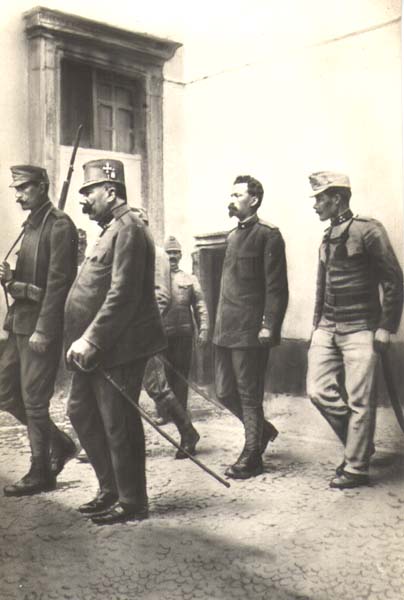
On this date in 1916, the Austro-Hungarian empire executed Cesare Battisti and Fabio Filzi for treasonous Italian nationalism.
It was the multiethnic Habsburg state that was itself dying of its constituents’ national aspirations; in little more than two years, the state entity that carried out this day’s sentences would no longer exist at all.
When the unpleasantness broke out, though, he made a break for the peninsula where he agitated* (successfully) for Italian entry into the fray against Austria-Hungary. Irredentists had long coveted Habsburg properties with a heavy Italian population, like the Adriatic port of Trieste and Battisti’s own native Trento; the war offered an opportunity to swipe those territories, notwithstanding Italy’s putative prewar alliance with the Austrians.
Although already 40 years of age when Italy entered the war, the intrepid Battisti enlisted to fight. He was captured along with an otherwise obscure subaltern, Fabio Filzi, on the Alpine slope of Monte Corno (now known as Monte Corno Battisti) repelling the Austrian Strafexpedition.**
Austria did not stand on ceremony with these men; their capture took place on July 10, their trial on July 12, and their executions at the Castello del Buon Consiglio — an ironic Calvary, for a parliamentarian — later that same day. (To complete the scene, the strangulation-hanging was botched when Battisti’s first rope broke.)
The Austrian writer Karl Kraus would observe that “they thought they were hanging Italy, but it was really Austria on the gallows.”
Battisti leaving the courtroom en route to his execution.
Battisti approaches the scaffold.
Battisti waiting at the scaffold as the sentence is read.
The Austrian army offers a prayer and salute to the shrouded body of Cesare Battisti.
* As a socialist who broke against the internationalist position and in favor of violent nationalism, Battisti was an ally of Benito Mussolini. It was Battisti, actually, who pioneered the socialist-nationalist-newspaperman act upon which Mussolini would later raise is own star, to such an extent that Battisti’s paper, Il Popolo — the apparent inspiration behind Mussolini’s own subsequent paper, Il Popolo d’Italia — gave the still-obscure future Duce some of his earliest gigs.
A martyr’s death during World War I fortuitously spares Battisti’s legacy the unpleasant association with his friend’s postwar turn towards fascism, so there are many streets and plazas named for Battisti, as well as a memorial in Trento. He’s also honored by name in the 1918 patriotic tune La Leggenda del Piave (lyrics).
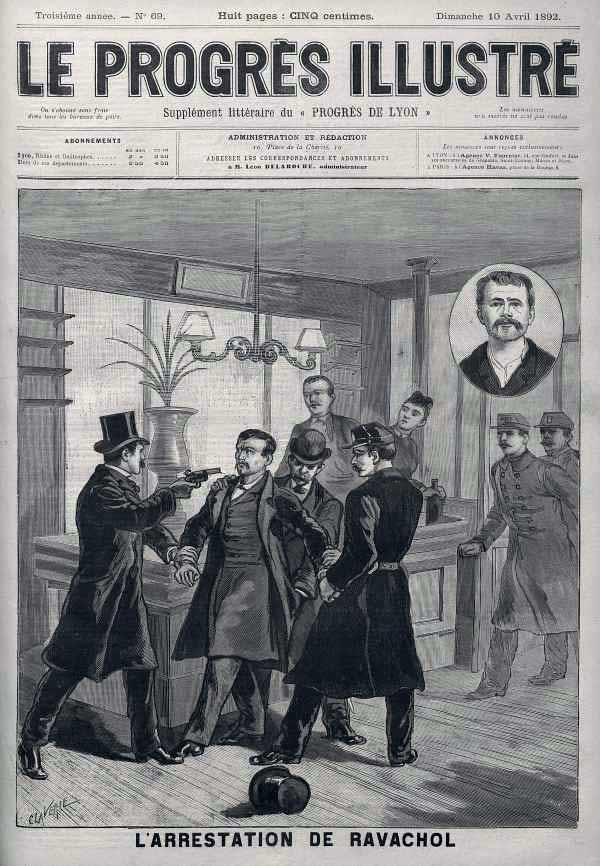
On this date in 1892, French anarchist François Claudius Koenigstein — better known as Ravachol — was guillotined at Montbrison for a series of bomb attacks on right-wing judges.
He took the name “Ravachol”, his mother’s, after his Dutch father ditched his mom, leaving the family in poverty.
Young Ravachol supported himself as best he could in proletarian labor and crime, as he attempted to observe* at his trial.
There are many people who will feel sorry for the victims, but who’ll tell you they can’t do anything about it. Let everyone scrape by as he can! What can he who lacks the necessities when he’s working do when he loses his job? He has only to let himself die of hunger. Then they’ll throw a few pious words on his corpse. This is what I wanted to leave to others. I preferred to make of myself a trafficker in contraband, a counterfeiter, a murderer and assassin. I could have begged, but it’s degrading and cowardly and even punished by your laws, which make poverty a crime. If all those in need, instead of waiting took, wherever and by whatever means, the self-satisfied would understand perhaps a bit more quickly that it’s dangerous to want to consecrate the existing social state, where worry is permanent and life threatened at every moment.
Personal want segued into political conviction for Ravachol, whose crimes were justified by the principle of reprise individuelle.
And the political led him to reprisals of a less individual nature, when French state violence against radicals caused him to dynamite several magistrates’ homes.
He was caught in a restaurant,** brought to trial, and let off with penal servitude for life. Then another jury, intimidated by public outcry, reversed the decision and sent him to the guillotine.
Anarchism, that revolutionary specter stalking fin-de-siecle Europe, burnt its fuse at both ends, but Ravachol’s falling head‡ left a legacy for his fellow-travelers. The next year, Auguste Vaillant tossed a bomb into the French Chamber of Deputies to avenge Ravachol. (Vaillant was himself guillotined, and himself avenged by Emile Henry and Sante Geronimo Caserio.)
Ravachol was also honored in a song, La Ravachole — set to the jauntily menacing tune of La Carmagnole, it cheers, “Long live the sound of the explosion!”
* This incendiary speech was cut off by the court.
** The table where the terrorist was nabbed got its own inscription: “Here ate Ravachol the day of his arrest.”
We had lost confidence in our culture. Everything had to be demolished. We would begin again after the ‘tabula rasa’. At the Cabaret Voltaire we began by shocking common sense, public opinion, education, institutions, museums, good taste, in short, the whole prevailing order.
‡ Ravachol was guillotined midway through a parting exclamation, “Vive la Re-“. Initial newspaper reports implausibly rendered this as the patriotic classic “Vive la Republique!” rather than a much more in-character word like, oh, “Revolution”.
Weeks of controversy ensued over some witnesses’ claims that the head post-severing had actually completed the word “-publique”, a notion of a piece with the idea that the severed head survives decapitation by a few seconds. Scienticians countered that obviously excited witnesses were maybe hearing air escaping from the headless trunk and filling in the rest of the scene in their heads.
On this date in 1538, Spanish conquistador Diego de Almagro was executed* at Cuzco by his vengeful rivals, the Pizarro brothers.
Conquistadoring with the rapacious Pizarros was a good way to get rich, get dead, or possibly both.
Almagro, a soldier, got to the New World in 1514 and soon fell in with alpha male Pizarro Francisco.** He’d become an adjunct to the latter’s conquest of the Incan Empire in the 1520s and 1530s; sent to capture the Incan city of Quito, Almagro found it razed by its defenders, and he sycophantically re-founded it as San Francisco de Quito.†
Things weren’t buddy-buddy for long.
The Iberian mothership divided Spain’s putative New World possessions north and south, putting Almagro in command of the southern cone. Great news … now all he had to do was actually take control of it.
Personally financing an expedition on the expectation of fabulous riches to be seized, Almagro instead foundered in Chile’s northern valleys in a frustrating environment of natives equally hostile and impecunious. After a couple years, he gave up and returned to Peru, angrier and poorer for his trouble — and there found that he could exploit the Spanish preoccupation with intransigent Incan chief Manco Inca to nick the capital city of Cuzco for himself.
Almagro actually had the lesser Pizarros — Gonzalo and Hernando — prisoner for a while, but he bartered them away to Francisco for a hill of beans (that is, a promise not to attack), and the Pizarros took their city back by routing Almagro at the Battle of Las Salinas.
The sentence of death against as august a personage as the appointed ruler of Nueva Toledo shocked many, and it was carried out against Almagro’s own entreaties for an appeal to the crown.
Detail view of a print of Almagro’s capture and execution. (Click for the full image.)
Francisco Pizarro would redeem his want of clemency towards his former partner in his own blood: in 1541, Almagro’s son, Diego de Almagro II or el Mozo, murdered Pizarro in an attempted coup d’etat. (Almagro the Younger, too, would be executed for his trouble.)
Although he was an important conquistador who spent most of his time at points further north, Almagro is best remembered today not in Peru but in Chile — for his abortive and disappointing expedition made him that land’s first European “discoverer”.
On this date in 1816, Jorge Tadeo Lozano was executed by firing squad in a Bogota temporarily reconquered for the Spanish crown.
Scientist, journalist, essayist and man-about-town Lozano (English Wikipedia entry | Spanish) sprang from the stock of New World Spanish nobility.
He studied literature, philosophy, medicine, chemistry, mathematics, mineralogy, botany; he served in the Spanish military and traveled in Europe; he returned to his native New Granada, where he became drawn into the liberal ferment with a celebration of the emerging bourgeoisie obviously contextualized by his scientific education.
Money, like the blood of a body, gives life and shares with each and every one proportionally the movement and robustness that it needs to freely comply with the action that it must complete as a member of society … This inistrumental motive of wealth can not be hushed, if it is to produce an effect … in the manner of electric flow [it] passes through bodies, leaving them with a glowing heat, also enlivens the arms and hands through which it passes… (Studies in the History of Latin American Economic Thought)
As a member of the constituent assembly, he helped draft an 1811 constitution that acknowledged the authority of the Spanish crown, but not of its viceroy, creating (so its signers thought) a new commonwealth state. Lozano thereupon became the first President of Cundinamarca, essentially the forerunner to the present-day Colombian presidency.
Since Lozano turned out to be a better botanist than executive, he resigned the office after a few months.
Only after Europe had sorted out the Napoleonic wars did the Spanish free up the resources for a brutal reconquista of their errant provinces. But when it came, under a general with the macho nickname El Pacificador, it had intellectuals just like Lozano right in its sights.
Even though he’d been back at lower-profile scribbling since his stint at the top, Jorge Tadeo was just the sort of guy Pablo Morillo targeted for demonstrative executions over the second half of 1816.
Thus perished the persons of the greatest wisdom, the most virtuous and wealthy, in New-Granada. The object which Morillo had in view, was to extinguish intelligence, remove men of influence, and destroy property, so that, in future, there should be none capable of originating or directing another revolution. (Source)
Thus perished Lozano this date, along with another intellectual, Miguel Pombo (Spanish link) among a whole train of patriotic martyrs over the months of Morillo’s rule.
The policy of killing these men to deprive New Granada of revolutionary potential was, however, an abject failure: just three years after these men were shot as traitors to that distant European line, Simon Bolivar detached Colombia from Spain at the Battle of Boyaca.
By the end of Longshanks’ life, the old king was so irate at their relationship (the prince had had the temerity to request a title and castles for Gaveston) that Gaveston was booted out of the country.
(But at least he wasn’t defenestrated, the fate of the fictional Gaveston stand-in “Phillip” in Braveheart.)
Ah, the gay-baiting.
The younger Edward immediately recalled his friend when death came for Longshanks, and Gaveston was resented both by English peers and the young Queen Isabella for the favor the new king held him in.
The purported homosexual relationship between Edward II and Piers Gaveston is commonly believed* though ultimately speculative, reading between the lines of chroniclers who are sometimes bitterly hostile towards these two. “The King loved an evil male sorcerer more than he did his wife,” for instance, is a bit of propaganda — we obviously don’t believe the “sorcery” bit — and even that’s not completely explicit.
There’s a strong circumstantial interpretation to made, but since the particulars of Edward’s behavior with his favorite behind drawn tapestries are permanently unavailable to us, it will suffice us to say that this interpretation has conditioned the “Piers Gaveston” who comes to us in later centuries as a widely-credited cultural artifact.
Whether as calumny or commendation, homosexuality is the first thing everyone “knows” about Piers Gaveston, the emblem of his life and the doomed reign of his sovereign. We meet him from the other side of Stonewall, even when we meet him in Renaissance poetry or Renaissance drama.
The historical, flesh-and-blood Piers — and there’s a very thorough biography of him here** — was certainly defined by more than gay identity, real or imputed.
The personal resentment he inspired in the likes of Lancaster and Beauchamp was political, mapped onto the timeless power struggle between nobles and crown, and within the nobility itself.
The king trusted Gaveston, who was himself just the son of a knight, with plum royal assignments like governing Ireland, and Gaveston executed them effectively; with an immoderate confidence in his own considerable talents, the favorite was not above tweaking his rivals with derisive nicknames.
The Lancaster faction progressively got the upper hand on Edward and Gaveston, and with civil war brewing, they captured the hated Gascon at Scarborough Castle while Edward scrambled unavailingly to raise an army of his own.
He was held privately for nine days before Lancaster — “a sulky, quarrelsome, and vindictive man … quick to resort to violence,” by Alison Weir’s reckoning — decided he had to go. Gaveston was beheaded without color of law at Blacklow Hill near Warwick. A monument to his memory still stands there today.
Thou executioner of foule bloodie rage,
To act the will of lame decrepit age.
The grief-stricken monarch would serve his revenge upon the Earl of Lancaster ten years’ cold, beheading him for treason in 1322 upon the verdict of the man who had by then slid into Gaveston’s place in the king’s favor, Hugh Despenser.
General Valle was shouldered out for his affiliations with the former regime: throughout the months following the coup, the Peron party was systematically proscribed and its leaders barred from politics.
In exile, Peron urged radical action by these disenfranchised followers, and Valle attempted to mount a revolt in June 1956.*
This operation was well-scouted by the government, and crushed instantly — with a couple dozen of its adherents summarily shot. (Spanish link)
Well, the Peronist party slogan was, “Our Lives for Peron.”
Valle avoided the initial slaughter, but he was captured in an apartment in Buenos Aires on this date and shot at the city’s National Penitentiary in the evening.
“Shot for trying to overthrow the government” doesn’t quite sound off the scale of typical coup outcomes, but in Buenos Aires in 1956, these executions were shockingly disproportionate relative to the handling of many recent unsuccessful coups. Actually, the Aramburu government had just that February repealed the death penalty as a statutory option for plotting a coup.
But it wasn’t using statutes to handle the Valle coup: it declared martial law, and handled subversives at its own discretion. (It rescinded martial law and ceased any further executions on June 13.)
The authorities’ brutal response was something of a turning point in Argentine political relations and culture. Throughout the Peronist decade even the harshest critics of the regime could not accuse it of executions of this sort, even though coups had been attempted against it. Bloodshed on this scale for political reasons was unprecedented in the political and military history of Argentina.
Aramburu himself would catch a bit of the blowback for authoring this “turning point”: in 1970, the former president was kidnapped (Spanish-language site) by the pro-Peron Montoneros guerrillas and himself summarily executed shortly thereafter — allegedly in specific retaliation for having shot Gen. Juan Jose Valle.
And the literary fallout was hardly more complimentary. Argentine writer Felix Luna penned La Fusilacion (The Firing Squad) the next year;** set during Argentina’s 19th century civil wars, it’s plainly informed by that country’s more contemporaneous problems.
* Valle’s top co-conspirator was another general, Raul Tanco. In a strange coda, Tanco managed to escape execution by claiming asylum in the Haitian embassy. Pro-government gunmen kidnapped him from that refuge and turned him over to the army, but in a gesture of diplomatic courtesy, Aramburu returned Tanco to the embassy unharmed, with apologies to the Haitians for the breach of decorum.

 Balta (English Wikipedia entry | Spanish) made his name as a soldier, an ironic background for a martyr to constitutional government.




 Before his abrupt fall just weeks before this date,
  It was the multiethnic Habsburg state that was itself




 Scientist, journalist, essayist and man-about-town Lozano (