This is the feast date (in Christianity’s western tradition) of Saint Jude.
Possibly one of the bit players among Jesus’s original 12 apostles — “Jude”/”Judah”/”Judas” was a common name among first-century Israelites, so there’s some confusion about the identities among various texts talking about various (?) Judes — St. Jude is aptly-for-this-blog considered the patron saint of “lost causes” or “situations despaired of”.
He’s traditionally supposed to have knocked around the eastern Mediterranean after the Nazarene‘s crucifixion, introducing Christianity (along with St. Bartholomew) to Armenia, which eventually became the first officially Christian kingdom. (Jude is also a patron saint of Armenia; his other patronage gigs include the Philippines, the Chicago Police Department, a a Brazilian football club, and countless hospitals.)
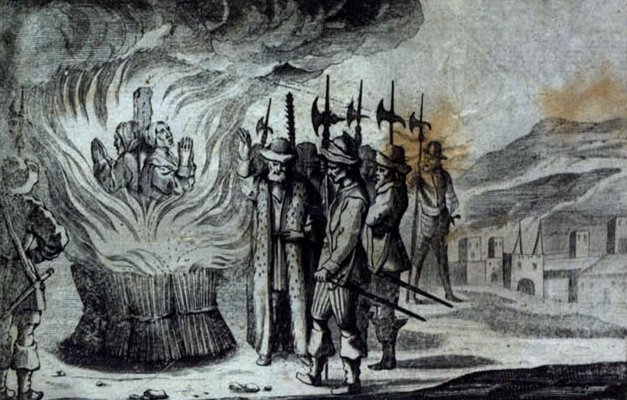
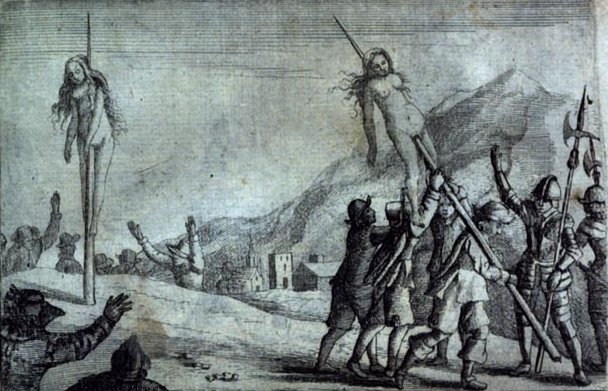
Despite making so many sad songs better, Jude was eventually martyred, possibly in Armenia, allegedly by halberd; as a consequence, that sinuous poleaxe is Jude’s iconographic symbol on the relatively rare occasions when he’s artistically depicted. It’s also something you can buy in pendant form: come on … embrace The Halberd. But again, there are different versions as to who martyred Jude and where, and considerable confusion over how many Judes those versions might be conflating.
At any rate, for those up against the executioner and despairing of any but the most improbable deliverance, St. Jude is your man.
There’s even St. Jude software which prevents execution … of rootkit exploits.
I, Francis Steinernherz, will be the first noble of my profession, where I shall have despatched one more knight of the Empire.”
“Thou hast been ever in my service, hast thou not?” demanded De Hagenbach.
“Under what other master,” replied the executioner, “could I have enjoyed such constant practice? I have executed your decrees on condemned sinners since I could swing a scourge, lift a crow-bar, or wield this trusty weapon; and who can say I even failed of my first blow, or needed to deal a second? The term of the Hospital, and his famous assistants, Petit Andre, and Trois Eschelles, are novices compared with me in the use of the noble and knightly sword. Marry, I should be ashamed to match myself with them in the field practice with bowstring and dagger, these are no feats worthy of a Christian man who would rise to honor and nobility.”
“Thou art a fellow of excellent address, and I do not deny it,” replied De Hagenbach. “But it cannot be — I trust it can — not be — that when noble blood is becoming scarce in the land, and proud churls are lording it over knights and barons, I myself should have caused so much to be spilled?”
“I will number the patients to your excellency by name and title,” said Francis, drawing out a scroll of parchment, and reading with a commentary as he went on, — ” There was Count William of Elvershoe — he was my assay-piece, a sweet youth, and died most like a Christian.”
“I remember — he was indeed a most smart youth, and courted my mistress,” said Sir Archibald.
“He died on St. Jude’s, in the year of grace 1455,” said the executioner.
One part Christianizing the pagans and two (or more) parts territorial aggrandizement, Charlemagne’s exertions on the Rhinish frontier were opposed by Widukind, or Witikind, or Widochind, whose “forest-child” name belies its owner’s legendary ferocity.
Widukind was reclaimed in the Renaissance as a patriotic or national figure. (Source)
In the summer of 782, when Charlemagne perhaps thought he had whatever passed for peace among the querulous Saxons, Widukind raised a revolt and dealt the Franks a stinging defeat that put a couple of imperial legates into the ground and made some martyrs out of clerics he found in the wrong place at the time.
Charlemagne’s forces counterattacked and routed the Saxons at the Battle of Suntel (or Sonnethal) Mountain, and thereupon
questioned the primores of the Saxons, all of whom be had summoned to attend him, as to who was responsible for the rebellion which had taken place. And since they all declared that Widukind was the author of this wickedness but were unable to deliver him up in view of the fact that he had taken himself off to the Northmen once the deed had been done, no fewer than 4500 of the others, those who had fallen in with his promptings and committed such a gross outrage, were handed over and at the place on the river Aller called Verden, at the king’s command, all beheaded in a single day. Thus was punishment executed; and the king then retired to winter-quarters at Thionville, where he celebrated both the Lord’s birthday and Easter in the customary fashion.
This merciless slaughter of prisoners is one of the lasting blights on Charlemagne’s impressive reputation. Even so, the reputation had the last word: three years later, Witikind was finally defeated and delivered up, in person, to the Frankish ruler … who accepted the Saxon pagan’s submission and forced him to convert to Christianity.
Charlemagne receives Witikind’s submission at Paderborn in 785.
On this date in 1536, Bernhard Krechting, Bernhard Knipperdolling, and Jan van Leiden were chained to stakes in the Münster public square, tortured with flesh-ripping tongs for more than an hour, killed with daggers thrust into their hearts, and their remains hoisted in cages in the city cathedral as a warning against any kindred misbehavior in the future.
Detail view (click for the full image) of Jan van Leiden et al being put to death in Münster. In the background, the Lambertuskirche spire shows the three cages in which the victims’ remains were gibbeted.
And the point was taken: the appalling deaths of these men also marked the death of early Anabaptism’s pretensions to secular political power.
These three unfortunates were the top surviving leaders of the Münster Rebellion, a revolution that turned that city into an Anabaptist commune for more than a year.
Just a few years before, southern Germany had been shaken by an apocalyptic peasant rebellion led by Thomas Muntzer, a sort of proto-Anabaptist.*
Though northern Germany was spared that particular maelstrom, that same religious tension and social discontent soon blew a hyperborean wind.
In the early 1530s, “Melchiorites” — Anabaptist followers of radical preacher Melchior Hoffman — proliferated rapidly among workers of the long-prosperous but now-waning Hanseatic territories in northern Germany and the Low Countries.
And these converts did not intend the meek example of evangelical martyrdom. They meant to rule.
In 1535, Democratic-Anabaptist types stormed the Amsterdam city hall; in a separate action, others seized and fortified a Friesland monastery before being overrun. An allied movement, less theologically distinct, won temporary control of Lübeck in 1533, before being expelled by force of arms.
Only in Münster did the Anabaptists realize the full flower of their project, albeit for a very brief period of time. Winning power over the course of the year 1533 by dint of internal politicking, energetic recruitment, and fortuitous imperial distraction, Münster Anabaptists booted out the 1% and started turning the place into a visionary “New Jerusalem.”
Among those visions, the most notorious was polygamy (pdf), introduced by Jan van Leiden when he inherited leadership after the charismatic firebrand Jan Matthys died in a sortie against a siege in April 1534. The story has it that van Leiden wanted to marry Matthys’s attractive widow Divara, though whether motivated by considerations of the loins or legitimacy is up to the reader’s good conscience.
There’s quite a controversial historiography surrounding their polygamous turn: while contemporary enemies were pleased to ascribe it to libertine devilries, German Communist intellectual Karl Kautsky vociferously defended the Münster Anabaptists — arguing that they resorted to polygamy for social stability when the gender disparity in the city had fallen past 3:1 owing to the vicissitudes of war.
And war, as Kautsky noted, was the commune of Münster’s essential condition, just like that of Paris.
Community of goods was the basis of the whole Baptist movement. For its sake the great fight was waged at Münster. It was not, however, the chief factor in determining the character of the Münster Baptist government, that factor being the siege. The town was a great war-camp; the demands of war took precedence of all other matters, and sentiments of freedom and equality were active only in so far as they were compatible with military dictatorship.
Jan van Leiden, by this time dignified the “King of Jerusalem”, was taken along with two of his chief aides and designated for this superlative punishment (many others less exalted faced less exalted executions, too).
For decades after the execution, the Anabaptists’ remains rotted publicly in cages on the tower of St. Lambert’s — like these still displayed there to this day. (cc) image from Rüdiger Wölk, Münster.
For Anabaptists as a whole this catastrophe commenced a long period of persecution and reckoning. But from such travails would the movement leave its mark. Indeed, it was also in January 1536 that a young Dutch priest named Menno Simons accepted adult baptism … and began a religious career that would make him the founding namesake of the Mennonites.
Dan Carlin’s “Hardcore History” podcast treats the Münster rebellion here.
Mikhail Yaroslavich (English Wikipedia page | the much more detailed Russian) in 1304 succeeded Alexander Nevsky’s younger brother as Grand Prince of Vladimir, a position granted by Mongolyarlyk that symbolized primacy over all other Russian knyazes. But Mikhail was challenged for leadership by his cousin, the Grand Prince of Moscow.
This fellow, Yuri(y) by name, would fight Mikhail off and on for the latter’s 14 years in power. Their personal rivalry was also the political rivalry of their respective cities, Moscow and Tver — vying for that yarlyk and, in effect, for the eventual leadership of the still-gestating Russian state.
Since it was gestating at the pleasure of the Khanate at this time, the dispute was resolved by Yuri’s getting in with the new khan, Uzbeg.* To get that yarlyk, and he got it in 1317, Yuriy even went so far as to marry one of Uzbeg’s daughters.
We mention this not because it’s a piquant period detail of kingly politics and intercultural exchange, but because the next time Mikhail and Yuriy met in battle, Mikhail won a rout … and ended up with the Mongol princess in his custody.
And then, she died in his custody.
This was a most grave development for Mikhail, almost as much as for the wife herself.
The Mongol commander whom Mikhail released — because Yuriy also got a Mongol army out of the yarlyk deal — reported the tragedy with the most incriminating coloration. While we’re in no position to assert definitively that Mikhail didn’t murder the woman, it plainly does not fit the cui bono test.
The furious Uzbeg summoned Mikhail to the Horde, a summons that, times being what they were, did not admit refusal.
When he arrived, Mikhail found himself already stitched up by the accusations of his enemies, and he was beaten and stabbed to death at the khan’s order.
Mikhail mostly reads as a garden-variety unprincipled local ruler, and he had his own conflicts with ecclesiastical leaders when they took the wrong sides in the Moscow-Tver power struggle. In spite of that, our man was posthumously expropriated by the Orthodox church as a saint.** In fact, he’s the patron saint of the city (which he’s holding, in the icon pictured above) … kind of because of what happened next.
Mikhail’s son Dmitry “the Terrible Eyes” had a terrible revenge for his father’s enemy, and murdered Yuri a few years later, temporarily gaining the yarlyk for himself. The Muscovites almost immediately recaptured the upper hand, however, and in an ensuing Tverite rising the Mongols intervened directly and sacked the city.
Tver would never again regain anything like peer status vis-a-vis Moscow, which in the following years grew larger, stronger, and wealthier under Ivan I; the Mongol yarlyk thereafter became essentially the hereditary possession of his family line. The Orthodox metropolitan outright moved to Moscow under Ivan’s reign … leaving Tver with memories of what might have been, and this monumental equestrian statue of the guy who couldn’t quite make it happen.
Although the “Tartar yoke” would eventually be thrown off, that was hardly the end for political domination in Russian history.
Experiencing a like phenomenon in altogether different circumstances, the 19th century Decembrist poet Alexander Bestuzhev, aka Marlinsky reclaims the long-ago Mikhail for an updated usage.†
His 1824 poem “Mikhail Tverskoy” (Russian link) casts the knyaz as a martyr for the Russian nation. After all, by Marlinsky’s time, the poet could take comfort that those terrible Mongols were
struck by their vassals,
[And] became their slaves‡
* Also Ozbeg or Uzbek. The longest-tenured khan in the Mongol empire’s history, Uzbeg adopted Islam and might be the namesake of the Uzbek ethnic group.
** According to this tome on the Russian church, Mikhail wasn’t really venerated as a saint until centuries after his death: only when that occurred were hagiographical details of his pious life, principled refusal to worship pagan Mongol gods, and supposed contemporary popular cult backfilled into the story.
† A maneuver quite like his friend Kondraty Ryleyev, who pulled the same trick with Severyn Nalyvaiko.
‡ Full original translation of this poem by friend of the blog Sonechka.
“Mikhail Tverskoy”
by Bestuzhev-Marlinskiy
In a dungeon, glum and hollow,
Amidst nocturnal gloom,
A darkish lampad flickers,
And shines its flimsy light
Upon two men within a shady corner:
One, in his youthful years’ prime,
The other, fettered in chains,
Adorned already with gray hair.
Why has this elder been immured
Within your walls, Abode of fear?
Is he condemned to end existence hither,
Or were the gallows meant for him?
No sighs escape his mouth,
And in his fervent eyes —
The glimmer of serenity divine.
Towards the skies his gaze is often cast,
Or with a tender sorrow, he beholds
His son, imbued with grief,
And speaks in consolation:
“Enough, my dear friend,
Of tears sousing your eyes;
The time has come for us to part,
And buy the tranquil calm of native land
with Mikhail’s head.
Be always honorable, truthful.
And, if you wish
To pay your father homage,
Relinquish all the enemies of his without vengeance …”
The people clatter at the square
In the metropolis of brutal khans,
These Russia’s fierce and evil tyrants;
They gawk with savage joy
At the cadaver, beset by wounds.
Above him, smitten by despair,
The young prince weeps,
And rips his clothes and hair,
Reproaching the Tartars and Uzbeks,
And summoning the deity of vengeance …
This mighty god has heeded prayers,
And aided Russians in revolt;
Obliterating the oppressors,
Whose city turned into the ravens’ dwelling;
Whose fields of wheat were desiccated,
Whose hand that held the arms grew weak,
Who, struck by their own vassals,
Became their slaves.
On this date in 1354, Cola di Rienzi (or Rienzo) was slain by a miserly Roman mob — rather a lynching than an execution, but by any name the tragic end to one of history’s most amazing political careers.*
“Almost the only man,” in the estimation of his admiring biographer Edward Bulwer-Lytton,** “who ever rose from the rank of a citizen to a power equal to that of monarchs without a single act of violence or treachery.”
So magnetic was that era’s revival of classical learning that young Rienzi’s plebeian parents found a way on an innkeeper’s wages to immerse the boy in Cicero, Seneca, and the rest. As Gibbon put it, “the gift of a liberal education, which they painfully bestowed, was the cause of his glory and untimely end.” (Surely this is an object lesson for present-day families contemplating the daunting cost of university education.)
And the oratorical gifts he thereby developed found ready exercise lamenting Rome’s medieval degradation.
This View of the Campo Vaccino actually dates to 1636, but you get the idea. “Campo Vaccino”: that’s “cow pasture,” also known (to you, me, and Julius Caesar) as the Roman Forum.
Rome had bled away the grandeur of its imperial past without recovering the liberty of its populace. A haughty and dissolute aristocracy tyrannized the brackish city: a brawl between rival factions took Rienzi’s own brother’s life, with no prospect of justice.
Added to this civic humiliation (though only fortuitous for Rienzi’s political opportunity), the papacy itself had decamped for its captivity in Avignon.
What to do?
How about — overthrow the bastards?
Astonishingly, for Rienzi, to dare was to do: on Pentecost in 1347, he rallied a Roman mob and proclaimed the Republic re-established — taking for himself the ancient honorific of Tribune and the real power of an autocrat. The nobility routed in disarray, or else submitted to the sudden new authority.
For the balance of the year, Rienzi’s word was law in Rome, and as a messianic, popular dictator he cleared woods of bandits, imposed the death penalty for (all) murderers, and beat the aristocracy’s re-invasion with a citizen militia. He audaciously began to resume the primacy of the caput mundi: as “Tribune”, Rienzi summoned delegations from the other Italian cities, and presumed to arbitrate the disputes of neighboring kingdoms. Audacity veered into delirium as he pressed demands on the likes of the Holy Roman Emperor. He acquired a taste for fine wine and good clothes.
“Never perhaps has the energy and effect of a single mind been more remarkably felt than in the sudden, though transient, reformation of Rome by the tribune Rienzi,” Gibbon marveled. “A den of robbers was converted to the discipline of a camp or convent: patient to hear, swift to redress, inexorable to punish, his tribunal was always accessible to the poor and stranger; nor could birth, or dignity, or the immunities of the church, protect the offender or his accomplices.”
But almost as soon as Rienzi’s republic began, the man fell: another invasion found the Roman in the street deaf to the alarm bells, and Rienzi fled.
“He was a dreamer rather than a man of action,” is the charge of the Catholic encyclopedia; excitable, injudicious, spendthrift, and prey to the “Asiatic” emoluments of his station.
This career alone would merit a remembrance, but Rienzi had a second act.
Richard Wagner’s first hit opera — though hard to come by in the wild nowadays — was Rienzi, der Letzte der Tribunen (synopsis), from a libretto based on Bulwer-Lytton’s homage.
After a long spell in exile, he was captured by the Holy Roman Emperor and transferred to the papacy, where he remained comfortably imprisoned for a couple of years. When the pontiff’s hat changed heads to Innocent VI, the latter freed the illustrious ex-Tribune and dispatched him back to Rome under the title of Senator — intending him a catspaw to re-assert the supremacy the papacy had abandoned by moving away.
Within weeks of arrival in 1354, Rienzi again made himself master of the city.
And within months thereafter, he had fallen again — to his death.
He is charged in this last term with severity (the execution of a high-born freebooter, Fra Monreale, in particular), with avarice and abuse of power and once more with political incompetence.
Gibbon claims that Rienzi “contracted the habits of intemperance and cruelty: adversity had chilled his enthusiasm, without fortifying his reason or virtue; and that youthful hope, that lively assurance, which is the pledge of success, was now succeeded by the cold impotence of distrust and despair.” We incline to prefer Bulwer-Lytton’s more generous estimation of a man who with no resource save his own brilliance twice recovered to his low-born person the tattered remnants of the purple and dared against a thousand mighty antagonists to lift it on the standard of the Gracchi. Flaws, and they fatal, he possessed in abundance: but greatness even more.
At any rate, all the scolds upon Rienzi’s imperfections were so much froth in 1354. He certainly did not succumb to the greater virtue of the polis, but merely to its shortsighted refusal to bear a levy:
it was from a gabelle on wine and salt that he fell. To preserve Rome from the tyrants it was necessary to maintain an armed force; to pay the force a tax was necessary; the tax was imposed — and the multitude joined with the tyrants, and their cry was, “Perish the traitor who has made the gabelle!” This was their only charge — this the only crime that their passions and their fury could cite against him.
Rienzi’s eloquence, so often his decisive weapon, failed to move the shortsighted mob that besieged him, and he was hauled to a platform in the Capitol where public executions had been performed at his behest. “A whole hour, without voice or motion, he stood amidst the multitude half naked and half dead: their rage was hushed into curiosity and wonder: the last feelings of reverence and compassion yet struggled in his favour; and they might have prevailed, if a bold assassin had not plunged a dagger in his breast.” (Gibbon)
If this amazing character’s contradictions seem difficult to reconcile and his actions sometimes perplexing, Bulwer-Lytton argues in Rienzi’s defense that we must view him as a complex man ultimately fired not by political ambition but by religious zealotry. One thinks of Savonarola, the prim monk who mastered Florence and perished in flames, save for the essential detail: Rienzi’s loss “was bitterly regretted … for centuries afterwards, whenever that wretched and degenerate populace dreamed of glory or sighed for justice, they recalled the bright vision of their own victim, and deplored the fate of Cola di Rienzi.”
Statue of Rienzi in Rome. (cc) image from ZeroOne.
* And surely in keeping with the time-honored way for Roman chiefs to fall.
** We’ve encountered Bulwer-Lytton glancingly in these pages; his novel Zanoni climaxes with the beheading of its fictional title character in one of the last carts of the French Revolution’s Terror, and he wrote a novel (savaged by Thackeray) about executed intellectual Eugene Aram. The “biography” in question for this piece is actually a work of historical fiction, Rienzi, Last of the Roman Tribunes; the quoted sections are from Bulwer-Lytton’s (non-fiction) afterword.
On this date in 1655, Catholic forces under the Duke of Savoy carried out a notorious massacre of Waldensians* in the Piedmont.
This interesting, excommunicate sect had persisted for centuries in those hard-to-reach places in Alpine foothills, intermittently ignored and hunted. After Martin Luther, many Protestants inclined to see them as a proto-Reformation movement, or even a counter-papal apostolic succession reaching back to ancient Christianity.
At any rate, they sure weren’t Catholic.
And our friend the Duke decided — perhaps piqued by the murder of a missionary Catholic priest, or for whatever other reason — to mount one of those heresy-extirpating sorties and make them Catholic in 1655.
On April 17, the Marquis of Pianezza appeared with an overwhelming force of mixed Piedmontese, French, and Irish** troops. They conducted a few skirmishes, then made nice with the Waldensian civic leaders and induced them to quartering their troops temporarily further to some expedient pretext.
Alas! alas! these poor people were undone. They had received under their roof the executioners of themselves and their families. The first two days, the 22d and 23d of April, passed in peace, the soldiers sitting at the same table, sleeping under the same roof, and conversing freely with their destined victims …
At last the blow fell like a thunderbolt. At four of the clock on the morning of the 24th April the signal was given from the Castle of La Torre. But who shall describe the scenes that followed? On the instant a thousand assassins began the work of death …
Little children were torn from the arms of their mothers, and dashed against the rocks; or, more horrible still, they were held betwixt two soldiers, who, unmoved by their piteous cries and the sight of their quivering limbs, tore them up into two halves. Their bodies were then thrown on the highways and the fields. Sick persons and old people, men and women, were burned alive in their own houses; some were hacked in pieces; some were bound up in the form of a ball, and precipitated over the rocks or rolled down the mountains … Some were slowly dismembered, and fire applied to the wounds to staunch the bleeding and prolong their sufferings; some were flayed alive; some roasted alive; others were disembowelled; some were horribly and shamefully mutilated, and of others the flesh and brains were boiled and actually eaten by these cannibals.
Without doubting the capacity of man’s inhumanity to man, the cannibalism charge reminds that we’re dealing with propaganda alongside historiography. And what great propaganda — like, babies-torn-from-incubators great.
Thumbnails (click for a larger, disturbing view) of selected images of this date’s atrocities from Samuel Morland’s The History of the Evangelical Churches of the Valleys of Piedmont
And there’s little doubt as to the overall savagery of the affair, which could well have become the opening salvo in a full-scale sectarian cleansing campaign. (A later addendum to Foxe’s Book of Martyrsnarrates the ensuing Piedmontese armed struggle, petering out before any definitive resolution in the field.)
Outrage at this hecatomb spread in Protestant Europe — which would also refer to the day’s doings as the “Bloody Easter,” since it corresponded with the eve of that celebration as reckoned by the Julian Calendar (source).
It was felt especially in Protectorate England, which intervened diplomatically.
A “day of solemn fasting and humiliation” was promulgated in Albion, along with collections for the relief of the survivors. Oliver Cromwell personally put £2,000 into the kitty.
More importantly, he dispatched diplomat Samuel Morland† to force the House of Savoy to lay off the persecution; in fact, he threatened to disrupt high statecraft between England and France unless the French twisted arms on behalf of the Waldensians.
Written correspondence for Morland’s diplomatic tour addressed to Louis XIV of France and various other continental potentates, as well as a fiery bit of oratory that Morland delivered to Savoy, all seem to have originated from the pen of Republican scribbler John Milton — the future author of Paradise Lost.‡
Milton, for whom the whole thing was more than just a day job, was further moved to put his umbrage at the slaughter into sonnet form:
Avenge O Lord thy slaughter’d Saints, whose bones
Lie scatter’d on the Alpine mountains cold,
Ev’n them who kept thy truth so pure of old
When all our Fathers worship’t Stocks and Stones,
Forget not: in thy book record their groanes
Who were thy Sheep and in their antient Fold
Slayn by the bloody Piemontese that roll’d
Mother with Infant down the Rocks. Their moans
The Vales redoubl’d to the Hills, and they
To Heav’n. Their martyr’d blood and ashes sow
O’re all th’ Italian fields where still doth sway
The triple Tyrant: that from these may grow
A hunder’d-fold, who having learnt thy way
Early may fly the Babylonian wo.
* The Waldensians in question here are interchangeably known as the Vaudois for their geographic region, actually above the Piedmont and abutting the Swiss region also known as Vaud. (These pages have visited the latter.)
On this date in 1868, on the eve of his rout at the hands of a British expeditionary force, the frustrated Emperor Tewodros II had hundreds of prisoners executed en masse.
Our setting is the 1868 British Expedition to Abyssinia, “one of the most expensive affairs of honour in history.” And it all got started from a bad experience with technical support.
Tewodros — generally known to the Europeans as Theodore — had risen from a humble station to the throne of Abyssinia, but by the 1860s held it but tenuously against various rival warlords. Tewodros lodged appeals for aid with a number of European powers, including the British, who evidently took the emperor’s letter for Queen Victoria and stuck it indefinitely in a file called “Pending”.
After two years without an answer, Tewodros took hostage the British consul Charles Duncan Cameron, a missionary named Henry Stern (whose unflattering report of Tewodros’s mean origins particularly enraged the monarch), and other Europeans.
Tewodros, perhaps, had depended on the notoriously treacherous Ethiopian highlands to protect him from any effective reprisal. But when the Brits decided in 1867 to let men with guns resolve the dispute, they spared no expense at all.
Months of planning and millions of pounds were poured into the operation, which landed 13,000 soldiers and 40,000 animals organized by the Bombay Army.
“For a total cost of about £9,000,000,” writes Harold Marcus in a biography of another former Tewodros hostage, the future Emperor Menelik II, “Napier set out to defeat a man who could muster only a few thousand troops and had long ago ceased to be Ethiopia’s leader in anything but title.”
The forces converged on Tewodros’s last stronghold, Magdala, with the mercurial king refusing repeated demands of the invader to release his European captives.
Angrily refusing, at least according to the accounts of the hostages who were the subject of all this … and whose accounts have just enough consciousness of the privilege their own skin has given them as they witness these bloodlettings.
On April 8, the king put to death seven of the native prisoners in his train. These prisoners comprised generally people on the political outs with Tewodros, adherents of once-rebellious chiefs and the families of those adherents. It was no mean thing to slaughter a few of them arbitrarily.
But much worse was to come the following day, when the hunted emperor espied the British advance guard reconnoitering his position.
According to a report by European hostage W.F. Prideaux in the May 21, 1868 London Times, the Emperor
had seen the British troops descending the Bashilo, and had remarked among them four elephants and some white animals, which we surmised to be Berbera sheep. A short time afterwards a friend of ours (for we had a few friends at Magdala) … implored us to keep within our tents, for the King was in a fearful passion, and was then issuing an order to kill all his native prisoners, who were confined in a few houses a couple of hundred yards off. The repeated discharge of firearms, which we heard soon afterwards, confirmed the sad story, and it was with many misgivings that we asked ourselves, “What next?” At dusk, however, the King returned, and we returned to our tents comparatively at our ease. From what I have heard it appears that the King rushed down mad with rage and arackee, and calling out one of the prisoners hacked him to pieces with his own sword. Another speedily met the same fate. The third was a boy about ten years of age. His youth and innocence (for it was his father who had been the offender) were no protection. He was mangled in the same way as the two others. The cutting and slashing went on in this manner for some time, when the King, finding this mode of execution too slow for his impatient spirit, ordered out the musketeers. The remainder were then quickly shot down, and thrown over the low cliff, the force of the shock in several cases opening the chains of the wretched victims. Those whose quivering limbs showed any signs of life were fired on from above till the murderous work was completed.
[W]e were suddenly startled by the sound of an intermittent musketry. … The rattle of musketry blended with the yells of despair, and the shouts of rage fell, however, with an ominous and appalling horror on our ears. “What is the matter?” I inquired of my neighbour. “Hist,” was the response, “the king is killing all the prisoners.” These terrible words diffused an aguish chill through my very heart. … The sun had already disappeared from the horizon, and twilight spread a dismal, dusky hue over the scene around, and still the firing continued unabated. With night it gradually diminished, and then only isolated shots reverberated across the panic-stricken camp.
The slaughter lasted about three hours, and during that interval three hundred and seven human beings* were, unwarned, and perhaps unprepared, hurled into eternity. Some of the prisoners did not unresistingly yield to their woeful doom. One, Immer Ali, a native of Ferga, near the Tzana Lake, formerly a chief of consideration in his province, in spite of hand and foot chains, with a convulsive grasp dragged his executioner towards the precipice over which he was to be hurled. The hangman, who dreaded the doom which he intended to inflict on his fellow man, shouted for help. On hearing the cry the tyrant, tiger-like, sprang forward and with his gory sword literally hacked the man to pieces.
And to hear Stern tell it, it was by dint of nothing but great fortune — or in his view, divine providence — that saved the British hostages from joining them.
One victim after another lay writhing and quivering in the last pangs at the foot of the dizzy precipice, and still the tyrant’s rage was un-appeased. “Bring the white men, and let their blood flow, mingled with that of my own subjects,” was the order that fell from his lips. Already, we were informed, whole bands of ruffians stood prepared to seize the intended prey, when several chiefs, no friends of the foreign captives, stepped forward, and requested that our execution might be deferred till next day. “Your Majesty,” they respectfully remarked, “the white men do not deserve the easy death of the sword and bullet; no, keep them till to-morrow, and then let the slow torture of a flaming hut put an end to their existence.” “You are right,” was the response.
Since the next day was Good Friday, the Christian Tewodros, “though a perfect fiend and coarse blasphemer, repaired, from a superstitious impulse, at a very early hour to church,” Stern says. The decisive British attack began later that day, and would end with the un-executed hostages liberated, and Tewodros taking his own life rather than fall captive.
* The provenance of the very precise figure of 307 is not apparent in Stern’s account; presumably, he knew through his friendly contacts (of from relieving the boredom of captivity in recreational head-counting) the overall number of prisoners beforehand.
On this date in 1582, Philippe Strozzi, the Florentine-born commander of a French naval expedition against the Spanish was summarily executed as a pirate.
The Strozzi were long one of Florence’s wealthy and powerful families, as evidenced by, say, the Strozzi Palace, or the Strozzi coat of arms on Michelangelo’s Doni Tondo.
That made the Strozzi sometime-allies, sometime-rivals* of Florence’s more famous powerbrokers, the Medici. It is in both capacities that we meet Philippe (English Wikipedia entry | Italian | French).
To cut a centuries-long story short, the Strozzi had basically come out on the wrong side of the power struggle in the 16th century.
Philippe’s father, Piero Strozzi, was the child of a Strozzi-Medici union, and Piero too married a Medici. He also fought the Medici for power and ended up in exile whereupon he gravitated to the French court of … Catherine de’ Medici. (Catherine had been educated at the home of Philippe’s grandfather, Filippo Strozzi.) Catherine then turned around and used Piero as a French Marshal, including sending him to back Tuscan city-state Siena in opposition to its (and France’s) rival, Florence.**
Your basic tangled geopolitical-genealogical web.
Bottom line, Piero’s son Philippe was born in Florence but grew up Gallic, and fought in the French army all over the continent from the time he was a teenager.
When France got involved in the War of Portuguese Succession, they put this warlike fellow aboard a boat and sent him to dispute Spanish King Philip II‘s attempt to claim the Portuguese throne and unify the Iberian peninsula.
Strozzi’s armada got its clock cleaned at the naval Battle of Ponta Delgada near the Azores, with devastating loss of life.
The Spanish galleon San Mateo, which did yeoman service at this battle.
Since Spain and France were putatively at peace, Spain treated its captives not as prisoners of war but as pirates, and proceeded to execute several hundred in Vila Franca do Campo. Strozzi didn’t even get that much ceremony, however; the day after the battle, he was mortally stabbed, then tossed into the waves.
Happily, the name and the fame of the Strozzi outlived Spanish justice. In the next century, a distant relative by the handle of Barbara Strozzi became one of the most renowned composers of Baroque vocal music. (As befits wealthy Italians of the Renaissance, the Strozzi were big on the arts; Philippe was supposed to be a fine musician himself.)
* The Strozzi-Medici conflict frames the action in the play Lorenzaccio, in which the titular Brutus-like character mulls assassinating the Medici dictator in order to restore the Republic, only to find no such restoration in the offing once he actually does the deed; the father and grandfather of our day’s protagonists are both principal characters.
On this date in 1570, Russian tsar Ivan IV Grozny — Ivan the Terrible — carried out one of his most infamous and horrible atrocities with hundreds executed on Red Square.
Ivan the Terrible, by Viktor Vasnetsov. (Cropped image; click for the full painting.)
We find ourselves in 1570 almost a quarter-century into the reign of this complicated, frightening figure. It is the oprichnina, the bloodiest spell of Ivan’s authority: years of torture, purges, and political violence vividly symbolized by the tsar’s black-clad personal Gestapo, the oprichniki.
“Children of darkness,” the exiled noble Kurbsky called these dreadful Praetorians. “Hundreds and thousands of times worse than hangmen.”
A dangerous time to draw breath, but a particularly dangerous time for any boyar, men of the feudal nobility whom Ivan set his iron hand to mastering. This, after all, was the historical task of monarchs at this time, and it was everywhere accomplished with bloodshed.
Already stung by the defection — and subsequent nasty correspondence — of one such noble, Andrei Kurbsky, Ivan was downright paranoid about disloyalty during the long-running Livonian War against Muscovy’s western neighbors, Poland, Lithuania and Sweden.
Ivan became ever readier to equate dissent with treason and to ascribe his military reverses to conspiracies on the part of his aristocratic commanders, rather than to the shortcomings of his war-machine in general. A vicious circle thus emerged – of military failures; suspected treachery; the suspects’ fear of condemnation and liquidation, and flight abroad.*
The innocent have nothing to fear!
Taking it into his head that the ancient, rival city of Novgorod — one of the cradles of Russian civilization — was scheming to deliver itself to the newly-formed Polish-Lithuanian Commonwealth, Ivan led an army there that in early 1570 massacred thousands of Novgorodians.**
He wasn’t done yet.
Returning to Moscow with his blood up, Ivan subjected his numerous Novgorodian prisoners to a savage regimen meant to uncover the extent of their nefarious doings. And it wasn’t long before the locals (who were, after all, just as suspect in Ivan’s eyes) got swept up in it, too. Politically-motivated magistrates with torture-induced confessions and denunciations did the dreadful things they always do.
This date in 1570 turned out to be the affair’s crowning carnival of barbarism.
“The Russian capital had seen many horrors in its time,” wrote Soviet-era historian A.A. Zimin (cited in this biography of Ivan IV). “But what happened in Moscow on 25 July, in all its cruelty and sadistic refinement, outdid all that had gone before and can perhaps be explained only by the cruel temperament and the sick imagination of Ivan the Terrible.”
Ivan Viskovaty (English Wikipedia link | French) had been one of Russia’s leading men on foreign affairs for a generation, as well as a longstanding ally of the tsar.
Nevertheless, he would be the first and most prominent victim on Red Square this date. Viskovaty’s rival Andrei Shchelkalov, who succeeded Viskovaty as the foreign affairs minister, neatly stitched up the senior diplomat for being in on the Novgorod “plot” as well as more exotic schemes to hand over southern cities to Turkey and the Khanate.
On July 25, in the middle of the market-place, eighteen scaffolds were erected, a number of instruments of torture were fixed in position, a large stack of wood was lighted, and over it an enormous cauldron of water was placed. Seeing these terrible preparations, the people hurried away and hid themselves wherever they could, abandoning their opened shops, their goods and their money. Soon the place was void but for the band of opritchniks gathered round the gibbets, and the blazing fire. Then was heard the sound of drums: the Tsar appeared on horseback, accompanied by his dutiful son, the boyards, some princes, and quite a legion of hangmen. Behind these came some hundreds of the condemned, many like spectres; others torn, bleeding, and so feeble they scarce could walk. Ivan halted near the scaffolds and looked around, then at once commanded the opritchniks to find where the people were and drag them into the light of day. In his impatience he even himself ran about here and there, calling the Muscovites to come forward and see the spectacle he had prepared for them, promising all who came safety and pardon. The inhabitants, fearing to disobey, crept out of their hiding-place, and, trembling with fright, stood round the scaffold. Some having climbed on to the walls, and even showing themselves on the roofs, Ivan shouted: “People, ye are about to witness executions and a massacre, but these are traitors whom I thus punish. Answer me: Is this just?” And on all sides the people shouted approval. “Long live our glorious King! Down with traitors! Goiesi, Goida!”
Ivan separated 180 of the prisoners from the crowd and pardoned them. Then the first Clerk of the Council unrolled a scroll and called upon the condemned to answer. The first to be brought before him was Viskovati, and to him he read out: “Ivan Mikhailovich, formerly a Counsellor of State, thou hast been found faithless to his Imperial Highness. Thou has written to the King Sigismund offering him Novgorod; there thy first crime!” He paused to strike Viskovati on the head, then continued reading: “And this thy second crime, not less heinous than thy first, O ungrateful and perfidious one! Thou hast written to the Sultan of Turkey, that he may take Astrakhan and Kazan,” whereupon he struck the condemned wretch twice, and continued: “Also thou hast called upon the Khan of the Krim Tartars to enter and devastate Russia:† this thy third crime.” Viskovati called God to witness that he was innocent, that he had always served faithfully his Tsar and his country: “My earthly judges will not recognize the truth; but the Heavenly Judge knows my innocence! Thou also, O Prince, thou wilt recognise it before that tribunal on high!” Here the executioners interrupted, gagging him. He was then suspended, head downwards, his clothes torn off, and, Maluta Skutarov, the first to dismount from his horse and lead the attack, cut off an ear, then, little by little, his body was hacked to pieces.
The next victim was the treasurer, Funikov-Kartsef, a friend of Viskovati, accused with him of the same treason, and as unjustly. He in his turn said to Ivan, “I pray God will give thee in eternity a fitting reward for thy actions here!” He was drenched with boiling and cold water alternately, until he expired after enduring the most horrible torments. Then others were hanged, strangled, tortured, cut to pieces, killed slowly, quickly, by whatever means fancy suggested. Ivan himself took a part, stabbing and slaying without dismounting from his horse. In four hours two hundred and been put to death, and then, the carnage over, the hangmen, their clothes covered with blood, and their gory, steaming knives in their hands, surrounded the Tsar and shouted huzzah. “Goida! Goida! Long live the Tsar! Ivan for ever! Goida! Goida!” and so shouting they went round the market-place that Ivan might examine the mutilated remains, the piled-up corpses, the actual evidences of the slaughter. Enough of bloodshed for the one day? Not a bit of it. Ivan, satiated for the moment with the slaughter, would gloat over the grief of the survivors. Wishing to see the unhapy wives of Funikov-Kartsef and of Viskovati, he forced a way into their apartments and made merry over their grief! The wife of Funikov-Kartsef he put to the torture, that he might have from her whatever treasures she possessed. Equally he wished to torture her fifteen-year-old daughter, who was groaning and lamenting at their ill fortune, but contented himself with handing her over to the by no means tender mercies of the Tsarevich Ivan. Taken afterwards to a convent, these unhappy beings shortly died of grief — it is said.
Thanks to this sort of wholesale purging, Ivan the Terrible became in the 20th century something of an allegorical shorthand for Joseph Stalin, whose ownreignofterror was a touchier subject for direct commentary. By that same token, and capturing the multifaceted meaning of the word Grozny, (both awful and awe-inspiring) Soviet patriotic mythology co-opted Ivan and his allegedly farsighted cruelty as a state- and nation-builder.
Sergei Eisenstein’s Ivan the Terrible — a planned trilogy of films of which only two were completed, due to Stalin’s distaste for his greatest director’s interpretation — captures a view of Ivan IV Grozny from the shadow of wartime Stalinist Russia. (The two extant films can be seen in their entirety on YouTube, and are well worth the watching.)
The more conventional take is that, especially by his later years, the guy’s tyrannical paranoia had metastasized enough to send him plum off his rocker. In 1581, that favorite son who had accompanied Tsar Ivan to Novgorod, and to Red Square on this date, piqued his father’s rage during an argument — and in a fury, Ivan struck him dead.
Detail view (click for the full, gorgeous canvas) of Ilya Repin‘s emotional painting of Ivan the moment after he has mortally wounded his son. Incited to his own act of lunacy by the tsar’s riveting madman expression, iconographer and Old Believer Abram Balashov slashed these faces with a knife (image) in the Tretyakov Gallery in 1913.
The capable young heir’s senseless death effectively spelled the end for Russia’s Rurikid Dynasty descended from the half-mythical Norse founder of Rus’, Rurik. That argument from order and progress in favor of Ivan’s ferocity inconveniently runs up against the fact that what he actually bequeathed to the next generations of Russians was the rudderless, war-tornTime of Troubles, when rival claimants struggled for the throne.
Ivan IV is sure to remain a controversial, compelling figure for many a year to come. Released just a few months ago as of this writing, and in a time when Ivan comparisons are coming back into vogue for the ominous contemporary Russian state, Pavel Lungin’s Tsar (review) mounts a gory critique of its subject.
* Jonathan Shepard, book review in The Historical Journal, vol. 25, no. 2 (June 1982).
** Novgorod by 1570 was not as important as it had once been, but Ivan’s sack massively depopulated the city, essentially destroying its remaining strength as an independent commercial center.
† The allied Ottoman Turks and Crimean Khanate did in fact devastate Russia (and pillage Moscow) the very next year.
By the end of Longshanks’ life, the old king was so irate at their relationship (the prince had had the temerity to request a title and castles for Gaveston) that Gaveston was booted out of the country.
(But at least he wasn’t defenestrated, the fate of the fictional Gaveston stand-in “Phillip” in Braveheart.)
Ah, the gay-baiting.
The younger Edward immediately recalled his friend when death came for Longshanks, and Gaveston was resented both by English peers and the young Queen Isabella for the favor the new king held him in.
The purported homosexual relationship between Edward II and Piers Gaveston is commonly believed* though ultimately speculative, reading between the lines of chroniclers who are sometimes bitterly hostile towards these two. “The King loved an evil male sorcerer more than he did his wife,” for instance, is a bit of propaganda — we obviously don’t believe the “sorcery” bit — and even that’s not completely explicit.
There’s a strong circumstantial interpretation to made, but since the particulars of Edward’s behavior with his favorite behind drawn tapestries are permanently unavailable to us, it will suffice us to say that this interpretation has conditioned the “Piers Gaveston” who comes to us in later centuries as a widely-credited cultural artifact.
Whether as calumny or commendation, homosexuality is the first thing everyone “knows” about Piers Gaveston, the emblem of his life and the doomed reign of his sovereign. We meet him from the other side of Stonewall, even when we meet him in Renaissance poetry or Renaissance drama.
The historical, flesh-and-blood Piers — and there’s a very thorough biography of him here** — was certainly defined by more than gay identity, real or imputed.
The personal resentment he inspired in the likes of Lancaster and Beauchamp was political, mapped onto the timeless power struggle between nobles and crown, and within the nobility itself.
The king trusted Gaveston, who was himself just the son of a knight, with plum royal assignments like governing Ireland, and Gaveston executed them effectively; with an immoderate confidence in his own considerable talents, the favorite was not above tweaking his rivals with derisive nicknames.
The Lancaster faction progressively got the upper hand on Edward and Gaveston, and with civil war brewing, they captured the hated Gascon at Scarborough Castle while Edward scrambled unavailingly to raise an army of his own.
He was held privately for nine days before Lancaster — “a sulky, quarrelsome, and vindictive man … quick to resort to violence,” by Alison Weir’s reckoning — decided he had to go. Gaveston was beheaded without color of law at Blacklow Hill near Warwick. A monument to his memory still stands there today.
Thou executioner of foule bloodie rage,
To act the will of lame decrepit age.
The grief-stricken monarch would serve his revenge upon the Earl of Lancaster ten years’ cold, beheading him for treason in 1322 upon the verdict of the man who had by then slid into Gaveston’s place in the king’s favor, Hugh Despenser.

 Possibly one of the bit players among Jesus’s original 12 apostles — “Jude”/”Judah”/”Judas” was a common name among first-century Israelites, so there’s some confusion about the identities among various texts talking about various (?) Judes — St. Jude is aptly-for-this-blog considered the patron saint of “lost causes” or “situations despaired of”.


 Mikhail Yaroslavich (