July 27th, 1794 — the 9th of Thermidor, year II — is inscribed in history as the day Robespierre fell, when a parliamentary coup d’etat between the right and the remnants of the parties he had destroyed shouted him down as he readied the National Convention for his next purge.
This scene from the multinational bicentennial epic La Revolution Francaise conflates the events of 8 Thermidor — when Robespierre delivered a menacing two-hour address but provoked outcries by failing to name the deputies he implicated in “conspiracy” — and 9 Thermidor, when Robespierre’s lieutenant Saint-Just was shouted down from the podium and Robespierre ended up staggering through the benches appealing against the imprecations of his colleagues as his arrest is decreed.
Even as the month of Thermidor’s eponymous epochal event was unfolding, the daily gears of Revolutionary justice were turning: the usual haul of unfortunates condemned, including seven women from the previous day’s batch of Saint Lazare prison conspirators who had pled their bellies to buy a day.
That day was one day too little.
Stanley Loomis is overtly hostile to the Revolution, but his middlebrow sensibilities are well-tuned for the pathos of the scene:
Indifferent to the storms that were raging in the Convention, the Revolutionary Tribunal continued to go about its implacable business with cold efficiency. The arrest of its President [the Robespierrist Rene-Francois Dumas (the link is French), who was taken in the courtroom] startled no one. Since its inception that court had been witness to too many dramas to be astonished any further. Dumas quietly departed; the trials continued. Forty-two prisoners were sentenced to death. By four o’clock their hair had been cut and they were ready to be sent on their way. But Samson, aware of disturbances in the St. Antoine quarter of the city, suggested to [prosecutor] Fouquier[-Tinville] that the executions be deferred until the morrow.*
“Justice must take its course,” snapped the Public Prosecutor. “Do your work.”
And so the last “batch” lumbered off in the direction of the Faubourg St. Antoine and the Place de la Nation. With the exception of the Princesse de Monaco, they were nearly all obscure and humble members of the petite bourgeoisie. Hanriot, waving his sabre, conducted the procession to the place of execution. By seven o’clock that evening, as the minutes of the military escort poignantly show, the unfortunate victims, who had been so close to deliverance, had all been executed.
Henriot proceeded directly from his escort service to the Convention to liberate Robespierre for the night’s brief pitched battle against the Convention, and here we take our leave of them, for now. We shall meet both of them on the scaffold tomorrow.
Not on the wagon** with the Princess of Monaco was a man whom Loomis would have pitied rather less.
The bloated, penniless 54-year-old fruit of an ancient noble house, Donatien Alphonse François de Sade, Marquis de Sade had, in the most recent chapter of his astounding career, navigated the Revolution in the improbable guise of a proletarian section head and revolutionary tribunal judge, until his own arrest late the previous year.
This day, de Sade’s name was on a list of prisoners to be seized from Madelonnettes Prison — “Sade, former count, captain of Capet’s guards in 1792, has corresponded with enemies of the republic,” it said — which he had occupied until a recent transfer to Picpus, a monastery converted into a prison adjacent to the guillotine’s place at the Place de la Nation. Whether the result of another of the many bureaucratic snafus we’ve witnessed this week or a well-placed bribe from his friend and/or mistress Marie-Constance Quesnet, the guards were in the wrong place, didn’t find him, and didn’t care to dig any further.
Three months later, he was — for the last time in his life — a free man.
One could hardly say that the Revolution made the author of Justine the man he so (in)famously was — but having lived within sight of the blade that might any day be called upon to chop off his own head, and the entire tableau of the years preceding, left their impression. Hundreds of bodies from the Terror were stuffed in the unpropitious clay of the makeshift jail’s yards under de Sade’s cell. “Those few months in the shadow of the guillotine did me more harm than all the years of my incarceration under the King,” he wrote a friend.
strangely mixing real memories with very Sadean embellishments … Plots, betrayals, denunciations, beheadings: these fictional motifs and Sadean phantasies are linked with the reality and the imaginary of the Revolution.
Good for what ails you.
* Sanson’s diaries — a memoir of the family business constructed by the famous executioner’s grandson — leave off before the events of Thermidor and suggest that the hecatombs of the Terror were taking their toll on the aging headsman. Other accounts of this day have the tumbrils stopped in the streets by clemency-inclined onlookers, only to be forcibly extricated by Henriot.
Minutes after midnight this date in 1944, four senior Wehrmacht officers who had come within an ace of murdering Adolf Hitler less than 12 hours earlier were summarily shot in Berlin — the first of thousands executed for the most famous assassination attempt on the Fuhrer.
One of those rare moments where historical epochs (arguably) turn on the minutest exigencies of chance, the so-called July 20 plot had seen Col. Claus Schenk Graf von Stauffenberg insinuate a bomb into Hitler’s conference room in modern-day eastern Poland, then fly back to Berlin to mount a coup d’etat.
Blam
Stauffenberg had every reason as he left Wolfsschanze to believe the devastating blast at 12:42 p.m. must have killed the Nazi dictator. Little did he know that another officer at the table where the high command was plotting strategy for the eastern front had, in the name of legroom, shifted the deadly satchel to the other side of a heavy oak table support — shielding Hitler from the brunt of the explosion.
Four men died. Hitler had hearing loss, an injury to his right arm, and one hell of a grudge.
Stauffenberg weaseled out of the confused bunker and flew back to Berlin, expecting that his confederates were even then launching Operation Valkyrie — a contingency plan for martial law in the case of civic disturbance that the conspirators intended to use to mount a coup.
Failure to Communicate
Control and distribution of information was not the least of the many threads in the tapestry of July 20, 1944. Hitler had risen to power on his artful grasp of propaganda; today, his headquarters’ mastery of communications would overpower the putschists’ rank amateurism.
While en route, Stauffenberg had no ability to communicate to the wider world. Landing in Berlin three hours after the not-quite-deadly-enough blast at Wolfsschanze, he must have been stunned to find that Valkyrie had not been launched. Apparently, fragmentary reports from the east were unclear as to whether Hitler had survived; everyone was reluctant about committing himself.
Frantically, Stauffenberg — already deeply committed — rallied his comrades and set the treasonable gears into motion. But by this time, communications with Hitler’s headquarters had been re-established and contradictory reports of the assassination attempt’s success were flying in Berlin. Stauffenberg’s sincere but incorrect eyewitness testimony of Hitler’s death became increasingly untenable. Compounded by the sluggish and ill-coordinated action of the conspirators, officers of a more opportunist bent soon began lining up with the bad guys.
Joseph Goebbels, the senior Nazi in Berlin and Hitler’s wizard of public relations, was inexplicably left unmolested for hours — long enough to phone the radio station (also never seized) an announcement of Hitler’s survival. “To think that these revolutionaries weren’t even smart enough to cut the telephone wires! My little daughter would have thought of that.”
Conspirators’ orders to military units around Berlin went out late, piecemeal, and far too often fell on ears already deaf to the appeals. In some cases, the proclamations that should have been queued up for inundating the airwaves instantaneously were with some other officer not on the scene, and consequently were haphazardly redrafted on the fly — for telex operators who had caught the day’s drift themselves and intentionally delayed or ignored them.
From the perspective of a radio editor it was tragic. Tragic because the way in which details were handled made it obvious that this revolt had had very lithe chance of succeeding. (Source)
The coup fell apart almost as soon as it began.
Fromm Here to Eternity
Most decisively of all, timely information had prevented any participation by Gen. Friedrich Fromm, Stauffenberg’s commanding officer and the head of the Reserve Army — it was that position that allowed his aide access to Hitler’s person, and it was under his authority that the putschists were issuing their Valkyrie orders.
Fromm fell in the “opportunist” camp, and would have been ready to strike had the Fuhrer been demonstrably killed. But a telephone connection straight from the scene of the crime assured him that Hitler had survived … and that his adjutant was a wanted man.
Fromm the potential collaborator quickly turned the tables on Stauffenberg and company late on the night of the 20th.
The Schwein Abides
Before advancing to our heroes’ foreordained fate, take a moment to appreciate this newsreel rushed into production to assure the German public that everything was under control. It’s an impressive advance on statist slick-talking from Germany’s World War I clunkers (like this):
Notice Hitler greeting Mussolini — the two had been scheduled to meet that day; it would be their last encounter in this world. His maimed right arm hanging concealed beneath a greatcoat, Hitler shakes left-handed.
Fromm … had quickly made up his mind to eliminate these men and not only to cover up the traces — for though he had refused to engage actively in the plot, he had known of it for months, sheltering the assassins and not reporting their plans — but to curry favor with Hitler as the man who put down the revolt. In the world of the Nazi gangsters it was much too late for this, but Fromm did not realize it.
He … announce[d] that “in the name of the Fuehrer” he had called a session of a “court-martial” (there is no evidence that he had) and that it had pronounced death sentences on four officers: “Colonel of the Genera Staff Mertz, General Olbricht, this colonel whose name I no longer know [Stauffenberg, his aide], and this lieutenant [Haeften].”
…
In the courtyard below in the dim rays of the blackout-hooded headlights of an Army car the four officers were quickly dispatched by a firing squad. Eyewitnesses say there was much tumult and shouting, mostly by the guards, who were in a hurry because of the danger of a bombing attack — British planes had been over Berlin almost every night that summer. Stauffenberg died crying, “Long live our sacred Germany!”
The courtyard of the Bendlerblock on modern-day Stauffenbergstrasse in Berlin, where Col. Stauffenberg and three compatriots were shot. Photo by Daniel Ullrich, licensed by CC-by-sa.
Minutes after they died, the SS arrived on the scene and forbade any further executions of potential witnesses.
Fromm’s gambit didn’t work any better than Stauffenberg’s had: he was arrested right away, and was himself later shot.
What If?
While the afternoon’s theatrics may have been doomed from the moment Hitler arose unkilled from the bomb’s debris, his miraculous escape from death — “confirmation of the task imposed upon me by Providence,” he told the nation in a radio address an hour after Stauffenberg’s execution — is an inexhaustible mine for historical hypothesizing.
That the bomb could have, and would have with the least change in the principle variables, slain the dictator is widely accepted; a 2005 reconstruction of the blast scene by the Discovery Channel supports that belief in the context of the cable-documentary-friendly format* of Adolf Hitler plus slow-mo explosives. (Parts 1, 2 and 3 of this series set up the episodes excerpted here with the plot’s historical background and the crew’s investigation into the precise dimensions of the blast space — a combination of file footage, modern recreation shots, talking heads, and tromping about the forest in the modern remains of Wolfsschanze.)
But that’s the easy what-if.
More problematic — and well into the realm of bar-stool dickering — are the questions of what would have happened if the explosive had hit its target.
Stauffenberg enjoys latter-day popularity in Germany — the street where he was shot bears his name — in no small measure because of the confessedly quixotic nature of the attempted murder. Indeed, he probably died at the height of his potential popularity for history.
But it’s not for nothing that this attempt (though it did have many botched antecedents) took place in the weeks when Germany’s military position went from desperate to disastrous. Over the preceding two months, Soviet offenses had pushed the front back to the prewar Polish border, and the Normandy landing had opened a rapidly expanding western front. The assassination had a healthy dose of self-interest … and therefore was at least potentially antithetical to other interests at play in the great conflagration.
The motivation of sparing the Fatherland the ravages of war on its own soil is not ignoble of itself, of course. But given this opposition circle’s years-long failure to take effective action against Hitler while he went from successful crime to successful crime, one might ask a little more than a late-breaking suicidal gambit for unreserved historical vindication.
The German military’s deal with the devil had seen Europe’s greatest armed forces squandered by its dumbest commander. The end result would bleed the Nazi state white at unspeakable human cost … but also, arguably, towards one of the better postwar outcomes imaginable.
And would the coup even have achieved the goal of leaving Germany unoccupied? It seems impossible to think that any outcome would have been worse than Hitler, and the last year of the war was also its bloodiest … but among the spectrum of counterfactual alternatives, the appealing possibilities mostly seem to work out in spite of the plotters, rather than because of them.
1. Civil War?
Countercoups, or even outright civil war, might very likely have erupted between rivals for succession. This might have worked out as the best-case situation — fragmenting German resistance and hastening the inevitable — but it might also have given Germany a leaner, meaner fascism with a path to enduring long-term. Predicting any particular arrangement of players to emerge from this black box is a just-so story, and any of them probably leads to one of the other three alternatives; certainly the plotters weren’t banking on their own subsequent overthrow.
2. Status Quo Ante?
The coup might have utterly failed to obtain peace. German was close to defeat; the Allies were demanding unconditional surrender, and the entire point of the plot was to surrender on better terms than that. Had no quarter been offered, the putschist government might then have fought on (either by choice, or by the compulsion of internal politics) to much the same end, although quite plausibly with much less gratuitous bloodletting in the camps. Accidentally abating the Holocaust would be a very significant plus, of course, but probably not what posterity has in mind when it goes naming streets for the man.
3. World War Against Russia?
The new government might have successfully made peace with the western Allies, which was its fervent hope. Under the circumstances of the summer of 1944, that practically implied the continuation of the global war with the capitalist and fascist powers aligning against the USSR. The horrors of the eastern front up to the summer of 1944 then would likely pale in comparison to what followed. You could tell the story so that it all works out in the end, but replacing the long Cold War with an immediate hot war, especially with the United States less than a year away from its first successful A-bomb test, isn’t exactly a presumptive improvement.
4. 1918 Redux?
In the all but unimaginable case that the post-Hitler government successfully sued for peace on both its fronts (or accepted unconditional surrender), it would have had to give up to a Soviet buffer zone much of what the Soviets ultimately conquered. Millions who died fighting for it, and millions more who died in concentration camps while the fighting played out, and millions of women raped by the conquering Red Army, would have considered that arrangement an improvement; still, the peace itself could have ensconced a less crazy and therefore more durable military dictatorship in central Europe, which wouldn’t necessarily seem like an altogether positive outcome vis-a-vis the actual postwar history. More worryingly, this might have horribly recapitulated the post-World War I scenario in which the liberal politicians who accepted defeat, and not the crazed reactionaries who caused it, were blamed for the loss, fueling the subsequent rise of some unattractive revanchist successor state. Precisely because that example would have been uppermost in the officers’ own minds, it’s hard to believe this least-bloodthirsty path would have been the actual consequence of the coup.
And so on …
Second-order effects from any of these possibilities generate a novelist’s trove of alternative histories. What would the map of eastern Europe have looked like? Whither European Jewry … and therefore the postwar state of Israel … and therefore the political chessboard in the Middle East? What would an early resolution in Europe have meant for the Pacific theater, or for the Chinese revolution? How would decolonization movements have been affected had the war concluded earlier, or had it transformed into a worldwide anti-Communist war?
Postscript
Somewhere in those alternate realities, staff at the re-education camp are bantering over happy hour about what would have happened if Stauffenberg had failed.
Who knows if “internally peacable European social democracies” are a bullet point for the pie-eyed optimists, or the incorrigible pessimists?
A few of the books about Stauffenberg and Operation Valkyrie
Poor Col. Stauffenberg is due to be played by a smirking Tom Cruise in the biopic Valkyrie, a role that has drawn some slightly overheated controversy in Germany over Cruise’s adherence to Scientology.
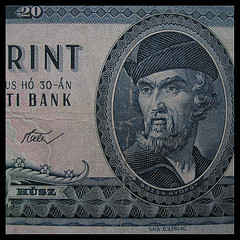
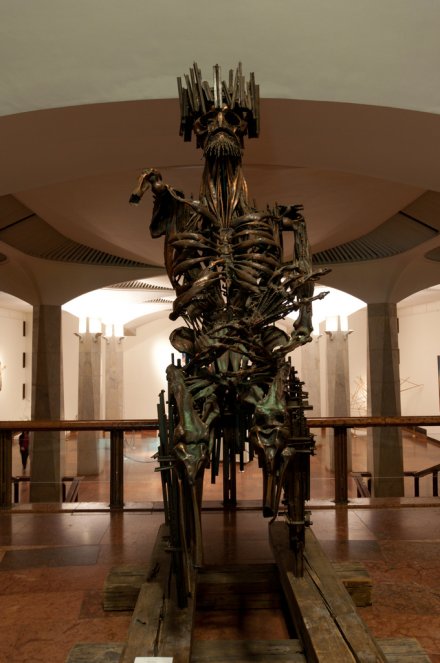
On this date in 1514, the leader of a Hungarian peasant uprising that scared the ermine robes off the feudal nobles met a punishment from the unspeakable depths of their medieval imaginations.
While Marki Sandor’s 1913 biographical treatment of this character — also rendered Georghe Doja or Dosa, or as György Székely for his native soil — is available online, it seems to be available only in Hungarian.
Since readily-accessible non-Magyar sources such as Dozsa’s Wikipedia page all appear to spring root and branch from the public domain edition of the 1911 Encyclopedia Britannica … well, who is Executed Today to buck the trend? (Some paragraph breaks added for readability.)
GYORGY DOZSA (d. 1514), Hungarian revolutionist, was a Szekler squire and soldier of fortune, who won such a reputation for valour in the Turkish wars that the Hungarian chancellor, Tamas Bakocz, on his return from Rome in 1514 with a papal bull preaching a holy war in Hungary against the Moslems, appointed him to organize and direct the movement.
In a few weeks he collected thousands of so-called Kuruczok (a corruption of Cruciati), consisting for the most part of small yeomen, peasants, wandering students, friars and parish priests, the humblest and most oppressed portion of the community, to whom alone a crusade against the Turk could have the slightest attraction.
They assembled in their counties, and by the time Dozsa had drilled them into some sort of discipline and self-confidence, they began to air the grievances of their class. No measures had been taken to supply these voluntary crusaders with food or clothing; as harvest-time approached, the landlords commanded them to return to reap the fields, and on their refusing to do so, proceeded to maltreat their wives and families and set their armed retainers upon the half-starved multitudes. Instantly the movement was diverted from its original object, and the peasants and their leaders began a war of extermination against the landlords.
By this time Dozsa was losing control of the rabble, which had fallen under the influence of the socialist parson of Czegled, Lorincz Meszaros. The rebellion was the more dangerous as the town rabble was on the side of the peasants, and in Buda and other places the cavalry sent against the Kuruczok were unhorsed as they passed through the gates. The rebellion spread like lightning, principally in the central or purely Magyar provinces, where hundreds of manor-houses and castles were burnt and thousands of the gentry done to death by impalement, crucifixion and other unspeakable methods.
Dozsa’s camp at Czegled was the centre of the jacquerie, and from thence he sent out his bands in every direction, pillaging and burning. In vain the papal bull was revoked, in vain the king issued a proclamation commanding the peasantry to return to their homes under pain of death. By this time the rising had attained the dimensions of a revolution; all the feudal levies of the kingdom were called out against it; and mercenaries were hired in haste from Venice, Bohemia and the emperor.
Meanwhile Dozsa had captured the city and fortress of Csanad, and signalized his victory by impaling the bishop and the castellan. Subsequently, at Arad, the lord treasurer, Istvan Telegdy, was seized and tortured to death with satanic ingenuity. It should, however, in fairness be added that only notorious bloodsuckers, or obstinately resisting noblemen, were destroyed in this way. Those who freely submitted were always released on parole, and Dozsa not only never broke his given word, but frequently assisted the escape of fugitives. But he could not always control his followers when their blood was up, and infinite damage was done before he could stop it.
At first, too, it seemed as if the government were incapable of coping with him.
In the course of the summer he took the fortresses of Arad, Lippa and Vilagos; provided himself with guns and trained gunners; and one of his bands advanced to within five leagues of the capital. But his halfnaked, ill-armed ploughboys were at last overmatched by the mailclad chivalry of the nobles. Dozsa, too, had become demoralized by success. After Csánad, he issued proclamations which can only be described as nihilistic. His suppression had become a political necessity.
He was finally routed at Temesvar* by the combined forces of Janos Zapolya and Istvan Bathory.
The radicalism of this revolt is not to be downplayed; Friedrich Engels’ The Peasant War in Germany, reports that Dozsa declared a republic and abolished nobility.
As with his French predecessor Guillaume Cale, his punishment would demarcate the feudal order by horrifically mocking its victim’s pretension to political authority. This description of Dozsa’s unenviable end comes from The History of Hungary and the Magyars, a 19th century text available free at Google Books, beginning with :
[After hearing his sentence, Dozsa] exclaimed — addressing the crowd whom he saw shuddering at his approaching doom — “Come back tomorrow, you miserable slaves, and see if I shrink in the midst of my sufferings! If a single groan escapes my lips, may my name be covered with eternal infamy!”
On the following day, he was placed almost naked on a burning throne, and his head was encircled by a crown of red-hot iron. Fourteen of his followers had been kept without food for several days, and were then brought into his presence, and while he was yet living the flesh was torn from his bones and cast to them that they might satiate their hunger. “To it hounds!” was his bitter exclamation, “ye are of my own rearing!”
This insurrectionist’s confrontation with backward power structures would offer plentiful fodder for those lands’ now-fallen Communist regimes; his name adorns many streets and monuments in Hungary and Romania.
However, Dozsa was well on his way into the nationalist pantheon before Communist ascendancy. Nineteenth-century composer Ferenc Erkel, for instance,** wrote an opera about him, and poet/nationalist revolutionary Petofi Sandor saluted him in verse in 1847.
* aka Timisoara — in modern-day Romania, where the execution actually took place.
** Dozsa was actually captured in a fortress constructed by John Hunyadi, whose executed son is a fellow nationalist martyr (playing for the traditional-authority team), and the subject of one of Erkel’s more famous operas.
In the small hours after midnight on the night of July 16-17 90 years ago, the former Tsar Nicholas II, his wife, children, and four family retainers, were shot in a Yekaterinburg basement by their Bolshevik jailers.
Doting family man, vacillating dictator, as weak and rich as Croesus … the doomed Emperor and Autocrat of All the Russias was a man small of stature. His reign emerged under a bad star when 1,300 Muscovites were trampled to death in the crush for his coronation largesse; 18 years later, Nicholas‘s support for Serbia against Austria-Hungary was instrumental in pitching Europe into World War I, a blunder for which he reaped a whirlwind long in the making.
When an anti-Bolshevik force approached Yekaterinburg (or Ekaterinburg), where the deposed royals had been stashed in a commandeered private residence,* Yakov Sverdlov (for whom the city was subsequently renamed) ordered the prisoners shot — not only the tsar, but his beloved wife, their hemophiliac heir, and those four daughters who had to be bayoneted because the state jewels secreted in their corsets shielded them from the gunfire.
The executioners (here’s the account of their leader; here’s another guard’s version) did their best to destroy and conceal the remains, helping fuel subsequent rumors that one of the children had survived and escaped.
Those rumors are only now, with post-Soviet investigation and DNA forensics, being debunked, and not yet to the satisfaction of all comers. This very week, Moscow affirmed (though the Orthodox church has not accepted) that the last of Nicholas’s family had been accounted for:
Modern nostalgia for this unimpressive sovereign is making a minor comeback, with Nicholas absurdly contending in a current poll for the title of “greatest Russian” … supported not only by the miseries of the state that succeeded his, but by the family’s decent and accessible private life.
Even a monarchist — especially a monarchist! — shouldn’t reason that the greatest monarch is the one who drove the bus over the cliff. But much is forgiven a martyr. Indeed, like Charles I of England, the last Romanov monarch has been posthumously saddled with divine sanction; he and all the family are certified “passion bearers”. (Update: And possible future relics!)
A handful of the many books about the Romanovs and their fall
* The Ipatiev House where the tsar was held (and shot) no longer stands. On its spot is a church consecrated five years ago yesterday to the Romanov canonization.
Update: The Romanovs were officially rehabilitated by the Russian Supreme Court on October 1, 2008.
On this date in 472, one of the last “twilight emperors” of the western Roman Empire — and the last of any conspicuous ability — was beheaded by his rebellious general Ricimer.
Here in Rome’s dying days, the dangerous, centuries-old game for the purple was played with the twist of political triangulation with barbarian kings who had set up permanent shop within the old empire’s borders.
Maybe it was his closet paganism, or his Greek patrician breeding, or the way he slung his toga — whatever it was, Anthemius didn’t have the knack for winning them over.
Born and reared in Constantinople, Anthemius was being groomed for succession in the relatively less treacherous eastern empire when his royal patron (and father-in-law) suddenly got gangrene and died.
The Alan commander who held military power in the east wasn’t into Anthemius, so he got the Al Gore treatment and Leo I got the laurels. Interestingly, although barbarian tribes were establishing themselves as the power behind the throne — and this was even more true in the west — they were not yet prepared to assert the imperial majesty in their own names. That last feeble cultural bulwark, however, would not hold out much longer.
Leo “rewarded” Anthemius for taking it all in stride by appointing him emperor of the perilous west. (He also rewarded the kingmaking barbarian chieftain by having him murdered. “Leo the Butcher,” he’s called.)
That pissed off legendary Vandal king Genseric (or Gaiseric, or Geiseric), who had sacked Rome in 455 and settled into a long career lucratively plundering the Mediterranean. And with good reason: Leo’s idea was for the two emperors jump Genseric.
Now, before this time Leo had already appointed and sent Anthemius as emperor of the west, a man of the senate of great wealth and high birth, in order that he might assist him in the Vandalic war. And yet Gaiseric kept asking and earnestly entreating that the imperial power be given to Olybrius, who was married to Placidia, the daughter of Valentinian, and on account of his relationship well-disposed toward him, and when he failed in this he was still more angry and kept plundering the whole land of the emperor. (Procopius)
That war was a debacle and left Genseric merrily raiding Italy, but Anthemius’ real problem was domestic: his new realm had its own Germanic commander who also preferred to pick his own emperors, and he took an instant dislike to the foreign ponce. Anthemius and Ricimer managed a brief detente, during which the new guy tried to take Gaul back from the Visigoths (no dice), but the two fell to fighting in 472. After a brief siege, Ricimer overran Rome and set up in Anthemius’ place that Genseric-favored Olybrius (who would last all of 39 days).
Anthemius took refuge in one of Rome’s churches — either St. Peter’s or Santa Maria in Trastevere — where he was betrayed, and beheaded by (naturally) Ricimer’s Burgundian nephew.
On a sweltering July 7, 1865, a mere 12 weeks after Abraham Lincoln was shot at Ford’s Theater, four of his assassin’s accomplices were hanged in the courtyard of the District of Columbia’s Washington Arsenal — present-day Fort McNair, and specifically its tennis courts.
Booth, on the far left, playing Marc Antony in Julius Caesar opposite his brothers. He had Brutus’ example in mind, as he wrote in his diary while on the run: “with every man’s hand against me, I am here in despair. And why? For doing what Brutus was honored for.”
The exact nature of the conspiracy against the man who had seen the North to victory in the Civil War has been debated ever since actor John Wilkes Booth lodged a ball from his one-shot Derringer behind Honest Abe’s ear. But it was a conspiracy — an astoundingly bold one.
Simultaneous with Booth’s successful attack upon Lincoln, there was an unsuccessful attempt to kill Secretary of State William Seward; it would emerge in the investigation that another man had been detailed to murder Vice President Andrew Johnson, but got drunk and chickened out. The apparent upshot: with the President and Vice President dead, new national elections would be required to replace the Senator who would become acting president — and with the Secretary of State dead too, there’d be nobody to implement them. Booth was trying to paralyze the North with its own constitutional machinery in some desperate hope of reviving the defeated South.
Ten Against D.C.
Hundreds were detained in the stunning assassination’s immediate aftermath, but ten would ultimately be the federals’ targets. A massive manhunt pursued Booth through southern Maryland and into Virginia, where he was killed in a shootout. John Surratt, who had conspired with Booth in an earlier plot to kidnap the president — that failed plot had been reconfigured into the assassination — escaped from the country.
The other eight were rounded up and stashed at the Arsenal to face a military tribunal. It was a highly controversial arrangement: the war had entered a gray area — Robert E. Lee’s surrender just days before the murder had effectively ended the war, but when the trial opened in May Confederate President Jefferson Davis was still at large, and the last Southern general wouldn’t lay down his arms until late June. The District of Columbia was still technically under martial law … so would it do to use a military court?
Military Tribunal
So the government asked itself: government, would you rather have looser evidentiary rules and a lower bar of conviction than you would have in civil court? The government duly produced for the government an opinion that the military characteristic of the assassination — that is, to help whatever southern war effort still obtained — licensed the government to use the military courts.
That didn’t sit well with everyone. One former Attorney General griped:
If the offenders are done to death by that tribunal, however truly guilty, they will pass for martyrs with half the world.
Indeed, a year later, the Supreme Court’s landmark ex parte Milligan ruling would forbid the use of military courts where civilian courts are open — which they were in Washington, D.C.
That, of course, was too late to help Booth’s comrades. It would be a military trial, with a majority vote needed for conviction and no right of appeal but to the president for the most infamous crime of the Republic. Everyone had a pretty good idea what the results would be.
Rogues’ Gallery
Two of the four today were doomed from the outset under any juridical arrangement imaginable: Lewis Powell (also known as Lewis Paine or Lewis Payne) had made the attempt on Secretary of State Seward; David Herold had guided him there with the getaway horse, and later escaped along with Booth. They were in way past their eyeballs. George Atzerodt, the schmo who couldn’t rise to the occasion of popping Andrew Johnson, looks a bit more peripheral from the distance of a century and a half, but in the weeks following the assassination he was much too close to the action to have any hope. All received death sentences.
Two others — Michael O’Laughlen and Samuel Arnold — had been involved in Booth’s earlier scheme to kidnap the president, but didn’t seem to have much to do with the murder. Still another two — Ned Spangler and Dr. Samuel Mudd* — were lesser participants. They all received long prison sentences for their pains, and the three of them still surviving were pardoned by Andrew Johnson as he left the presidency in 1869.
That left Mary Surratt, mother of the fugitive John and the only woman in the dock, the focus of attention and controversy. The 42-year-old widow owned a downtown boardinghouse, plus a tavern of sufficient importance at a Prince George’s County, Maryland, crossroads, that its community was called Surrattsville.**
The conspirators met frequently in her lodgings; Surratt maintained her innocence beyond that, but evidence and witness testimony began to pile up heavily against her … especially when Seward assailant Lewis Powell wandered into her place looking for refuge right while the police were questioning her. Booth and Herold turned out to have made a pit stop at her Surrattsville tavern to pick up a package of guns that Mary had prepared for them.
Though Surratt’s avowal of ignorance was not widely believed, a gesture of presidential mercy was anticipated — many thought (and think) she went on trial as a virtual hostage for her absconded son, who declined to take the bait. Strangely, five members of the nine-judge panel who condemned Mary Surratt turned around and asked President Johnson for clemency. Johnson claimed never to have seen the memo, but his mind seemed pretty made up — when Surratt won a habeas corpus stay on the morning of her scheduled hanging, he promptly “specially-suspended” the writ specifically to hang her:
I, Andrew Johnson, President of the United States do hereby declare that the writ of habeas corpus had been heretofore suspended in such cases as this; and I do hereby specially-suspend this writ, and direct that you proceed to execute the order heretofore given upon the judgment of the Military Commission.
Harsh treatment, and possibly well-deserved, for the first woman executed by the U.S. government. Even so, it does seem a curious thing when all is said and done that the mother of “the nest that hatched the egg” was worth a special suspension of the Great Writ, and even the stagehand who just held Booth’s horse for him caught six years, but old Jeff Davis — who apart from having figureheaded a treasonous four-year insurrection was implicated for giving Booth’s kidnapping plot official Confederate sanction — got to retire to write his memoirs.
The Surratt houses, by the way, are still standing. The Maryland tavern is kept as the Surratt House Museum by the Surratt Society. The downtown boarding house is a Chinese restaurant … marked with a plaque remembering more momentous doings than bubble tea.
* The panel voted 5-4 to hang Mudd, a Maryland doctor who not only set the leg Booth broke when he leaped onto the stage after shooting Lincoln, but then misdirected Booth’s pursuers. However, the rules for the trial said a two-thirds majority was required for execution.
** They changed the name after the unpleasantness. Today, it’s Clinton, Maryland.
On this date in 1535, Sir — later Saint — Thomas More kept his conscience at the expense of his head on Tower Hill.
For all More‘s greatness — as intellectual, polemicist, lawyer, statesman, father — none of his many gifts at the end could avail him beside his commitment to Catholicism at the dawn of the English Reformation.
Yet it is for those gifts that he cut such a commanding presence in his times, for those very reasons that his sovereign hounded his first citizen to assent to the divorce and remarriage he was fixed upon.
A devotee and friend of Erasmus from years before, More was in Henry’s more orthodox youth the king’s very scourge of Protestantism. His scatological invective against Martin Luther in Responsio ad Lutherum — much in the impolite tenor of Catholic-Protestant rhetoric continent-wide, it should be noted — is of the sort to crimson the cheeks of the milquetoast modern:
Since he has written that he already has a prior right to bespatter and besmirch the royal crown with shit, will we not have the posterior right to proclaim the beshitted tongue of this practitioner of posterioristics most fit to lick with his anterior the very posterior of a pissing she-mule until he shall have learned more correctly to infer posterior conclusions from prior premises?
Over that hairshirt, he wore the robes of state. But his engagement with the world had a selective bent that must have exasperated his colleague and predecessor as Lord Chancellor, Cardinal Wolsey. Orson Welles and Paul Scofield spar here in the definitive More hagiography A Man for All Seasons over the intellectual’s delicate refusal to dirty his gloves with the great matter of state before them — the annulment the king demanded of his marriage to the Queen (and More’s friend) Catherine of Aragon:
Peas in a pod, these two: Wolsey, the cleric grounded in realpolitik; More, the barrister who trusts to God. (More considered holy orders as a young man.)
Our man’s reputation for honesty in a den of hypocrites has certainly outrun Wolsey’s. Still, all More’s disdain for the deal-making that invests the sovereign majesty and all his foreboding for the relationship he had with his dangerous king were not quite enough to stop him accepting the Chancellorship and the opportunity to stamp out Lutheranism … knowing perfectly well the simultaneous thrust of Henry’s boudoir policy.
It all cuts quite a contrast to More’s (barely) pre-Reformation text, Utopia (available free from Project Gutenberg), which named a literary genre and described an imagined society of tolerant primitive communism that surely would have blanched at its inventor’s coming role in the state’s machinations:
I can have no other notion of all the other governments that I see or know, than that they are a conspiracy of the rich, who, on pretence of managing the public, only pursue their private ends, and devise all the ways and arts they can find out; first, that they may, without danger, preserve all that they have so ill-acquired, and then, that they may engage the poor to toil and labour for them at as low rates as possible, and oppress them as much as they please
…
[E]very man might be of what religion he pleased, and might endeavour to draw others to it by the force of argument and by amicable and modest ways, but without bitterness against those of other opinions; but that he ought to use no other force but that of persuasion, and was neither to mix with it reproaches nor violence* …
It’s not a given that More himself agrees with every (or even any) sentiment expressed in Utopia, but his most famous work’s criticism of the death penalty too liberally applied makes interesting reading.
[E]xtreme justice is an extreme injury: for we ought not to approve of those terrible laws that make the smallest offences capital … God has commanded us not to kill, and shall we kill so easily for a little money [i.e., execute petty thieves]? But if one shall say, that by that law we are only forbid to kill any except when the laws of the land allow of it, upon the same grounds, laws may be made, in some cases, to allow of adultery and perjury: for God having taken from us the right of disposing either of our own or of other people’s lives, if it is pretended that the mutual consent of men in making laws can authorise man-slaughter in cases in which God has given us no example, that it frees people from the obligation of the divine law, and so makes murder a lawful action, what is this, but to give a preference to human laws before the divine? and, if this is once admitted, by the same rule men may, in all other things, put what restrictions they please upon the laws of God.
This insistence on the supremacy of divine law over human institutions forms the basis of his objection to parliament’s overthrowing the papacy — which he expressed openly only after he was convicted by obviously perjured “jailhouse snitch” testimony
[Y]ou have no authority, without the common consent of all Christians, to make a law or Act of Parliament or Council against the union of Christendom.
Paul Scofield bears enjoying in the role in A Man for All Seasons:
More is sometimes suspected of desiring martyrdom since he marched so unerringly into it, but he also made every attempt to survive Henry’s demand the he affirm the royal remarriage and the king’s ecclesiastical supremacy by withdrawing silently from the public sphere rather than openly opposing it. More had by every account an enviable, downright happy life at his own hearth, and a tender and intellectual relationship with his favorite daughter Meg. (Meg corresponded with her father in prison, collected his works, and retrieved his head from London Bridge.)
But by his way of thinking — Meg tried to talk him out of it — he couldn’t swear to the Act of Succession acknowledging the king’s right to divorce Queen Catherine and disinherit her daughter Mary if Henry decided to force the choice. And in the king’s eyes, there was no middle ground for someone of the ex-Chancellor’s stature.
Henry could see to it, though, to cut his old friend a break and commute the sentence from drawing and quartering to “mere” beheading, here depicted in the past season of the Showtime series The Tudors.
More’s last moments as rendered here — the ironic remark at the foot of the scaffold, “See me safe up: for my coming down, I can shift for myself”;** his generous answer to the headsman’s plea for forgiveness — are well-documented. Undoubtedly, his sturdy martyr’s bearing, the extension of a life of joyful piety, helped cement for posterity the fame he held in life.
And that dying address — “I die the King’s good servant, but God’s first” — gathers in one sentiment free of bombast or self-pity the irreconcilable demands of conscience that would lead many thousands besides More to Henry VIII’s scaffolds, and rings equally true to less lethal challenges to the conscience in every land and time since.
Anne Boleyn, who caused More’s fate, shared it less than a year afterwards.
Thomas More was canonized by the Catholic Church in 1935 — the patron saint of politicians. Rather bizarrely, July 6 is also his feast day on the Anglican calendar, a tribute to the nearly universal regard his memory enjoys.
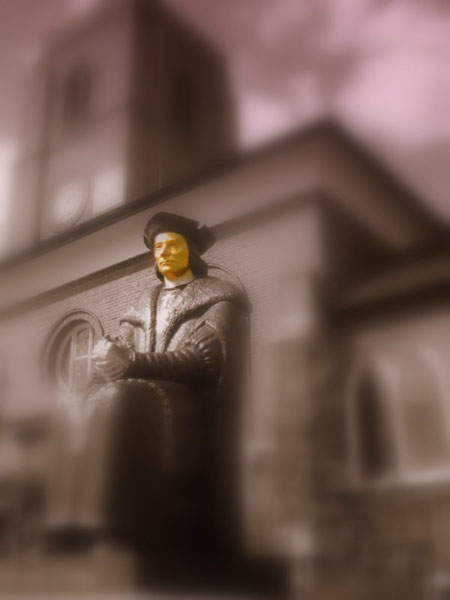
Chelsea resident Thomas More’s statue at the (Anglican) Chelsea Old Church.
* Despite its religious tolerance, More’s Utopia — anticipating Dostoyevsky — maintains:
a solemn and severe law against such as should so far degenerate from the dignity of human nature, as to think that our souls died with our bodies, or that the world was governed by chance, without a wise overruling Providence … since a man of such principles must needs, as oft as he dares do it, despise all their laws and customs: for there is no doubt to be made, that a man who is afraid of nothing but the law, and apprehends nothing after death, will not scruple to break through all the laws of his country, either by fraud or force, when by this means he may satisfy his appetites.
On this date, Antonio della Pagliara was hanged across the Tiber from the Castel Sant’Angelo in Rome for heresy.
The present-day view from the square where Paleario is thought to have been put to death, over the Ponte Sant’Angelo’s span across the Tiber to the Vatican’s imposing citadel.
Better known as Aonio Paleario (English Wikipedia entry | the considerably deeper Italian), the humanist scholar grew into his intellectual career just as Martin Luther’s doctrine was shaking Christendom.
Paleario’s positions were dangerously — and at length, fatally — close to Protestantism. He counted himself a humanist, a great admirer of Erasmus, who from the Low Countries managed to hold his critical positions without running afoul of the Catholic Church.
This would prove an increasingly difficult trick as the century unfolded … especially in the pope’s back yard.
Paleario’s most particular offenses were to take what amounts to the Lutheran side on the primacy of scriptural text over ecclesiastical tradition, and of salvation through Christ alone without the Church’s intermediation. (He also denied Purgatory.)
Since the Italian academic also cottoned to the Protestant-humanist critique of clerical corruption, he pitched Martin Luther and John Calvin on the notion of convening a Christendom-wide ecclesiastical council to reconcile competing sects. He seems to have wanted to reconcile the reformist current of humanism still within the Catholic tradition, and that of those critics who had broken, perhaps not yet irrevocably, with Rome.
The effort ultimately foundered. Instead, the curia-approved Council of Trent formulated a Roman Catholic doctrine that insured the permanent schism with Protestantism.
The Counter-Reformation was on. Still, with contending theologies — and contending polities — afoot in the Italian quiltwork plus his own towering reputation as the greatest orator in Italy, Paleario was able to find protectors and carry on. He taught in Siena, Lucca and Milan for more than three decades, surviving two bouts with the Inquisition before a Rome in crackdown mode finally pinned a heresy rap on him.
By that time, the septuagenarian didn’t much bother to fight it.
If your Eminences have so many credible witnesses against me, there is no need to give yourselves or me any further trouble … Judge, therefore, and condemn Aonio; satisfy my adversaries, and fulfil your office.
The office was fulfilled consuming the old man in flames, but they did extend the favor of hanging him (and apparently exposing the corpse for several days) first.
A book uncertainly attributed to Paleario, Beneficio di Criso (The Benefit of Christ’s Death) is available free at Google Books.
On this date in 1882, America’s weirdest assassin recited fourteen verses of the Gospel of Matthew and (sans requested orchestral accompaniment) a poem of his own composition entitled “I am Going to the Lordy,” and was hanged in the District of Columbia jail for shooting forgettable Gilded Age president James Garfield.
Mad as a march hare, Charles Julius Guiteau had irritated the obscure reaches of the Republic near four decades, trying his hand at free love, law, newspapering* and evangelism. A contemporary account of his religious flimflammery survives:
Charles J. Guiteau (if such really is his name), has fraud and imbecility plainly stamped upon his (face). (After) the impudent scoundrel talked only 15 minutes, he suddenly (thanked) the audience for their attention and (bid) them goodnight. Before the astounded 50 had recovered from their amazement…(he had taken their money and) fled from the building and escaped.
Having failed at each characteristic American monkeyshine more comprehensively than the last, he naturally gravitated to politics; while today Guiteau might tilt with his psychoses on some vituperative blog, in 1880 he published and delivered as a speech a widely-ignored crackpot encomium** for his eventual victim. Guiteau reckoned the GOP carried the 1880 elections on the strength of such rhetorical thunderbolts as “some people say he [Garfield] got badly soiled in that Credit Mobilier transaction but I guess he is clean-handed.”
Stunned that his contributions did not earn him a diplomatic posting to France, Guiteau stepped out of obscurity and into this blog’s pages by shooting the ungrateful (and unguarded) executive in the back at a Washington, D.C. train station (since demolished, and today occupied by the National Gallery of Art).
“To General Sherman: I have just shot the President. I shot him several times as I wished him to go as easily as possible. His death was a political necessity. I am a lawyer, theologian, and politician. I am a stalwart of the Stalwarts. I was with Gen. Grant, and the rest of our men in New York during the canvass. I am going to the Jail. Please order out your troops and take possession of the Jail at once. Very respectfully, Charles Guiteau.” (Click for the full image.) From the Georgetown Charles Guiteau collection.
Thoughtfully, he had already hired a cab to take him to jail, where he expected to be liberated by General William Sherman.
Malpractice
The bugger of Garfield’s assassination is that Guiteau was no better at killing presidents than he was at electing them. Despite his exultation “Arthur is President now!”, he actually inflicted what could have been a non-fatal flesh wound that through ten-thumbed medical intervention became an agonizing eighty-day Calvary for the miserable Garfield.
Doctors jabbed unwashed hands into the the wound, failing to dig out the bullet they were looking for but successfully turning the three-inch wound into a crater, puncturing Garfield’s liver, and passing him Streptococcus. Alexander Graham Bell invented a metal detector to find the missile, but the damn thing gave a bad reading … because Garfield was lying on a bed with metal springs. His doctors, feuding with one another and with the press, instituted a regimen of rectal feeding — “Nutritive enemas — consisting of beef bouillon, egg yolks, milk, whiskey, and several drops of opium … Garfield’s flatulence became intolerable,” according to one biographer — that “basically starved him to death.”† He lost 100 pounds before succumbing; the autopsy concluded that Garfield probably would have lived if not for the medical attention, which didn’t stop the doctors from submitting a sizable invoice to the feds for services rendered.
Horribly hilarious, this American Absurdistan. “Except for the dead-serious details of his assassinating President Garfield and being in all likelihood clinically insane, Charles Guiteau might be the funniest man in American History,” Sarah Vowell put it.
Guiteau’s circus trial — with the defendant constantly interrupting to harangue participants, object to his own attorneys or converse with the spectators, plus the macabre appearance of the late Garfield’s actual vertebrae (now at Washington D.C.’s National Museum of Health and Medicine) as an exhibit — was for all that a landmark test of evolving law around criminal insanity.
Just as Garfield probably would have survived his injury had he been treated by the next generation’s medical norms, Guiteau probably would have survived his brush with the law if treated by the next generation’s legal norms.
Against an almost-too-strict-to-achieve earlier bar for legal insanity, a more accommodating jurisprudential norm called the M’Naghten Rules or M’Naghten Test was even then being adopted from English courts: essentially, did the “criminal” realize his act was wrong? Still the basis for legal insanity claims in much of the U.S. today, the first trial of a presidential assassin would be the M’Naghten standard’s trial by fire.
While the judge gave ample leeway for the defense to use M’Naghten, the legal standards it implied were still not widely understood and the medical testimony about Guiteau’s mental condition was (embarrassingly, for the profession) wildly contradictory. Ultimately, the judge cued the jury that “the law requires a very slight degree of intelligence indeed” on Guiteau’s part to impute him with sufficient criminal culpability to hang. There were cheers in the courthouse when the jury took an hour to decide that Guiteau had that very slight degree of intelligence indeed.
In the final analysis, as Charles Rosenberg observes in The Trial of the Assassin Guiteau: Psychiatry and the Law in the Gilded Age, the jurors’ prompt conviction of the widely hated, barking-mad defendant underscored the real-life constraints of dry legal theory as applied by an outraged community to a notorious offender:
[T]he Guiteau case demonstrated anew that the circumstances of a particular case had ordinarily as much to do with its disposition as the precise injunctions of rules of law … Many observers agreed after the trial that if an individual of Guiteau’s marked eccentricity had killed an ordinary man … he would almost certainly not have been convicted; very likely he would not even have been brought to trial. Similarly, while Garfield lay on his sickbed, it was commonly assumed that his assailant would be institutionalized if the President should survive. But if not, then not.
Reckoning the gesture could cost him the 1884 Republican nomination, Chester A. Arthur declined to spare his “benefactor” (“Arthur has sealed his own doom and the doom of this nation,” was Guiteau’s reaction, picturing fire and brimstone) and left Guiteau to his strange and lonely fate. The latter was talked out of an early plan to go to the gallows in the Christlike garb of only his undergarments, but did insist upon delivering his incoherent parting ramble in a high-pitched childlike tone (“the idea is that of a child babbling to his mama and his papa”).
Wrapping up this surreal historical episode in a neat little bow, Charles Guiteau got his own bluegrass tune:‡
* One of Guiteau’s failed newspaper ventures was to exploit the telegraph to reprint original content from other outlets. That one looks a lot less harebrained in retrospect: it’s a primitive model of the wire service, and latterly of RSS-based distributors like Google News.
‡ The “Charles Guiteau” ditty is actually a rather shameless knock-off of a murder ballad for James Rodgers, an Irish immigrant hanged in New York in 1858.
On this date in 1979, the putschist government of Ghana shot former military rulers Frederick William Kwasi Akuffo and Akwasi Amankwaa Afrifa along with four others at the Teshie Military Range for corruption.
Twenty-two years before, Ghana had become the first black sub-Saharan former colony to gain independence, but after a 1966 coup it had staggered through political and economic chaos. Six different men had been head of state in that span, three of them deposed by coups. By 1979, General Fred Akuffo‘s government was the target of explosive anger.
Enter Flight Lieutenant Jerry Rawlings, who had actually failed in a coup attempt in May and was in line for execution himself before his mates toppled the government on June 4.
Seeking to stabilize the situation — and, Rawlings himself has said, riding the tiger of popular fury — the new government served up a few high-profile morsels on charges of pilfering the treasury in order to forestall a general slaughter of senior officers by the armed forces’ lower ranks.
There was no alternative. We had to contain it within the military so it didn’t spill into the civil front — if it had it would have been terrible.
We had no choice but to sacrifice the most senior ones — the commanders.
Another former head of state, Gen. Ignatius Kutu Acheamphong, had been shot earlier in the month; on this date, Akuffo and Gen. Akwasi Afrifa, one of the original 1966 plotters who had ruled Ghana in 1969-70, followed him. Afrifa, ironically, had written to Acheamphong worrying that political upheaval and military discipline could find them … well, where it eventually found them:
I feel greatly disturbed about the future after the government … In order to discourage the military from staging coups in the future, how about if they line all of us up and shot us one by one? I do not certainly want to be arrested, given some sort of trial and shot.
All these shootings had an unseemly character of haste and summary justice; charges against the four senior ministers* shot along with the former rulers have struck an especially sour note. Rawlings has claimed that he only wanted the two former heads of state shot and tried unsuccessfully to stop the other four executions.
I attempted to prevent it and sent an officer but the firing squad shot the officers before their commander could give the order … you must understand our country was in a state of rage then, not different from what Russia was when it had its revolution.
…
I was a partial hostage to that situation. I had no force. The authority that I enjoyed was my moral authority with the people. Their action (the execution of the senior officers by the boys) was to curtail the anger of the nation.
Rawlings would hand power over to a civilian government, which he then overthrew again in 1981 — looking like this:
He would run Ghana for the next two decades, the last eight years after winning elections. Rawlings’ legacy is much up for debate, but to many he cuts the figure of a benevolent dictator (how many former strongmen have fan pages?) whose human rights abuses were mild in the scheme of things and helped usher in a relatively prosperous and democratic Ghana that stands a very far cry from the country he took over in 1979.
Rawlings himself has graduated to a sort of global elder statesman — for instance, he recently called for fair elections in Zimbabwe. And he has not been hesitant to justify his political actions, as in this interesting BBC interview from 2005 — in which, pressed on the executions of the former state ministers, he concedes:
There were some of them who probably deserved it. Pardon me for putting it that way. There were some of them who did not — very brilliant, beautiful officers. But we had no choice but to make that sacrifice.
The bodies of all the officers executed in June of 1979 were exhumed for “fitting burial” under Rawlings’ successor in 2001.
* One of the aides held the Ghanaian high jump record at the time of his death, a mark not surpassed until 1996.

 While en route, Stauffenberg had no ability to communicate to the wider world. Landing in Berlin three hours after the not-quite-deadly-enough blast at Wolfsschanze, he must have been stunned to find that Valkyrie had not been launched. Apparently, fragmentary reports from the east were unclear as to whether Hitler had survived; everyone was reluctant about committing himself.

 [After hearing his sentence, Dozsa] exclaimed — addressing the crowd whom he saw shuddering at his approaching doom — “Come back tomorrow, you miserable slaves, and see if I shrink in the midst of my sufferings! If a single groan escapes my lips, may my name be covered with eternal infamy!”



 Mad as a march hare,


