1586: Anthony Babington and fellow plotters, Walsingham’d

The recently completed papal visit to England has summoned many a recollection of that country’s traumatic break from the Church. (As well as more recent embarrassments.)

While we know the schism from the comfort of retrospection, those present for its 16th century inception (and long afterward) had the task of sorting out winners and losers on blood-soaked scaffolds.

So we pause this date to note the extirpation September 20 and 21 of the Babington Plot, a half-baked scheme to re-establish the Old Faith that turned into one of history’s signature achievements of espionage.

Its namesake, young Sir Anthony Babington, was a secret Catholic with more money than sense; like many a Catholic of this time, he bristled under the rule of Elizabeth I, the daughter of the very woman who started all this English Reformation trouble.

Besotted with fellow-Catholic Mary Queen of Scots after having served as her page in his youth, Babington was easy prey for the fellow invariably described as Elizabeth’s “spymaster”Francis Walsingham.

Not one for scruples where his own security or his sovereign’s was concerned, Walsingham had long considered Mary Queen of Scots too dangerous to be left alive: every Catholic plot against Elizabeth intended to replace her on the throne with this Catholic cousin.

Trying to overcome Elizabeth’s reluctance to off fellow royalty — dangerous precedent, in these dangerous times — Walsingham entrapped Babington and a coterie of other Catholics into designing and documenting a scheme to assassinate Elizabeth and support a Spanish invasion.

And most importantly to Walsingham, they got Mary to sign off on it.

Though the design was grandiose, the real danger was pretty much nil — since Walsingham, a Renaissance reconnaissance man famous for his continent-spanning intelligence network, had penetrated the circle months before.* Walsingham let the conspiracy ripen long after he had the goods on the likes of Babington, intending to make it the instrument of Mary’s destruction. He succeeded.

Coded correspondence that Mary thought she was smuggling in and out of her cell was in fact being intercepted and decrypted.

When Babington wrote to her, alluding to his intent with “six noble gentlemen” to murder Queen Elizabeth, Mary doomed herself with a favorable reply:

The affair being thus prepared, and forces in readiness both within and without the realm, then shall it be time to set the six gentlemen to work; taking order upon the accomplishment of their design, I may be suddenly transported out of this place.

Within days, all — Mary, Babington, six gentlemen, and more — were in chains, and the commoners were being tortured into confessions and implications.**

The reckoning for Mary Queen of Scots would not arrive for some months yet.

But those of lesser breeding were dispatched with dispatch. Tried in two bunches, there were 14 in all condemned; on this date, Babington, was hanged, drawn and quartered for treason, along with accomplices John Ballard, Thomas Salisbury, Robert Barnewell, John Savage, Henry Donn and Chidiock Tichborne — the last of these leaving behind this doleful poetic adieu:

Elegy

My prime of youth is but a frost of cares,
My feast of joy is but a dish of pain,
My crop of corn is but a field of tares,
And all my good is but vain hope of gain;
The day is past, and yet I saw no sun,
And now I live, and now my life is done.
The spring is past, and yet it hath not sprung;
The fruit is dead, and yet the leaves be green,
My youth is gone and yet I am but young,
I saw the world and yet I was not seen;
My thread is cut and yet it is not spun,
And now I live, and now my life is done.
I sought my death and found it in my womb,
I looked for life and saw it was a shade,
I trod the earth and knew it was my tomb,
And now I die, and now I am but made;
My glass is full, and now my glass is run,
And now I live, and now my life is done.

-Chidiock Tichborne

(Hear this bummer of a verse read aloud here and here.)

The torture these first seven unfortunates endured as their entrails were ripped from their still-living bodies was so horrible that Elizabeth ordered the seven others awaiting execution the next day simply to be hanged to death before all the disemboweling business.†

A few books about spymaster Francis Walsingham

* Walsingham had plenty of plots to contend with, but did Elizabeth even greater service keeping tabs on the buildup of the Spanish Armada through a spy network in Italy — even using it to delay the invasion by a crucial extra year by drying up Spain’s credit line with Italian bankers. (Source, via (pdf))

Incidentally, and completely off topic: the subversive, forward-thinking philosopher Giordano Bruno — an Italian who was eventually executed by the Inquisition — has been alleged to be one in Walsingham’s employ.

** Luckily for Elizabeth, the treasonous Protestants who supported her back when she was at the mercy of her Catholic half-sister Mary Tudor were better able to hold their tongues under duress.

† One of those executed on September 21, Charles Tilney, has an oblique Shakespeare connection: he’s one possible author of the play Locrine, which Shakespeare might have revised and/or staged; Locrine is in the Shakespeare Apocrypha.

On this day..

1951: Antonio Riva and Ruichi Yamaguchi

On this date in 1951, the first two foreigners — Italian merchant Antonio Riva and Japanese bookseller Ruichi Yamaguchi — were convicted and immediately executed in Beijing for a supposed plot to assassinate Mao Zedong.

According to Time magazine’s coverage of the affair, Radio Peking said that

“the streets they passed through [en route to execution] were thronged with people who expressed their feelings .. . with shouts of ‘Down with imperialism! Suppress counterrevolutionaries! Long live Chairman Mao!'”


No relation.

Riva (English Wikipedia entry | Italian) was a World War I fighter ace who had relocated to Beijing/Peking in the 1920s to peddle aircraft and training the Chinese Koumintang.

(In 1936, Riva married Catherine Lum, the daughter of American wood block artist Bertha Lum and sister of Eleanor Peter Lum, who took after mom.)

When the guys those planes were being used against won the Chinese Civil War, Riva mulled an expedient departure, but reportedly declared (Spanish link) that he could do business under any regime type.

The Communist government decided he had a different sort of business in mind. Citing Chinese state media, the London Times (Aug. 18, 1951) described the plot thus:

the conspirators planned to fire mortar shells at a reviewing stand outside the Tien An gate of the forbidden city in Peking during a procession to celebrate China’s national day on October 1 last year.

Several others, both Chinese and foreigners, drew long prison sentences as part of the “conspiracy” uncovered in a one-hour trial. The most illustrious of those was the Italian bishop Tarcisio Martina.*

Though Riva and Yamaguchi were the first foreigners officially executed by the new Chinese government, they were far from the last. All the more remarkable, then, that in a country that carries out thousands of executions per annum, Antonio Riva is thought to have been the last European citizen put to death there until Akmal Shaikh in 2009.

The Shaikh case helped rekindle interest in Riva’s execution — a timely confluence, since a recent book, L’ uomo che doveva uccidere Mao, critiqued the case against the Italian aviator.

* American diplomat Col. David Barrett, safely beyond the reach of the Maoists at Formosa, was a supposed ringleader.

On this day..

1878: Max Hödel

On this date in 1878, journeyman tinsmith Max Hödel was beheaded in Berlin’s New Prison for taking a potshot at Kaiser Wilhelm I.

Nothing daunted by the prospect of trading his life for an 81-year-old* man’s, this propagandist of the deed tried to kill the conservative German emperor in May of 1878. He missed his target, but killed a bystander.

(Hodel’s cover story that he was just trying to blow his own brains out, not shoot the emperor, was belied by a number of hints he had given to others prior to the attack — e.g., telling a photographer who took his picture that the photo would soon be worth thousands.)

Just weeks after Hodel’s miss, another unsuccessful attempt to kill the emperor was undertaken by Karl Nobiling. Though Nobiling died of self-inflicted injuries, Hodel had to make do with decapitation.

Reichstag fire-like, these two outrages provided the Reich sufficient pretext to outlaw the Social Democratic Party** — even though the gunmen were much more radical types than this. (Hodel himself had previously been booted from the SDP.)

Germans having taken a front-row seat to the Paris Commune just a few years before, Chancellor Otto von Bismarck had no intention of allowing radical organizing of any variety to pick up any steam.

Coincidentally, our day’s protagonist shares an execution date with the next generation’s (better) anarchist assassin, Sante Geronimo Caserio — guillotined 16 Aug. 1894 for killing the French president.

* And he was right: nature didn’t take its course with Kaiser Wilhelm for nine more years; he missed outliving his own son and heir by a mere three months.

** Engels — writing polemically, of course — reckons over 11,000 political prisoners arrested from 1879 to 1880 alone.

On this day..

1890: Major Panitza, by Stefan Stambolov

Sophia, June 28, 1890

With reference to my telegram of this day’s date, I have the honour to report that this morning Major Panitza was conducted from his place of confinement in town to the camp of Bali Effendi, close to Sophia, where the troops are quartered for the summer, and in presence of the whole brigade drawn up in military file he was shot by a peloton of twenty-four soldiers.

Major Panitza fell uttering the cry, “Long live Bulgaria.”

After the execution, Major Marinoff, the Commandant of the Sophia garrison, addressed a short speech to the troops, in which he said that Major Panitza had met his death in just punishment for treason against his Prince and country, and that a similar fate would be dealt out to whosoever should prove a traitor to the interests of the Fatherland.

The troops maintained a perfectly impassive attitude throughout the proceedings, and the execution of the condemned in the presence of the garrison shows that the Government wished to make an example which should be a warning to the officers to refrain from the political intrigues that had during the last few years become so prevalent, and that were dangerously undermining the discipline and loyalty of the army.

British and foreign state papers, vol. 83

Having recently gained independence by backing its Slavic brethren against its longtime Ottoman master in the Russo-Turkish War, Bulgaria was enjoying all the perquisites of being a minor power pressed between major powers.

The leading concern of its able, authoritarian, and justifiably paranoid leader* Stefan Stambolov — “the only Prime Minister in Europe who receives his visitors with a revolver lying next to the ink-stand on his desk,” in the New York Times’ description — was the interest of Bulgaria’s “benefactors” in St. Petersburg in turning this breakaway Ottoman province into an ever more pliant Russian instrument.

Whether it was the coreligionists or their coin who inspired it, many in Bulgaria felt sincere loyalty to Russia; in an age of empires, it wouldn’t have been unreasonable statecraft to opt for the security of dependency.

With that object in mind, Major Panitza hatched a dangerous plot to overturn the Bulgarian government. His plot conjured an equally dangerous reprisal from Stambolov — who was determined to keep as much independence as Bulgaria could sustain.

Despite fairly widespread sympathy in the army and the populace for Panitza’s plot, and of course in the face of entreaties of Russia, Stambolov had the execution carried out with impolitic dispatch just weeks after the court-martial did its work.**

Many outside of Bulgaria saw statesmanlike quality in Stambolov, but his severe rule exemplified by his unpopular ruthlessness towards Major Panitza made him many enemies at home. Stambolov was himself assassinated shortly after resigning from government in 1895, and his corpse abused en route to its resting place.

* Generally transliterated “Stambouloff” or “Stambuloff” during his own lifetime, this gentleman got control of the state by mounting a counter-coup against a Russian putsch. Since the Russians still succeeded in definitively dethroning the sitting Bulgarian king, Stambolov’s hand alone guided the unsteady Bulgarian ship of state for a time.

Stambolov eventually installed an Austro-Hungarian noble as Prince Ferdinand I (the two came to hate each other). Later titled “tsar”, Ferdinand was the grandfather of Simeon II, who achieved the unusual distinction of becoming Prime Minister of Bulgaria through democratic election in 2001.

** Panitza’s co-conspirators got various prison terms, including the former Commandant of the Sofia garrison, a gentleman sporting the Strangelovian moniker Lieutenant-Colonel Kissoff.

On this day..

1906: Ivan Kalyayev, moralistic assassin

On this date* in 1906, Ivan Kalyayev (also transliterated Kaliayev, or Kaliaev) was hanged by his own assent for assassinating Grand Duke Sergei Alexandrovich in Moscow.

The Warsaw-born Kalyayev tread the usual path of student radicals — expulsion, arrest, internal exile — into the camp of the Socialist-Revolutionary Party and the trendy propaganda-of-the-deed philosophy.

He was the very epitome there of what Chaliand and Blin call “the moralistic approach to terrorism”; he would slay, of course, from a profound sense of moral outrage, but contextualized that terrible act with a no less dramatic sense of personal moral responsibility.

Revolutionary fellow-traveler Boris Savinkov remembered** of our day’s principal that he

loved the revolution with the tender, profound love felt for it only by those who have made it an offering of the whole of their lives.

Kalyayev voluntarily aborted his first attempt to murder the Grand Duke when he beheld his target’s wife and child riding along in the carriage where he meant to toss his bomb. Upon successfully carrying out the hit two days later, he made no attempt to flee, and at trial requested the death sentence for himself.†

In this behavior, Kalyayev presents the fascinating specter of a terrorist whose certainty of the justice of his crime does not excuse himself from moral responsibility for the crime.

For Kalyayev, the murder itself and its mortal expiation completed its own redemptive cycle. As the murderer wrote to his mother,

I am happy to know I acted in obedience to the call of my duty … It would be ridiculous to think of saving my life now, when my end makes me so happy. I refused to sign the petition for pardon, and you know why. It was not because I have spent all my physical and mental powers; on the contrary, I have preserved all that life gave me for my last triumph in death … I could not accept pardon because it is against my convictions.

This striking attitude recommended him to Camus, who featured it in Les Justes (The Just Assassins), a 1949 play exploring the morality of terrorism.

The second act of the play features Kalyayev’s revolutionary cell disputing his decision not to follow through on his first opportunity to kill the Grand Duke. Ignacio Gotz describes our killer’s posture as, “kill only when absolutely necessary and then accept your own death as proof that murder is not permitted.”

That’s what love is — giving everything, sacrificing everything, without any hope of it being returned.

-The character Ivan Kalyayev, in Les Justes

This was not the only ethos competing for purchase on the story and the soul of Ivan Kalyayev.

The widowed Grand Duchess Elizabeth Fyodorovna visited her husband’s assassin in prison and unavailingly attempted to convert him to Orthodox Christianity. (The Grand Duchess would take her own solace in a religious life, ultimately being martyred by the Bolsheviks during the Russian Civil War; she has since been canonized.)

The Russian paper Novaya Gazeta published a fairly lengthy Russian-language biography of Kalyayev on the centennial of his entry into the executioner’s annals.

* May 23 was the Gregorian date of the execution; it was May 10 by the Julian calendar still in use in Russia at the time.

** Cited in The History of Terrorism: From Antiquity to Al Qaeda.

† With the requisite grandstanding, of course — a moral indictment given added depth by Kalyayev’s personal conduct.

We are separated by mountains of corpses, by hundreds of thousands of broken lives, by an ocean of tears and blood that is flooding the entire country in a torrent of outrage and horror. You have declared war on the people. We have taken up the challenge … You are prepared to say that there are two moralities, one for mere mortals, stating, “Thou shalt not kill; thou shalt not steal,” and another, political, morality for the rulers, for whom it permits everything.

On this day..

1792: Jacob Johan Anckarström, assassin of Gustav III

On this date in 1792, Jacob Johan Anckarström lost his right hand and his center head for murdering Gustav III.

Like some other nobles, this officer considered the “theater king” and enlightened despot Gustav III a, well, despot.
Times being what they were, regicide was in order, to usher in an age of constitutional liberalism.

A conspiracy of Swedish nobles surrounded the royal victim at a masquerade ball on March 16, 1792, and shot him in the back. Alas for them, the scene was immediately sealed and the attendees unmasked before the gang could get away.

Although in the confusion nobody knew whodunit among those disguised revelers, it was only a matter of time before the discarded murder weapon was identified as Anckarström’s.

(Actually, it was a much longer matter of time before it became a “murder” weapon. The king only succumbed to the infection 13 days later.)

Five were condemned to death, but the four who hadn’t pulled the trigger were commuted to exile instead. Exile for regicide? Maybe that’s making you wonder why they all thought it was such an oppressive regime they all lived under.

Jacob Johan Anckarström could give them the answer. He was said to have met his beheading joyfully, which would only be natural after he’d been flogged in chains in three different parts of the city over the preceding three days.*

For readers of Swedish (or exploiters of online translation), there’s much more about Jacob and his dastardly plot here and here.

Appropriately, given the murder’s stagey venue, the Anckarstrom assassination was great performance art material in the 19th century. Verdi based Un Ballo in Maschera on it, although he’s given the principals a generic love-triangle relationship — and because of mid-19th century censorship, the iteration of it below is set in colonial Boston with “Anckarstrom” sporting the very New England name “Rennato”.

Although this particular plot didn’t achieve the revolutionary thing its authors intended, it didn’t have the opposite effect either. The king’s teenage son Gustav IV Adolf succeeded the throne, with an unsurprising hatred of Jacobinism. But in the tumult of the Napoleonic Wars (that also cost Sweden its dominion over Finland), Gustav IV was deposed and a liberal constitution adopted.

* He wasn’t handled with kid gloves in prison, either, but you can take in the scene over the libation of your choice at the present-day cafe that occupies Anckarstrom’s onetime dungeon. The joint is named for another Swedish political martyr, Sten Sture.

On this day..

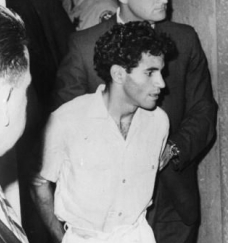
1969: Sirhan Sirhan condemned

On this date in 1969, Sirhan Sirhan was condemned to the California gas chamber for assassinating Robert F. Kennedy.

The aggrieved Palestinian was not marked by fate to suffer that last extremity of the law, however; instead, his sentence was commuted to life imprisonment when all existing death penalty statutes were invalidated in 1972.*

As a result, Sirhan Sirhan remains alive as of this writing, serving that sentence in the Golden State’s Pleasant Valley State Prison. He’ll be next up for parole in 2011.

(In a parole appeal back in 1982 — he’s been on a bit of a losing streak — the convicted assassin had the chutzpah to complain that “if Robert Kennedy were alive today, I believe he would not countenance singling me out for this kind of treatment.”)

Although the guy was seen in a crowded room pulling the trigger (onlookers tackled him) and he subsequently confessed to the deed, there has long been a conspiratorial counternarrative suggesting that other shooters were there, too. It’s pretty hard to say that the guy who emptied his chamber in front of dozens of witnesses wasn’t involved, but there are versions of this where he’s a Manchurian Candidate-style hypnotized patsy.

Politics: much more interesting in the 1960s.

Precisely because that is so, this particular man’s crime attracts retrospective interest for what followed: the charismatic Democratic frontrunner from Camelot cut down; the sinister Richard Nixon arising in his place to bomb Cambodia, burgle Watergate, and create the Environmental Protection Agency. Sirhan Sirhan “assassinated modern U.S. history.”

That really seems a bit much.

Sirhan Sirhan himself has contributed to the trippy theorizing about his case by being all over the map on it. At one point, he attempted to plead guilty and draw the death penalty; the trial judge forced him to go through with a defense. Subsequently, as noted, he’s whinged for an early release. He’s claimed to have had no memory of the attack, which certainly isn’t what he said after he got arrested.

Ultimately, the most self-evident explanation has always been the first one that he offered: “I did it for my country.”

Sirhan was a Jerusalem-born Palestinian dismayed by Israel’s success in the Six-Day War, and by America’s concomitant foreign policy tilt towards Israel.

Kennedy was a strong advocate of that policy, and his death happened to coincide with the anniversary of war.

Maybe that’s just what they want you to think. But it has to be allowed that the cause in question has claimed more lives than just RFK’s.

* People v. Anderson, decided by the California Supreme Court. Later that same year, the U.S. Supreme Court would issue Furman v. Georgia, which would have had the same effect for Sirhan Sirhan.

On this day..

1910: Ahn Jung-geun, Korean nationalist

A century go today, Korean independence martyr Ahn Jung-geun (or An Jung-geun) hanged at Port Arthur for assassinating Japanese statesman Ito Hirobumi.

Ahn Jung-geun, who was also a skilled calligrapher (his epigram, “Unless reading everyday, thorns grow in the mouth” is well-known in Korea), actually had a more visionary pan-Asianist agenda than his nationalist byline might initially suggest.
But he militantly opposed Japan’s annexation of the peninsula, and won his hero stature for gunning down Ito in Manchuria.

Ito, for his part, is a national hero in Japan for establishing that country’s parliamentary government and serving as its first Prime Minister.

So, yeah. Still a spot of tension over this incident.

Because the Japanese worried that “if Ahn Jung-geun’s body is handed over to the surviving family or impudent Koreans … it will not be good in the future,” its ultimate deposition has become an enduring historical mystery, with China the current likely suspect. Koreans’ intensified hunt for records pointing to Ahn’s grave has been much in the news during the centennial run-up.

Wherever his bones rest, the Korean patriot (as the saying has it) lives on. He’s even been posthumously promoted by the South Korean army to the rank of “General”.

The recent Korean film 2009 Lost Memories is premised on an radically different alternate timeline starting when Ahn is prevented from killing Ito. Here’s its aesthetically appealing climax, when history is righted.

Scrabbel put the Ahn Jung-geun story to music.

On this day..

1623: Amboyna Massacre

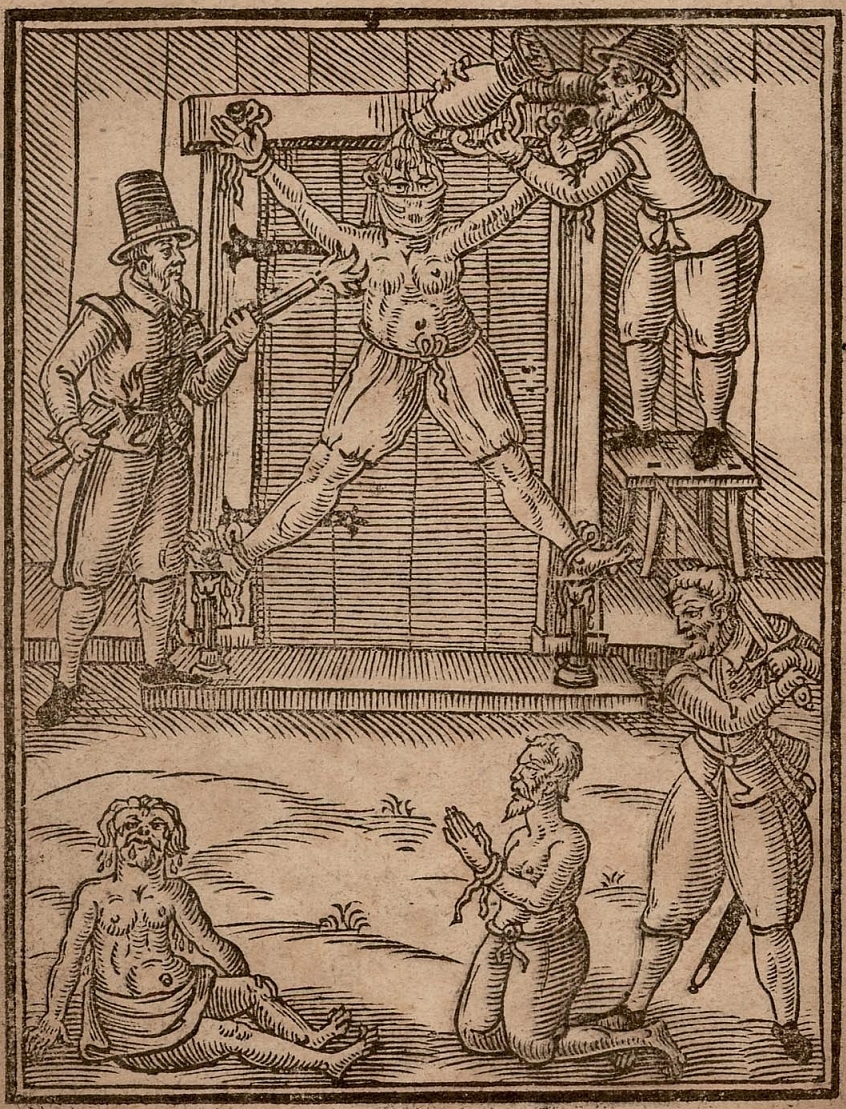
On February 27,* 1623, the Dutch East India Company beheaded twenty who had been waterboarded into confessing to a terrorist plot.

English prisoner suffering “waterboarding” faux-drowning torture, published under the name “A true relation of the unjust, cruell, and barbarous proceedings against the English at Amboyna in the East-Indies 1624”.

The torturers “poured the water softly upon his head until the cloth [wrapping his head] was full, up to the mouth and nostrils, and somewhat higher, so that he could not draw breath but he must suck in all the water.” More nasty description.

(cc) Image from Flickr | BiblioOdyssey

Posh Spice

As in modern times, this scenario originated with resource competition in the Muslim world … in this case, competition for spice, in Indonesia.

European colonialism had pitted the Dutch East India Company against its British counterpart on the archipelago, both scrabbling after the lucrative trade in cloves and pepper, with garnishes of nutmeg, cinnamon, mace, and ginger.

The two rival powers had, as we lay our story, recently come to a tense truce, dividing the commerce between them — and swapping mutual accusations of violating that pact. The arrangement basically gave the Dutch a bigger slice of the pie, so we’ll find them when the cloves hit the fan having the balance of power on their side.

Terrorists

We’re going to oversimplify to set the scene.

On Ambon Island, one of the very “Spice Islands” (i.e., the Moluccas) — at the Dutch-controlled fortification of a trading post also shared by the English — the Dutch merchant-governor Herman van Speult heard that a Japanese mercenary had asked about the Dutch fortifications.

The security-conscious van Speult ordered that unfortunate soldier interrogated under torture.

As tends to happen when the interrogators in such a case are convinced of a ticking time bomb situation, the torture uncovered a ticking time bomb situation.

The mercenary got the Dutch to stop burning and drowning him by “revealing” a highly implausible** English plot to seize the Dutch fort, with 20 guys or so and no prospect of imminent outside aid. Wouldn’t you know it: when the supposed confederates named by the mercenary were similarly tortured, they too admitted the plot. Van Speult’s English opposite number, Gabriel Towerson, was one of them.

The Amboyna Massacre followed anon, with Towerson and nine other British East India Company employees beheaded, along with nine Japanese mercenaries and one Portuguese. (The latter ten worked for the Dutch East India Company, not the British. A fifth column!)

They went to their deaths protesting their innocence, and many smuggled out written recantations to that same effect: “tortured … with that extream Torment of Fire and water, that Flesh and Blood could not endure it, and we take it upon our Salvation, that they have put us to Death Guiltless.”

Anger in the English Street

That last quote comes from Karen Chance, “The Amboyna Massacre in English Politics, 1624-1632,” in Albion: A Quarterly Journal Concerned with British Studies (Winter 1998).

As the title of that piece suggests, the Amboyna Massacre outraged Towerson’s countrymen and -women once word finally made it back to the mothership. (In addition to the torture/wrongful execution dimension, the legal authority of the Dutch trading concern to impose judicial punishment on their English counterparts was questionable at best.)

English demands for satisfaction against the perpetrators continued to complicate Dutch-English relations into the reign of Charles I and beyond. Even Oliver Cromwell required, as the price of peace for the First Anglo-Dutch War in the 1650s, punishment of any surviving offenders. (Which was apparently nobody at all.)

And still later, the burgeoning British Empire’s propaganda arm reached for the Amboyna narrative to justify seizing New Amsterdam on the grounds that the Dutch had attempted to spring a massacre on English settlers — “their Amboyna treacherous Cruelty extended itself from the East to the West Indies, and pursued thus the straight channel of Dutch blood”.

As for the trade-jockeying: the Netherlands’ commanding position in Indonesia ultimately squeezed the English out.** But don’t fret for Old Blighty: she turned attention to gobbling up India, and made a lot more bank than did the Dutch spice racket.

* February 27 was the date according to the Julian calendar in use at this time by the British. By the Gregorian calendar the Dutch were using, the massacre took place on March 9.

** For more on both the fanciful nature of the supposed plot, and the economics of the East Indies trade as it unfolded in the 17th century, see D.K. Bassett, “The ‘Amboyna Massacre’ of 1623”, Journal of Southeast Asian History, September 1960.

On this day..

1880: Ippolit Mlodetsky, Loris-Melikov’s would-be assassin

If you were a person of any privilege or official authority in late 19th century Russia, chances are that Narodnaya Volya was planning to take a shot at you.

If you were General Loris-Melikov, a Ukrainian Jew did that to you two days before this date in 1880.*

And if you were that errant assassin, Ippolit Mlodetsky, this was your execution date.

Even though Melikov rated as something of a liberal on the Russian autocracy spectrum, he had no qualms about ordering legal proceedings barely this side of summary.

Gen. Melikoff, on Wednesday evening, ordered a court-martial to assemble on Thursday morning. The trial of the prisoner was opened at 11 o’clock in the morning. The prisoner was insolent in his language and demeanor, and refused to stand up or take any part in the proceedings. He said he had nothing to add … that he did not want to be troubled any more, and wanted the matter finished. … at 1 o’clock … judgment was pronounced against him. The judgment on the prisoner sentenced him to be hanged, and his execution was appointed for 10 o’clock this (Friday) morning on the Simeonofsky Plain, near the Tsarskoe-selo Railway terminus.

And so he was.

Mlodetsky’s public hanging was witnessed by novelist Fyodor Dostoyevsky in the very square where Dostoyevsky himself had faced mock-execution for revolutionary activity 30 years before.

Dostoyevsky was, even then, pulling together his magnum opus, The Brothers Karamazov.

The very day Mlodetsky tried to kill Melikov found Fyodor Mikhailovich chatting with fellow reactionary journalist Aleksey Suvorin about the plague of terrorism and its accompanying social malaise.

On the day of the attempt by Mlodetsky on Loris Melikov I was with F. M. Dostoyevsky.

… Neither he nor I knew anything about the assassination. But our conversation presently turned to political crimes in general, and a [recent] explosion in the Winter Palace in particular. In the course of talking about this, Dostoyevsky commented on the odd attitude of the public to these crimes. Society seemed to sympathize with them, or, it might be truer to say, was not too clear about how to look upon them … (Quoted here.)

Dostoyevsky in this conversation revealed that for the planned sequel to The Brothers Karamazov — never to be realized in the event —

he was going to write a novel with Alyosha Karamazov as the hero. He planned to bring him out of the monastery and make a revolutionary of him. He would commit a political crime. He would be executed.

(Much more about this sequel in this paper.)

Melikov’s brush with death did not dissuade him from continuing to push for constitutional reforms as the antidote to terrorism, including introduction of a parliament. Tsar Alexander II was on the point of implementing that proposal … when he himself was assassinated by Narodnaya Volya, precipitating a political backlash.

That murder of Alexander II helped put the kibosh on the Karamazov sequel, which would thereafter have become politically problematic.

Nor was that the only artistic casualty of the Russian terrorists.

A discomfiting thematic similarity in Mlodetsky’s execution with that of the protagonist resulted in the cancellation of a just-opened opera: The Merchant Kalashnikov. (It would be a few more decades before that connection could appear ironic.)

* The assassination attempt occurred on February 20, with the execution on February 22, according to the Julian calendar still in use in Russia at that time. By the then-12-days-later Gregorian calendar, the dates were March 3 and March 5, respectively.

On this day..