1597: Severyn Nalyvaiko

On this date in 1597, Cossack Severyn Nalyvaiko was publicly quartered in Warsaw.

Nalyvaiko organized “unregistered” Cossacks in Poland’s eastern realms, modern-day Belarus and Ukraine, into what became a significant rebellion. (Poland’s efforts to “register” and thereby control Cossacks would continue to cause tension in the years ahead.)

The Poles outmuscled him, and here he is.

However, because longer-term historical trends were not so favorable to the Polish-Lithuanian Commonwealth, Nalyvaiko rates a place as an early independence martyr for (east) Slavic resistance to Warsaw’s Polish imperialism.

Not only does he get a spot on present-day Ukrainian coinage (as pictured); 19th century Russian poet Kondraty Ryleyev, who would himself be executed for his part in the Decembrist plot, lyricized Nalyvaiko’s death as heroic national sacrifice … and simultaneously elevated the poet’s own prophesied fate for himself.

“In Ryleyev’s poetry, fate — romantic fate — is not simply personal and individual,” writes Lauren Leighton. “The fate of his heroes, and so his own fate, is raised to the level of national-historical tragedy. By welcoming his fate and dying for his land, Nalivayko ennobles his people.”


“Nalyvaiko”

Say not, thou holy man, again
That this is sin, thy words are vain,
Be it a fearful mortal sin
Worse than all crimes that e’er have been,
I care not — for could I but see
My native land at liberty,
Could I but see my race restored
To freedom from the foreign horde,
All sins would I upon me take
Without one sigh for Russia’s sake. —
The crimes of all the Tartar race,
The apostates Uniates‘ treason base,
The sins of every Jew and Pole —
All would I take upon my soul.
Try not with threats my mind to shake,
Persuasive words no change can make,
For hell to me is to have viewed
My loved Ukraine in servitude;
To see my fatherland set free,
This, this alone, is heaven for me!

E’en from the cradle was my breast
With love of liberty possessed;
My mother sang me glorious lays
Of those long-past historic days,
Whose memory yet lives ‘mongst men,
For no fear seized on Russians then,
None cringed before the haughty Pole;
The iron of a foreign yoke
Weighed upon no free Russian’s soul,
None cowered beneath a stranger’s stroke;
Cossacks were then the Pole’s allies,
Bound each to each in equal ties,
Such as free men would well beseem —
Now all is vanished like a dream.
Cossacks long since had learned to know
How into tyrants friends may grow;
The Lithuanian, and the Jew,
The Pole, and all the Uniate crew,
Like ravening crows around their prey
Seize us, and tear our limbs away.
The voice of law no more is heard
In Warsaw’s city, none are stirred
At hearing all a nation’s wail,
Our mourning voices nought avail,
And now within me burns a flame
Of hatred for the Polish name —
A fierce hot flame of raging fire —
My look is wild with passion dire
And frenzied wrath; the soul in me
Sickens for love of liberty.
One thought have I by night and day,
Which like a shadow haunts my way,
E’en where the steppes lie silent, bare,
Unresting it pursues me there;
E’en in the soldier’s camp, and when
The battle’s whirl, and tramp of men,
Around me roar with maddening rush,
I hear it still, and in the hush
Of the still church’s vaulted gloom,
Sound in my ears the words of doom
“‘Tis time,” the holy accents say,
“‘Tis time to sweep the foes away,
“O’er the Ukraine who bear their sway.”
I know full well the direful fate
Which must upon the patriot wait
Who first dare rise against the foe
And at the tyrant aim the blow.
This is my destined fate — but say
When, when has freedom won her way
Without the blood of martyrs shed,
When none for liberty have bled?
My coming doom I feel and know
And bless the stroke which lays me low
And, father, now with joy I meet
My death, to me such end is sweet.

On this day..

1782: Captain Joshua Huddy

On this date in 1782, Captain Joshua Huddy of the revolutionary New Jersey patriot militia was summarily (and extrajudicially) hanged on the New Jersey coast by the British Tories.

Huddy was a troublesome rascal in civilian life, a regular denizen of courts in his native Salem, Mass., and (upon transplant in 1778) Monmouth County, N.J.

Tory British Loyalists found him troublesome in the bare-knuckled revolutionary conflict in Monmouth, “often engaged in raids and revenge executions, which continued even after the war’s end.”

Huddy mounted various guerrilla raids in the area from 1779; his Loyalist opposite number actually captured him in 1780, but Huddy was freed by his comrades before he could be taken to the British.

Not so lucky this time.

On March 24, 1782, Loyalists overwhelmed Huddy’s fort at Toms River, N.J..

This was, de facto if not de jure, within the compass of those raids occurring after the war’s end, since at five months after Yorktown, the American Revolution was settled in all but name.

Huddy figured to be exchanged for Loyalist prisoners, but word came that a Monmouth County Tory named Philip White had been killed.

The last English royal governor of New Jersey, William Franklin,* ordered Huddy’s execution in retaliation-slash-punishment without any form of court-martial. (It seems the Loyalist position was that Huddy had himself been involved in White’s death; the Patriots insisted that Huddy was already in British hands when White was killed.)

A note was found pinned to Huddy’s body, reading,

We the refugees, having with grief long beheld the cruel murders of our brethern, and finding nothing but such measures daily carrying into execution — we, therefore, determine not to suffer without taking vengeance for the numerous cruelties; and thus begin, and, I say, may those lose their liberty who do not follow on, and have made use of Captain Huddy as the first object to present to your view; and further determine to hang man for man while there is a refugee existing. Up goes Huddy for Philip White.

(Two other prisoners taken with Huddy were exchanged, and had the story to tell — including Huddy’s remark that he would “dye innocent and in a good cause.”)

This, of course, caused quite a hue and cry for vengeance on the Patriot side.

George Washington demanded Huddy’s executioner for a bit of tit-for-tat, but although the British repudiated the lawless hanging, they refused to give Washington his man. Richard Lippencott (or Lippincott) instead got a British trial in New York, skated on an only-following-orders defense, and subsequently retired to Canada to live to the ripe old age of 81.

The frustrated proto-Americans resorted to selecting a captured Yorktown officer by lot for a reprisal execution.

This lottery was “won” by the young British officer Charles Asgill, who stood for some months in danger of a politically awkward hanging even as the sides maneuvered towards the official end of the war.

Since Asgill turned out to be a charismatic, youthful officer of unblemished honor, nobody felt good about the situation; even Huddy’s widow asked for Asgill’s life to be spared. (Though that might also be because Huddy stiffed her in the will he scribbled out moments before death, written on the head of the barrel they used to hang him.)

Eventually, pressure from the Revolution’s French patrons — the hostage had a Huguenot mother — helped Asgill avoid hanging.**

Returned to the British, Asgill went on to become a very prominent general.

Nobody ever expiated Captain Joshua Huddy’s hanging.


Memorial for Joshua Huddy at Huddy Park in Highlands, N.J. Image (c) Sheena Chi and used with permission.

* Son of American patriotic luminary Benjamin Franklin. This is why you don’t talk politics with family.

** Upon his release from American custody, Asgill traveled to France to thank personally his royal saviors. Louis XVI and Marie Antoinette could hardly have imagined that they would one day soon stand in Huddy’s shoes.

On this day..

1554: Thomas Wyatt the Younger, with the Queen’s life in his hands

On this date in 1554, rebel leader Thomas Wyatt the Younger tied on his own blindfold and laid his head on the block, having declared that not “any other now in your durance [i.e., the Tower] was privy to my rising”.

That remark exculpated the Princess Elizabeth, who just days before had been ominously rowed to the Tower on suspicion of having known of or involved herself in Wyatt‘s abortive revolt.

And Wyatt had had to do more than talk the talk to keep the future Queen Elizabeth I out of the executioner’s way.

Sore afraid that Wyatt’s rebellion had been engineered with the connivance of her Protestant half-sister, the Catholic Queen Mary Tudor had had Wyatt tortured to implicate her.

Wyatt held firm to Elizabeth’s innocence.

Had he not, the princess might have followed her mother to the scaffold, instead of becoming one of the realm’s most illustrious monarchs* — a fraught situation aptly portrayed at the outset of the 1998 Cate Blanchett flick Elizabeth.

It wasn’t only religion that made the political situation in 1550s England so perilous.

Mary Tudor’s marriage to Philip of Spain had roused fears of Spanish political domination. This, much more than theology, triggered the plot that took Thomas Wyatt’s head off his shoulders.

Against this specter of Iberian influence, Wyatt and some fellow-nobles attempted to raise coordinated insurrections in early 1554. Most fizzled or were busted by authorities before they could get going. Wyatt’s alone, in quarrelsome Kent, ignited: he marched 4,000 men on the city of London and for a moment seemed to have a real prospect of capturing it before the crown rallied the city.

A paroxysm of vengeful executions in February 1554 claimed nearly 100 participants in the rebellion, their mutilated bodies demonstratively hung up around town. (It also claimed Lady Jane Grey, the lately defeated rival contender for Mary’s throne, whom the latter now realized was too dangerous to be left alive.)

It could have been uglier, though.

Despite her “Bloody Mary” reputation, the Queen went fairly easy on this dangerous challenge to her authority, making some high-profile examples but paroling most of the rank-and-file traitors in a hearts-and-minds clemency campaign.

The namesake rebel, however, was never going to be in that bunch. He was kept on a bit in the Tower while Mary’s goons “laboured to make Sir Thomas Wyatt confess concerning the Lady Elizabeth … but unsuccessfully, though torture had been applied.”

“Much suspected by me, nothing proved can be, Quoth Elizabeth prisoner”

Having kept his head under torture, Wyatt lost it on this date — and readied Elizabeth’s to wear the crown.


If you find the Elizabethan age worth celebrating, spare an extra thought this date for Thomas Wyatt the Younger’s eponymous old man.**

This Henrician poet is supposed to have been Anne Boleyn‘s last lover before Henry VIII.

In Henry’s snakepit, youthful frolics could come back to bite you; Wyatt the elder was actually imprisoned for adultery with the queen, only ducking the fatal charge thanks to some pull with Thomas Cromwell.

Wyatt pere wrote a melancholy poem about this depressing turn of his fortunes, but considering his times, you’d have to say he was born under a good sign.

A few years later, he was again on the hook for treason, and (Cromwell having been beheaded in the interim) saved by the fortuitous influence of Queen Catherine Howard, who was herself not long before a fall and a chop. (After that, Lady Wyatt, famous for her gallantries, was supposed to be in the running to become King Henry’s sixth wife even though she was still married to Thomas.)

The elder Wyatt managed to die naturally before trying his luck with a third treason charge.

* Many a slip ‘twixt a cup and a lip, but that turn of ill fate for Elizabeth could have set Mary, Queen of Scots on her way to becoming one of England’s most illustrious monarchs, instead of going to the scaffold.

** The illustrious family ties go the other direction, too. Thomas Wyatt the Younger was the grandfather of Francis Wyatt, the first English royal governor of the New World territory named for Queen Elizabeth: Virginia.

On this day..

1747: Simon Fraser, Lord Lovat

Unprincipled, octogenarian Scottish noble Simon Fraser,* Lord Lovat was on this date in 1747 the last to lose his head on Tower Hill.

The Clan Fraser patriarch was an expert double-dealer from his youth in Restoration England — when he recruited a small regiment in nominal service to William and Mary but allegedly plotting to desert to the Stuarts at the opportune moment.

That moment never came … and the Stuarts’ fruitless quest for it in the decades to come would eventually claim the Lord Lovat.

But first up: a long life of opportunistic, frequently reprehensible political maneuvering.

  • He kidnapped, raped, and forcibly married a woman from a rival clan in order to gain claim on a contested succession (Lovat had to flee the country, a death sentence in absentia at his heels)
  • He expediently converted to Catholicism to get in with the exiled Stuarts and their continental allies
  • He forged incriminating documents in an unsuccessful bid to undermine rival nobles
  • He played both sides of the Hanover-Stuart intrigue, ingratiating himself with both Jacobites and London during the 1715 rising. He did this so adeptly that George I served as Lovat’s son’s godfather

When the Jacobites decided to double down on doomed risings in 1745,** this wily knave finally managed to commit himself to the wrong team at the wrong time. Hey, everyone should be allowed one fatal mistake every 80 years or so. (Read all about those years in this public-domain biography.)

Though Lovat was so infirm he had to be borne on a litter, his military acumen would have been worth the rebels’ while had they possessed the muscle to get into a fair fight.

But they didn’t, and Lord Lovat was captured in the undignified circumstance of being stashed in a tree, and at length fitted for a no less undignified trial.

He could neither walk nor ride, as he was almost helpless; he was deaf, purblind, eighty years of age, ignorant of English law, and it was therefore not a matter of surprise that the high-born tribes, who thronged to his trial, were disappointed in the brilliancy of his parts, and in the readiness of his wit. “I see little of parts in him,” observes Walpole, “nor attributed much to that cunning for which he is so famous; it might catch wild Highlanders.” … It appeared, indeed, doubtful in what form death would seize him first, and whether disease and age might not cheat the scaffold of its victim.

Oh, well.

Only the good die young.

By his public life, he has left an indelible stain upon the honour of the Highland character, upon his party, upon his country.

* Not to be confused with the Canadian explorer for whom British Columbia’s Simon Fraser University is named.

** The 1745 rebellion spawned a popular patriotic song that became the national anthem: “God Save the King/Queen”.

One of the tune’s impolitic verses you won’t hear performed at glitzy official ceremonies (or much of anywhere at all) is this nationalist blast at the Jacobite party:

Lord grant that Marshal Wade
Shall by thy mighty aid
Victory bring
May he sedition hush,
And like a torrent rush
Rebellious Scots to crush
God save the King.

All of which, one supposes, gives Simon Fraser claim to a spot in the fine print of the credits for the song, and for that matter, for the Sex Pistols’ riposte.

Nothing new, this scandalous punk riff: English radicals were travestying the nationalist anthem within the lifetime of many who personally saw the rebellious Scot Lord Lovat crushed.

On this day..

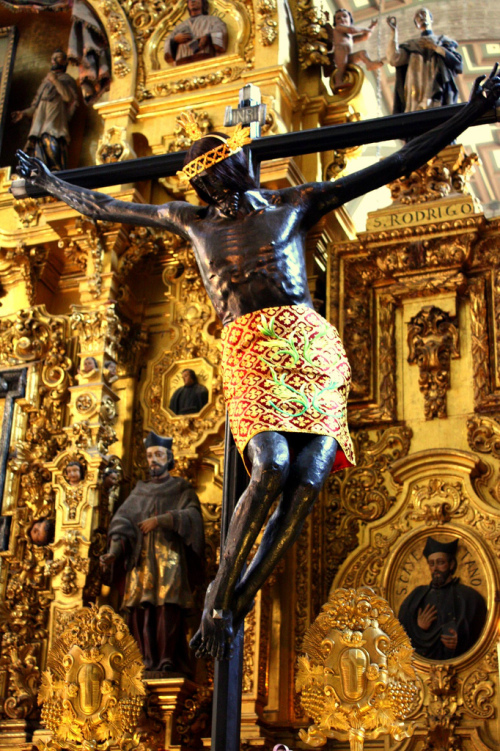
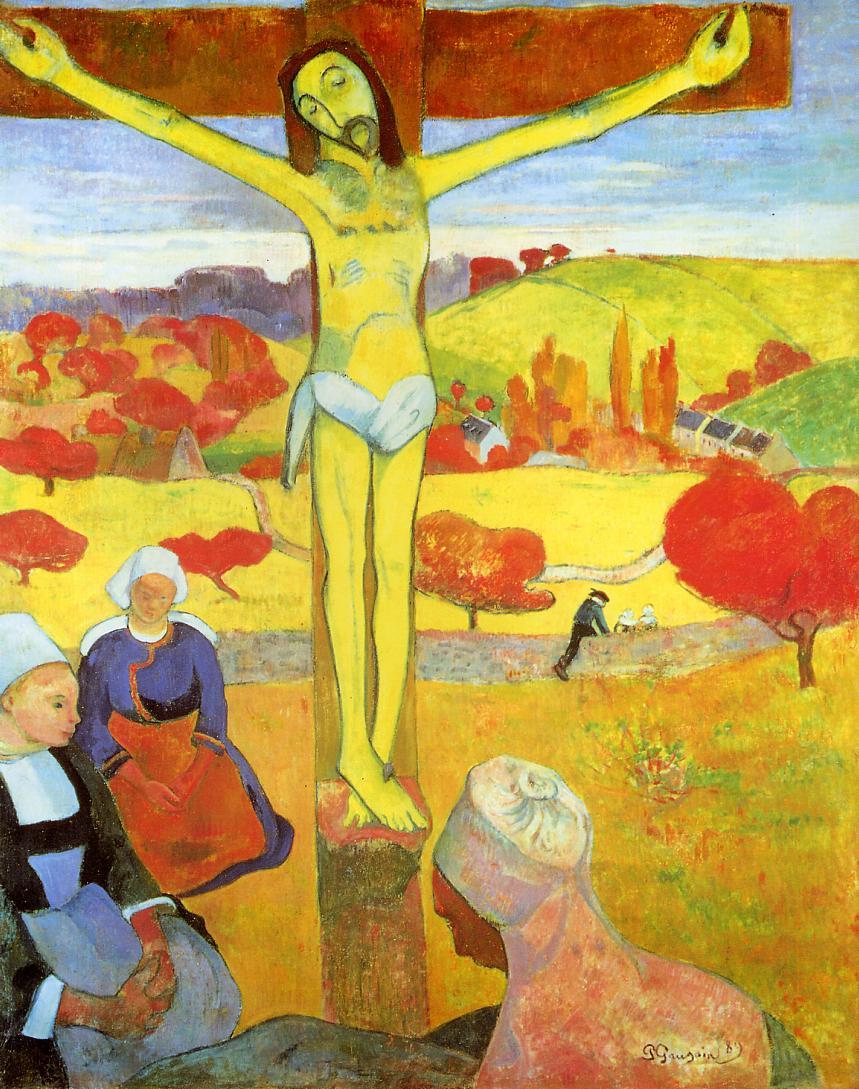
Jesus of Nazareth, King of the Jews

Images of the Crucifixion


(Thanks to Jeffrey Fisher [jeffreyfisher at me.com] for the guest post.)

On Good Friday every year,* Christians around the world commemorate the death by crucifixion of Jesus of Nazareth, rabbi, prophet, Son of God, Son of Man, messiah, and all-around trouble-maker.

The truth is that very little is known of Jesus’ life and teachings from verifiable accounts, but this has not stopped generation after generation of Christians from telling his story, beginning with Jesus’ semi-official biographers, the evangelists of the New Testament. Almost everything we know about the life and teachings of the physical human being Jesus are in those writings, which do not portray him always in compatible ways, and which are almost entirely unconfirmed by any external source. The Roman historian Tacitus mentions (with disdain if not disgust) Jesus’ cult following, as does the Jewish historian and philosopher Josephus, but neither gives us anything to work with as historians (or, for that matter, as theologians). For the record, Suetonius and Pliny also talk about Christians, but these piecemeal sources tell us much more about Roman perceptions of Christians than about Christ and his teachings, or even necessarily Christian beliefs and practices.

What, then, can we reasonably say about Jesus?

It is almost impossible to find universal agreement around anything more than a few basics, including most importantly Jesus’ crucifixion. The Gospels narrate it; Paul the Apostle (who never met Jesus in the flesh, as it were) hangs his theology on it, together with the equally important resurrection; and no contemporary sources (Christian or otherwise) dispute it.

But it’s when we ask why Jesus was crucified that things start to get interesting.

What did he do? The two men he is traditionally said to have been crucified with are commonly understood to be “robbers,” but that they were common criminals is highly unlikely. Crucifixion is a horrible death designed to make a very public statement about the crucified, the sort of thing you use on gladiator-slave rebels like Spartacus, not on pickpockets and roustabouts. The Greek term used for these two men (lestai) is consistent with the description of the released Barabbas as one who had participated in rebellious activities, whose “criminality” was related to his revolutionary business. Moreover, the name “Barabbas” means literally “son of the father,” a purely symbolic and surely entirely fictional name, and that the people choose to have him released indicates their affinity for him as a thorn in the side of the Romans. He is thus contrasted with Jesus, the other son of the father, the peaceful (apocalyptic) revolutionary.

So Jesus would have been crucified as a political criminal, a rebel. This would make sense of accounts of his having been identified by the Romans as “Iesus Nazarenus Rex Iudaeorum”: “Jesus of Nazareth, King of the Jews.” Anyone claiming to be king (and “son of God” was a Jewish way of talking about the king of Israel recorded clearly in Psalm 2), would, if taken seriously, be understood as challenging Roman authority.

Insofar as Jesus seems to have been deliberately poking the Romans’ local running dogs, the Sadducees and the Temple priests, his seizure and termination were surely inevitable. If his teaching is as opposed to violence and unconcerned with “politics” as it seems to have been, it’s hard to believe the Romans would have noticed him without some prodding, this coming not from the “crowd,” but from the leadership (who in Mark and Matthew incite the crowd). Indeed, the priests and scribes look for ways to arrest him when the crowds are not around, because they fear a riot.

If we take the Gospel of Mark at all seriously, Jesus was preaching a new kingdom of God, an apocalyptic redemption of the people of the earth by God’s direct intervention (and with Jesus as the sacrificial pesach lamb). If we take the Gospel of Luke seriously, Jesus spoke in a classic prophetic mode, calling people — Jew and Gentile both — to care for the oppressed of the earth, the poor and the hungry and the helpless. Both Jesuses called for people to be better to each other, to love each other, and indeed to love each other when love was, according to common sense, the foolish thing.

Why would this get you executed?

Well, in itself, it wouldn’t. But the Gospel of Mark tells us of Jesus speaking with a man who realizes that all the animal sacrifices in the world don’t amount to a hill of beans (in that crazy world). When love counts more than sacrifice, we are undermining the Temple. When we go into the Temple, start knocking things over, and say it’s become about robbing the poor and not about loving God and one’s neighbor, we are undermining the Temple. And to undermine the Temple’s authority is also to undermine Rome’s authority, and Rome’s cash flow.

Jesus, like the Essenes he may or may not have associated with, was a purist.

The Temple was full of collaborators and exploiters, the kind seen before in the history of Israel (and berated by prophets like Isaiah and Amos), the kind hated also by the Dead Sea community of apocalyptic purists awaiting a final showdown between God and evil (i.e., the Roman Empire and their local potentates, the Temple authorities).

Jesus, like other Jewish prophets before him, thought that Judaism was about something. That it was somehow about justice and not just about following rules or waiting around for things to get better: that it was about our making the world a better place, and not just making our own lives better.

Start talking that way and get people on your side, and you’re fairly likely to get killed, even twenty centuries later.

* Though the actual date (even the year) of the execution marked by the movable feast of Good Friday is fundamentally unknowable, there are some present-day astronomer types who’d like to sell you April 3, 33 A.D.

On this day..

1794: Jacques Hebert and his followers

On this date in 1794, firebrand revolutionary pamphleteer Jacques Hebert and his eponymous party of Convention radicals mounted the scaffold during the Paris Terror.

As a 32-year-old, Hebert started putting out his foul-mouthed blog radical newspaper Le Pere Duchesne in the Revolution’s early months.

In this increasingly vituperative rag, Hebert — incongruously writing in the voice of “Old Man Duchesne” — savaged first the royal couple, and then (after that pair lost their well-coiffed heads) whatever the retrograde element of the unfolding Revolution happened to be on any given day: the constitutional monarchist Lafayette; the bourgeois liberal Girondists. His paper valorized the Parisian working-class sans-culottes, and lustily demanded heads for the satisfaction of their various grievances.

Here, he literally channels Marat:

All of these thoughts trouble my brain, and the memory of Marat follows me without end. Last night I saw him in a dream: his wound was still bleeding, dammit. Upon seeing it I cried. Friend of the people, I shouted, is it you? Yes, good Père Duchesne, it’s Marat who comes from the dead to talk with you, because — dammit — the love of freedom pursues me even beyond the grave. Content to have lost my life for my republic, there only remains to me the regret of not having seen it delivered, before my death, from all the scoundrels who tear away at its breast. Père Duchesne, you must do what I couldn’t do. You closely followed me in the revolution; like me you consecrated you life to the defense of the rights of the people. You speak the language of the Sans Culottes, and your foul mouth, which makes little mistresses faint, sounds beautiful to free men, for free men shouldn’t be sought among the beautiful souls. Your joy and your anger have done more than all the dreams of statesmen. They know this well, the worthless fucks, and that’s why they’ve persecuted you like they did me. Courage, old man; don’t back off when you suffer the same trials as me, don’t be afraid: is there a more beautiful death than mine? But since you’re useful to your fellow citizens, try to avoid the daggers of statesmen. Live a while longer in order to denounce them and to complete, if you can, the task I’d undertaken.

Yes, Père Duchesne, you have to go after them hammer and tong, and not take it easy on anyone. When three months ago I proposed planting three hundred nooses on the terrace of the Tuileries in order to hang there the perfidious representatives of the people, some took me for a madman, and others as someone thirsty for blood. But nevertheless, if I’d been believed how much bloodshed would have been avoided! More than a million fewer men would have perished! So when I made that proposition I wasn’t speaking as a bloody monster, on the contrary I spoke as a friend of humanity. The moderates have buried more victims than those that fell before the steel of our enemies. Nothing is more harmful in a revolution than half measures. We have finally arrived at the era when we must pare things right down to the bone. … No more quarter for the defeated party, because, dammit, if the statesmen had the upper hand for one moment there wouldn’t exist a single patriot in six months.*

Late in his run, Hebert was on to venting dissatisfaction with the party of Danton, who had followed the monarchists and the liberals off the starboard of acceptable revolutionary opinion. Sensible centrist Maximilien Robespierre would indeed strike that faction down — just two weeks after he’d purged the radical Hebertist gaggle itself.**

Eleven days after Le Pere Duchesne last hit the streets, its author’s head hit the basket.

His printed editorials (like the one above) often assert a modish conviction in his own coming martyrdom, but as proof against a fatal political reversal, Hebert had trusted overmuch to his power base in the Paris commune. When he was carted out this morning, the mob whom his own paper once played to reveled in old Pere Duchesne’s fall just as readily as it had reveled in his enemies’.

some men carrying long sticks, at the end of which were suspended braziers of burning charcoal, symbolical of the “Charcoal-burners” of the “Pere Duchesne,” thrust them into the face of Hebert, insulting him with the same bitter railleries with which he tormented so many other victims (Alphonse de Lamartine)

Hebert was executed at the Place de la Revolution in a batch of 20 fellow-radicals, among whom we also find the eloquent “orator of mankind,” anticlerical† wordsmith Anacharsis Cloots. (Victor Hugo on his revolutionary leader in Les Miserables: “he had too much of Saint-Just about him, and not enough of Anacharsis Cloots.”)

The original La Pere Duchesne was dead, but just as the hot-selling mag had attracted ripoffs in its original run, the name lived on as a symbol of popular revolutionary menace — to be reclaimed by later generations in print and song.


La chanson du pere duchesne (live at RMZ)

* I know, right? Hebert was such a wild man, he thought ill of slavers.

Everywhere and at all times men of commerce have had neither heart nor soul: their cash-box is their God; they only know how to thieve and deceive; they would shave an egg, they would kidnap their own fathers; they traffic in all things, even human flesh; theirs are the ships which sail to the African coasts to capture negroes whom they then treat as worthless cattle.

** These rival factions linked as fellow-victims of Robespierre’s Terror are neatly symbolized by the spouses of their respective antipathetic scribblers: Jacques Hebert’s wife Marie, and Lucile Duplessis, wife of the Dantonist journalist Camille Desmoulins. Marie and Lucile were guillotined together that April, having forged a friendship while awaiting the chop.

† “The personal enemy of Jesus Christ,” Cloots called himself. He also remarked, “What is man’s chief enemy? Each man is his own.” A lot of enemies, this one had.

On this day..

1526: Antonio Osorio de Acuña

On this date in 1526, Spanish bishop Antonio Osorio de Acuña was beheaded in Simancas for supporting the revolt of the comuneros.

Acuna was in his sixties when the popular revolt rose in Castile.

Given his age and station, he might have been expected to exercise the bishopric of Zamora in the interests of the powers that be. Instead, he threw in with the rebels, even fearlessly leading men into battle.

If that sounds (rightly or wrongly) principled to you, you might be surprised that Acuna has generally been tarred as an opportunist.

Was it “opportunistic” to seize the vacant bishopric of Toledo when that city was under attack by royalists? Or was it a courageous and needful stroke to take the ecclesiastical power in hand and direct the church’s material resources to the cause?

It’s really all in how you look at it. Surely throwing dissenting priests into the dungeon was a little harsh, but then, it was wartime.

Acuna was caught fleeing for France after the revolt broke down, but his execution took four-plus years to arrange through the sluggardly church courts.

Still, he was executed — a fact which underscores the stakes he was playing for, and insured that he would never get the benefit of historiographic doubt.

This Spanish-language page summarizes Acuna’s pre-comuneros career of graft and careerism. This Castilian nationalist page likes him quite a lot better.

On this day..

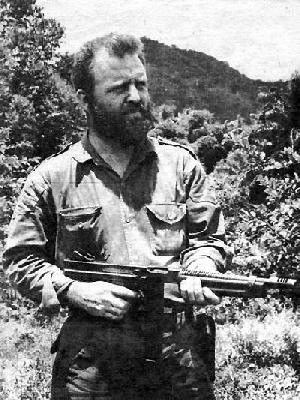
1961: William Morgan, the Americano

On this date in 1961, American William Morgan — once an anti-Batista rebel — was shot in Havana’s La Cabana fortress for counter-revolutionary activity against the Castro government.

The high school dropout and army washout went to Cuba around late 1957 or early 1958.

He’d had an unsettled life, this Morgan. He’d been a convict, a circus sideshow, a wanderer. But he was about to make his name.

This strange gringo soon to be nicknamed “El Americano” walked into the Escambray Mountains and joined a group of anti-Batista rebels that was unaffiliated with Castro’s 26th of July Movement. Morgan won the respect of Cubans for his courage and his evidently un-mercenary commitment to the cause.

Fatally for him, that cause was a constitutional-democracy take on opposing the Batista dictatorship.

Morgan was stridently anti-Communist and not shy about saying so.

“There isn’t anyone in Cuba who doesn’t know where I stand-Fidel, Raul, or anyone. I am anticommunist. I don’t like them.”

That attitude would put him on a collision course with the only other foreigner to hold a comandante rank among the anti-Batista guerrillas: Argentinian Ernesto “Che” Guevara.

Those two men’s columns nearly exchanged shots when Guevara was dispatched by Castro to reach an understanding with Morgan. Morgan and Guevara came to terms that day — there was a revolution to be won, after all — but animosity would remain between these two impassioned freedom-fighters whose visions of freedom could never be reconciled.

They personify the competing choices before post-Batista Cuba, in those first years when Cuba kept to a tenuous hold on non-alignment.

Morgan supported that revolution; he even made the headlines for dramatically foiling a Dominican-backed plot to topple Castro in 1959.

But it was Guevara who was the future. More radical July 26th members won senior spots in the new administration, while outsiders like Morgan got assignments like frog-farming. Geopolitical events saw Cuba sliding into the Soviet camp.

Disenchanted, Morgan started plotting for real.* It didn’t work.

He was caught in late 1960, held incommunicado for a period, then tried, convicted and condemned two days before his execution (along with fellow-traveler and -plotter Jesus Carreras Zayas (Spanish link)) after nightfall March 11, 1961.

Morgan’s execution was carried out by a fellow Yanqui, Herman Marks — himself destined to run afoul of the Castro regime down the road. (Marks fled back to the U.S.) The sympathetic account of el Americano‘s death is quite the flowery affair, with the Cubans kneecapping Morgan when he defiantly refuses to kneel.

Castro himself is sometimes said to be present, the shadowy observer issuing the fatal commands to which Morgan will not bow, like the insouciant silhouette of Stalin behind a screen at trials where his former henchmen were purged.

A poetic touch, though one would think a head of state might have more pressing business than personally orchestrating executions: and indeed, it seems that Fidel actually spent that evening at a diplomatic reception with Soviet and Chinese ambassadors. Two months later, Castro officially declared Cuba a socialist state.

And as with Morgan, so with many of his brethren-in-arms from the Escambray Mountains. It took Havana the better part of the 1960s to suppress anti-communist “bandits” in Morgan’s old stomping-grounds — Cuba’s (successful) War Against the Bandits.

* There’s more skullduggery in Morgan’s shadowy life than this post has space for, but theories exist that the Dominican plot he “foiled” was actually one he had been an earnest participant in before it was sniffed out by Cuban security, with the war hero Morgan forced to betray it.

On this day..

1974: Salvador Puig Antich and Heinz Ches, the last garroted in Spain

On this date in 1974, in the face of an international controversy, Spain executed anarchist Salvador Puig Antich — the very last execution by garrote.

Handsome young Salvador radicalized as a youth in the 1960s under the oppressive semi-fascist Franco dictatorship.

As was the style at the time, the Catalan nationalist’s philosophy soon migrated to anarchism, and he brought his army experience to the Movimiento Ibérico de Liberación (MIL), whose direction-action credo entailed bank robberies branded as “expropriation.”

Puig Antich was caught in a police ambush that also claimed the life of a police officer — at least some of the bullets seemingly delivered by police friendly fire.

But his defense that his own gun discharged only as he was beaten senseless by the gendarmes never had a chance, since between arrest and trial, another set of proscribed leftists assassinated Prime Minister Luis Carrero Blanco.

Blanco’s successor went by the handle “Butcher of Malaga” for his depredations as a nationalist prosecutor during the Spanish Civil War.

So there was no quarter forthcoming from the Spanish regime, notwithstanding domestic general strikes and worldwide gnashing of teeth.

Salvador Puig Antich went on to a post-mortem existence as anarchist martyr. To help take the political edge off the scene, a non-political murderer, Heinz Ches (Spanish link), was garroted at almost the same time, in a different prison.

Spain soon did away with the discomfiting garrote; its very last executions were carried out by firing squad.

Salvador Puig Antich was the subject of a 2006 film, Salvador. (Here is a hostile anarchist review.)

The junior partner in the day’s twin killing, Heinz Ches, was himself the subject of a documentary, Nobody’s Death: The Enigma of Heinz Ches, exploring the weird near-total obscurity of the man who shared the headlines with Salvador Puig Antich. (A clip can be viewed here.)

On this day..

1942: Boris Vilde, linguist

On this date in 1942, Estonian linguist and ethnographer Boris Vilde was shot with his French Resistance circle at Fort Mont-Valerien.

St. Petersburg-born, Estonian-raised, the young scientist came to Paris at age 25 (French link) with his life in a backpack.

In the eight short years remaining to him before he gave his life for his adopted land’s anti-Nazi resistance, Vilde cofounded the Paris Musee de l’Homme. (When visiting, be sure to look for the skull of Suleiman al-Halabi, a Syrian executed for assassinating one of Napoleon’s Egyptian officers in 1800.)

It says here that Vilde even imported the French word “resistance” into Estonian.

Boris knew whereof he spoke.

His Musee de l’Homme group recruited scientists and intellectuals and published anti-fascist propaganda.

When the Vichy government infiltrated it and had its principals condemned, one of Vilde’s compatriots is said to have bellowed at the firing squad at the last moment,

Imbeciles, it’s for you, too that I die.

On this day..