On this date in 1683 at Lincoln’s Inn Fields in London the great Whig parliamentarian William, Lord Russell was beheaded with a legendary want of dexterity by Jack Ketch.
 The third son of the Earl (later Duke) of Bedford, Lord Russell emerged from a decade of comfortable obscurity in the Parliament’s back benches to become a leading exponent of the nascent Whigs* opposed to royal absolutism and to Catholicism — two heads of the same coin, for the Whigs, given that the heir presumptive James had controversially converted to Catholicism.
The national freakout from 1678 over an alleged “Popish Plot” to undo Old Blighty gave Russell his cause; his leadership of the resulting parliamentary bid to exclude James from royal succession made the gregarious Russell “the governing man in the House of Commons”.
“Lord Russell was a man of great candour, and of general reputation; universally beloved and trusted; of a generous and obliging temper,” his friend Gilbert Burnet recorded of our man. “He had given such proofs of an undaunted courage and of an unshaken firmness, that I never knew any man have so entire a credit in the nation as he had.”
Russell was, Burnet allowed, “a slow man, and of little discourse, but he had a true judgment, when he considered things at his own leisure: his understanding was not defective; but his virtues were so eminent, that they would have more than balanced real defects, if any had been found in the other.”
Chief among those virtues was his wholehearted sincerity for his cause — a passion the source of both his renown, and his destruction. Russell was heard to espouse the view that James ought not merely be excluded from succession, but executed like his father.
Matters never quite approached that point, but the crisis provoked by the Exclusion Bill firebrands led King Charles II to dissolve parliament in 1681, depriving the Whigs of their legal perch. In the ensuing years politics played out not as legislation but conspiracy, and the crown’s rather more successful harassment of same: many of the chief Whig actors were driven offstage to scaffolds, dungeons, or continental exile.
The half-dozen most eminent Whigs remaining — to whom, besides Lord Russell, we number the king’s illegitimate son Monmouth, the Earl of Essex, Baron Howard of Escrick,** Algernon Sidney, and John Hampden† — formed a sort of informal Council of Six who met secretly to consider the bad options available to the fractured Whig movement. Some section of the wider Whig network in which this Council operated turned eventually to considering the most desperate of measures.
Their Rye House Plot schemed to waylay and assassinate the royal person near a fortified manor handily on the king’s route back to London from the Newmarket races. It was owned then by a radical former soldier of Cromwell‘s New Model Army.
It has been long debated to what extent any of the top Whigs knew of or actively participated in this Guy Fawkesian plot, or its complement, a projected armed rising of the sort that Monmouth would indeed mount in 1685. One school of thought is that the Tories seized it as an expedient to eviscerate the remaining Whig leadership by conflating the entire movement with a regicidal scheme; another is that the Whig insistence upon its martyrs’ innocence — and Lord Russell is the chief man in this pantheon — has amounted to a fantastic propaganda coup.‡
In June 1683, a salter who was in on the Rye House planning got a cold sweat and informed on the Whigs. This backstab earned a royal pardon for himself, and started a familiar policing sequence of incriminated conspirators turning crown’s evidence and informing in their turn on the next part of the network.
Many of the Whigs fled to the Netherlands, received there by the House of Orange which would seat itself on the English throne inside of six years.
Lord Russell, however, refused to fly. He landed in the Tower of London by the end of the month, to face trial as a traitor on the evidence of his association with other Whigs and his entertaining the plan of raising an armed revolt. (He would have been joined in the dock by Essex, but that worthy cut his own throat in the Tower.) The judge’s summation to the jury even underscored that “You have not Evidence in the Case as there was [in other Rye House cases] against the Conspirators to kill the King at the Rye. There was a direct Evidence of a Consult to kill the King, that is not given you in this Case: This is an Act of contriving Rebellion, and an Insurrection within the Kingdom, and to seize his Guards, which is urged an Evidence, and surely is in itself an Evidence, to seize and destroy the King.”
Lord Russell’s case shifted around the fringes of actual innocence — those plans for Insurrection within the Kingdom, he said, occurred sometimes at meetings he happened to attend but only off on the side, or without Lord Russell’s own involvement or support. (Speaking from the scaffold, he would several times insist that his acts were at worst misprision of treason, which was no longer a capital crime at this point.)
Against this the crown produced Lord Howard, a cravenly interested party to be sure, who saved his own skin by testifying that the six-headed cabal was down to planning the specifics of the places where a rebellion might best be stirred up, the procurements of arms and bankroll that would be necessary to same, and how to draw Scotland into the fray as an ally. “Every one knows my Lord Russell is a Person of great Judgment, and not very lavish in Discourse,” Howard allowed on the point of Russell’s active assent to the plans. “We did not put it to the Vote, but it went without Contradiction, and I took it that all there gave their Consent.”
David Hume would observe in his History of Great Britain that Russell’s “present but not part of it” parsing didn’t make for a very compelling story. “Russell’s crime fell plainly under the statute … his defence was very feeble.”
 Detail view (click for the full image) of an 1825 painting of Lord Russell’s trial, commissioned of George Hayter by Lord Russell’s admiring kinsman John Russell, Duke of Bedford. John Russell also wrote a biography of his famous ancestor. The unbroken succession of Dukes of Bedford from William Russell’s father continues to the present day; the current Duke of Bedford, 15th of that line, is one of Britain’s richest men.
Conscious of the great pulpit his scaffold would offer, Lord Russell drafted with the aid of his wife a last statement vindicating his own person and the Whig cause that flew into print before the onlookers at Lincoln’s Inn Fields were dipping their handkerchiefs into his martyrs’ blood.
Nor did I ever pretend to a great readiness in speaking: I wish those gentlemen of the law who have it, would make more conscience int he use of it, and not run men down by strains and fetches, impose on easy and willing juries, to the ruin of innocent men: For to kill by forms and subtilties of law, is the worst sort of murder …
I never had any design against the king’s life, or the life of any man whatsoever; so I never was in any contrivance of altering the government. What the heats, wickedness, passions, and vanities of other men have occasioned, I ought not to be answerable for; nor could I repress them, though I now suffer for them.
These notices drew furious confutations from Tory pamphleteers aghast at the face these traitors had to forswear their malice against King Charles; a battle of broadsides to control the historical narrative ensued, and was resolved in the Whigs’ favor by the imminent conquest of power by the aforementioned House of Orange. The Whig-aligned William and Mary reversed Lord Russell’s attainder in 1689 — but that’s never stood in the way of historians’ debates.
In a much lower historical register, Lord Russell’s execution was egregiously bungled by the London headsman Jack Ketch, who had to bash repeatedly at the man’s neck before he could remove it from the shoulders. It is largely from this event that Ketch derives his lasting reputation as an incompetent and/or sadistic butcher, mutually reinforcing with Russell’s martyr status.
Ketch would later claim in a published “Apologie” issued against “those grievous Obloquies and Invectives that have been thrown upon me for not Severing my Lords Head from his Body at one blow” that his prey
died with more Galantry than Discresion, and did not dispose him for receiving of the fatal Stroke in such a posture as was most suitable, for whereas he should have put his hands before his Breast, or else behind him, he spread them out before him, nor would he be persuaded to give any Signal or pull his Cap over his eyes, which might possibly be the Occasion that discovering the Blow, he somewhat heav’d his Body
and besides that Ketch “receav’d some Interruption just as I was taking Aim, and going to give the Blow.” How would you like it if someone came to your workplace and did that?
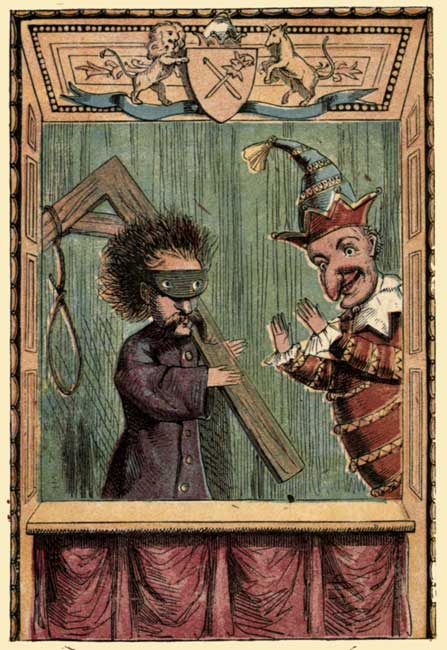
The damage to Ketch’s reputation was already done. Two years later, en route to the block for a subsequent failed bid to topple the Stuarts, the Duke of Monmouth tipped Ketch with the scornful charge not to “hack me as you did my Lord Russell.” When Ketch botched that execution too, he was nearly lynched — but escaped the scaffold to live on in Punch and Judy and in the English tongue as the definitive lowlife executioner.
* Short for “Whiggamores”, who were Covenanter rebels in the 1640s. “Tories”, by contrast, took their name from Irish Catholic outlaws: each party became known by the slur its foes attached to it.
** Yes, another one of those Howards: this Howard’s great-grandfather lost his head for the Ridolfi intrigue.
† Hampden survived the suppression of Whig intrigues long enough to coin the term “Glorious Revolution” when the Stuarts were finally overthrownJournal of British Studies, January 1985 for a skeptical-of-Russell reading of the evidence. “The government did not concoct the plot; it was frightened by the revelations, whatever use it made of them. There is no doubt that proposals for an insurrection of some kind were discussed; Russell’s impetuosity and extremism make it more likely than not that he was an active party to these discussions. What is in doubt, since nothing came of the discussions, is how far the parties had gone in developing a concrete plan for a rising.”
On this day..


 Executed Today’s Guide to Halloween, Part II (Click




 The hangman addressed himself to his office. But he had been disconcerted by what the Duke had said. The first blow inflicted only a slight wound. The Duke struggled, rose from the block, and looked reproachfully at the executioner. The head sank down once more. The stroke was repeated again and again; but still the neck was not severed, and the body continued to move. Yells of rage and horror rose from the crowd. Ketch flung down the axe with a curse. ‘I cannot do it,’ he said; ‘my heart fails me.’ ‘Take up the axe, man,’ cried the sheriff. ‘Fling him over the rails,’ roared the mob. At length the axe was taken up. Two more blows extinguished the last remains of life; but a knife was used to separate the head from the shoulders. The crowd was wrought up to such an ecstasy of rage that the executioner was in danger of being torn in pieces, and was conveyed away under a strong guard.