On this date in 1747,* the Swedes beheaded Scottish-born adventurer Alexander Blackwell for meddling with their line of succession.
Blackwell, “a man of mercurial and adventurous temperament,” had his printing business busted in England for having failed to precede it with the required apprenticeship, and was thrown in jail as a debtor.
To extricate the family from poverty, Blackwell’s wife Elizabeth thereupon launched an amazing career as an herbal limner, drawing, engraving, and hand-coloring editions with hundreds of plants that became a standard reference in the field in the late 1730’s, and whose revenues managed to liberate her spouse. (Elizabeth is still remembered on a plaque at the Chelsea Old Church, in her old neighborhood.)
That mercurial ex-deadbeat might have done better to stick close by his now highly esteemed wife (or possibly his brother, a bloviating classicist), but the wanderlust sent Alex abroad to wash ashore in Stockholm as physician to King Frederick I, where he was soon convicted (on evidence uncertain, apart from the torture-extracted confession) of having intrigued to alter the royal line of succession further to enmeshing Sweden in an alliance with Britain.
He protested his innocence on the scaffold. More memorably, perhaps, he laid his head the wrong way upon the chopping block, requiring the executioner to correct him — whereupon Blackwell cracked wise that he, after all, lacked experience at the art of being beheaded.
* Some sources, like this Google Books biography, offer August 9 as Blackwell’s execution date. The 11-day discrepancy is due to the still-pending adoption of the Gregorian calendar: July 29 was the date on the Julian calendar still in use in the realms both of Blackwell’s birth and death; in 1752 and 1753, respectively, Britain and Sweden would adopt the Gregorian system.
On this date in 1685, the haughty Duke of Monmouth mounted the scaffold at London’s Tower Hill to suffer beheading for treason, and tipped the headsman with the words, “Here are six guineas for you and do not hack me as you did my Lord Russell. I have heard you struck him four or five times; If you strike me twice, I cannot promise you not to stir.”*
Upon this tart public reminder of his recent and infamous failure of craft, the eponymous executioner Jack Ketch quite came apart.
Monmouth, certainly, would have appreciated the advance that would bring the guillotine. Beheading by a free-swinging axe was a ghoulishly inexact procedure: bad aim, insufficient force, an untimely flinch, or the tough neck muscles of a grizzled campaigner regularly complicated the process, often to the fury of spectators. Jack Ketch is sometimes reported a sadist, and sometimes a professional hangman so rarely summoned to give a nobleman the chop that he simply lacked proficiency. Either way, he’d been on the job for a generation by this time: his reputation for infelicity with the blade preceded him.
Historical fiction from the perspective of the Duke of Monmouth.
Monmouth, an illegitimate son of King Charles II, had cause to dread Ketch’s offices for the rebellious culmination of a long power struggle with his uncle, the future King James II.
The personal contest between these men for the throne of England was the echo of the decades-old struggles straining the English polity — the Reformation and the reach of royal authority.
As it became known that the king’s brother James had gone from Catholic sympathizer to Catholic convert, Protestants began maneuvering to keep him from inheriting the crown. For three years, Parliament pushed the Exclusion Bill, which would have excluded James from succession.**
Favor among the bill’s supporters settled on the Protestant playboy Monmouth — politically convenient rumors that he was actually a legitimate child began circulating. “Weak, bad, and beautiful,” this unfriendly-to-Monmouth free book has him; whatever he was, his allies in the House of Commons were handily outmaneuvered. The Exclusion measures failed, and in 1685, James II began his reign as England’s last Roman Catholic monarch.
Monmouth’s hopes had been raised, however, and he proceeded to invade England at Dorset with a somewhat ragtag army that was routed by the Protestant royal troops who remained loyal to James at the Battle of Sedgemoor — not quite the last battle fought on English soil, but the last consequential one (the last fought with pitchforks makes a livelier distinction). Monmouth was caught trying to get away in a shepherd’s disguise. Other fugitives of his cause were hunted mercilessly.
The defeated duke was reputedly not above begging the sovereign for his life; obviously, that didn’t work out. But his cause was a popular one, nearing reverence among some commoners. Jack Ketch may have had a case of the butterflies even before the duke undressed him … and as it turns out, Ketch almost left the scaffold worse than his victim.
The hangman addressed himself to his office. But he had been disconcerted by what the Duke had said. The first blow inflicted only a slight wound. The Duke struggled, rose from the block, and looked reproachfully at the executioner. The head sank down once more. The stroke was repeated again and again; but still the neck was not severed, and the body continued to move. Yells of rage and horror rose from the crowd. Ketch flung down the axe with a curse. ‘I cannot do it,’ he said; ‘my heart fails me.’ ‘Take up the axe, man,’ cried the sheriff. ‘Fling him over the rails,’ roared the mob. At length the axe was taken up. Two more blows extinguished the last remains of life; but a knife was used to separate the head from the shoulders. The crowd was wrought up to such an ecstasy of rage that the executioner was in danger of being torn in pieces, and was conveyed away under a strong guard.
In the meantime many handkerchiefs were dipped in the Duke’s blood; for, by a large part of the multitude he was regarded as a martyr who had died for the Protestant religion.
Just the sort of soil for posthumous tall tales — that his execution was bogus and he was in hiding to return again, or had been packed off to France to become the Man in the Iron Mask. One possibly better-founded legend is that his head was set back upon its stump to sit him for what must have been a pungent portrait.
Protestant opponents of James were much thicker on the ground than the Duke’s own person, of course. They soon succeeded where Monmouth had failed.
* Slightly different versions of this address from the Duke to the executioner are recorded. Macaulay omits the “if you strike me twice” clause but adds “My servant will give you some more gold if you do the work well”; a more polite (barely) construction suggests “Do not serve me as you did my Lord Russell.”
** The factions in this dispute — the “Petitioners” (supporting the bill) and the “Abhorrers” (supporting the king) — evolved into the Whig and Tory political parties.
On this date in 1535, Sir — later Saint — Thomas More kept his conscience at the expense of his head on Tower Hill.
For all More‘s greatness — as intellectual, polemicist, lawyer, statesman, father — none of his many gifts at the end could avail him beside his commitment to Catholicism at the dawn of the English Reformation.
Yet it is for those gifts that he cut such a commanding presence in his times, for those very reasons that his sovereign hounded his first citizen to assent to the divorce and remarriage he was fixed upon.
A devotee and friend of Erasmus from years before, More was in Henry’s more orthodox youth the king’s very scourge of Protestantism. His scatological invective against Martin Luther in Responsio ad Lutherum — much in the impolite tenor of Catholic-Protestant rhetoric continent-wide, it should be noted — is of the sort to crimson the cheeks of the milquetoast modern:
Since he has written that he already has a prior right to bespatter and besmirch the royal crown with shit, will we not have the posterior right to proclaim the beshitted tongue of this practitioner of posterioristics most fit to lick with his anterior the very posterior of a pissing she-mule until he shall have learned more correctly to infer posterior conclusions from prior premises?
Over that hairshirt, he wore the robes of state. But his engagement with the world had a selective bent that must have exasperated his colleague and predecessor as Lord Chancellor, Cardinal Wolsey. Orson Welles and Paul Scofield spar here in the definitive More hagiography A Man for All Seasons over the intellectual’s delicate refusal to dirty his gloves with the great matter of state before them — the annulment the king demanded of his marriage to the Queen (and More’s friend) Catherine of Aragon:
Peas in a pod, these two: Wolsey, the cleric grounded in realpolitik; More, the barrister who trusts to God. (More considered holy orders as a young man.)
Our man’s reputation for honesty in a den of hypocrites has certainly outrun Wolsey’s. Still, all More’s disdain for the deal-making that invests the sovereign majesty and all his foreboding for the relationship he had with his dangerous king were not quite enough to stop him accepting the Chancellorship and the opportunity to stamp out Lutheranism … knowing perfectly well the simultaneous thrust of Henry’s boudoir policy.
It all cuts quite a contrast to More’s (barely) pre-Reformation text, Utopia (available free from Project Gutenberg), which named a literary genre and described an imagined society of tolerant primitive communism that surely would have blanched at its inventor’s coming role in the state’s machinations:
I can have no other notion of all the other governments that I see or know, than that they are a conspiracy of the rich, who, on pretence of managing the public, only pursue their private ends, and devise all the ways and arts they can find out; first, that they may, without danger, preserve all that they have so ill-acquired, and then, that they may engage the poor to toil and labour for them at as low rates as possible, and oppress them as much as they please
…
[E]very man might be of what religion he pleased, and might endeavour to draw others to it by the force of argument and by amicable and modest ways, but without bitterness against those of other opinions; but that he ought to use no other force but that of persuasion, and was neither to mix with it reproaches nor violence* …
It’s not a given that More himself agrees with every (or even any) sentiment expressed in Utopia, but his most famous work’s criticism of the death penalty too liberally applied makes interesting reading.
[E]xtreme justice is an extreme injury: for we ought not to approve of those terrible laws that make the smallest offences capital … God has commanded us not to kill, and shall we kill so easily for a little money [i.e., execute petty thieves]? But if one shall say, that by that law we are only forbid to kill any except when the laws of the land allow of it, upon the same grounds, laws may be made, in some cases, to allow of adultery and perjury: for God having taken from us the right of disposing either of our own or of other people’s lives, if it is pretended that the mutual consent of men in making laws can authorise man-slaughter in cases in which God has given us no example, that it frees people from the obligation of the divine law, and so makes murder a lawful action, what is this, but to give a preference to human laws before the divine? and, if this is once admitted, by the same rule men may, in all other things, put what restrictions they please upon the laws of God.
This insistence on the supremacy of divine law over human institutions forms the basis of his objection to parliament’s overthrowing the papacy — which he expressed openly only after he was convicted by obviously perjured “jailhouse snitch” testimony
[Y]ou have no authority, without the common consent of all Christians, to make a law or Act of Parliament or Council against the union of Christendom.
Paul Scofield bears enjoying in the role in A Man for All Seasons:
More is sometimes suspected of desiring martyrdom since he marched so unerringly into it, but he also made every attempt to survive Henry’s demand the he affirm the royal remarriage and the king’s ecclesiastical supremacy by withdrawing silently from the public sphere rather than openly opposing it. More had by every account an enviable, downright happy life at his own hearth, and a tender and intellectual relationship with his favorite daughter Meg. (Meg corresponded with her father in prison, collected his works, and retrieved his head from London Bridge.)
But by his way of thinking — Meg tried to talk him out of it — he couldn’t swear to the Act of Succession acknowledging the king’s right to divorce Queen Catherine and disinherit her daughter Mary if Henry decided to force the choice. And in the king’s eyes, there was no middle ground for someone of the ex-Chancellor’s stature.
Henry could see to it, though, to cut his old friend a break and commute the sentence from drawing and quartering to “mere” beheading, here depicted in the past season of the Showtime series The Tudors.
More’s last moments as rendered here — the ironic remark at the foot of the scaffold, “See me safe up: for my coming down, I can shift for myself”;** his generous answer to the headsman’s plea for forgiveness — are well-documented. Undoubtedly, his sturdy martyr’s bearing, the extension of a life of joyful piety, helped cement for posterity the fame he held in life.
And that dying address — “I die the King’s good servant, but God’s first” — gathers in one sentiment free of bombast or self-pity the irreconcilable demands of conscience that would lead many thousands besides More to Henry VIII’s scaffolds, and rings equally true to less lethal challenges to the conscience in every land and time since.
Anne Boleyn, who caused More’s fate, shared it less than a year afterwards.
Thomas More was canonized by the Catholic Church in 1935 — the patron saint of politicians. Rather bizarrely, July 6 is also his feast day on the Anglican calendar, a tribute to the nearly universal regard his memory enjoys.
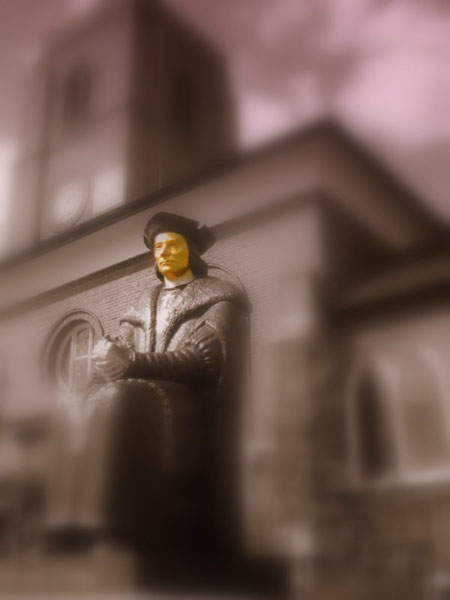
Chelsea resident Thomas More’s statue at the (Anglican) Chelsea Old Church.
* Despite its religious tolerance, More’s Utopia — anticipating Dostoyevsky — maintains:
a solemn and severe law against such as should so far degenerate from the dignity of human nature, as to think that our souls died with our bodies, or that the world was governed by chance, without a wise overruling Providence … since a man of such principles must needs, as oft as he dares do it, despise all their laws and customs: for there is no doubt to be made, that a man who is afraid of nothing but the law, and apprehends nothing after death, will not scruple to break through all the laws of his country, either by fraud or force, when by this means he may satisfy his appetites.
On this date in 1856, the Victorian poisoner William Palmer stepped on the scaffold at Stafford prison, eyed the trap suspiciously, and asked, “are you sure it’s safe?”
It wasn’t.
One of the more notorious characters of 19th century crime, Palmer hanged for poisoning a gambling buddy with strychnine, but he was widely thought to have left many more bodies in the ground. The philandering physician certainly had a knack for having people turn up suddenly dead around him:
The last four of his five legitimate children;
His illegitimate child;
Two people to whom he owed money;
His mother-in-law;
His wife (after Palmer took out insurance on her);
His brother (ditto);
And John Parsons Cook, whom Palmer was finally convicted of killing.
Evidence against Palmer was completely circumstantial, the public mood was completely prejudicial, and the case was completely sensational. It didn’t help Palmer’s cause that future Lord Chief Justice Sir Alexander Cockburn was on the case, inflicting a withering cross on the defendant. Neither did it help his cause as much as one might think having the victim’s body come up negative for any lethal dose of poison. Robert Graves wrote a book about the case, and reckoned it a likely frame-up. Most other popular recollections — like Madame Tussaud’s, where Palmer stood until 1979 — have figured him for the same cold-blooded poisoner his public thought him. Gambling debts on the verge of burying him afforded him very plausible motivation (Cook was supposedly killed because Palmer had fraudulently borrowed a few hundred pounds against his name and was about to be found out).
How quickly “crimes of the decade” fade away. Palmer was the O.J. Simpson of the 1850’s, although his spell in the public eye was only a few months. Parliament had to intervene to move his case from Staffordshire to London for want of an unprejudiced jury; 35,000 people crammed the streets overnight in the rain to watch him swing; and time was you could get yourself the Unabridged Edition of The Times‘ minute-by-minute report on the Palmer trial or bone up on the case in the 19th century’s legal tomes, to say nothing of the requisite (and in this case, poetic) broadsheet and enough cultural ejecta to stock a museum exhibit.
Palmer earned a passing name check in Sherlock Holmes — “When a doctor does go wrong he is the first of criminals. He has nerve and he has knowledge.” His case is supposed to be the source of the pub idiom “what’s your poison?”
Legend — scurrilous, of course — has it that his hometown of Rugeley even petitioned the government to change its name for fear of never escaping its association, but that the change would only be permitted if the town named itself after the Prime Minister: Lord Palmerston. Rugeley it remains.
* Notably, Palmer was convicted of poisoning in the face of exculpatory toxicology evidence. He denied the poisoning to the end.
On this date in 1594, a 70-year-old Portuguese physician was torn apart at Tyburn before a jeering London mob for attempting to poison Queen Elizabeth I.
Born around 1525 to a family of conversos — Jewish converts forcibly converted to Christianity — Rodrigo Lopez (alternatively, Lopes) went abroad because the Spanish Inquisition menacingly suspected him of secretly maintaining the faith of Abraham.*
For us, the man’s true doctrines might be a matter for his god. In the 16th century, Lopez never could outrun his Jewishness.
Establishing himself in London in 1559, nearly the precise midpoint of his life, Lopez built a thriving medical practice, eventually rising in 1586 to the attendance of Her Majesty herself. England in those days was scrapping with the mighty Spanish empire, one front of which was endlessly byzantine diplomatic intrigue. It happened that Elizabeth gave harbor to a Portuguese pretender (Lopez had attended him, too), whose circles the Spanish were naturally endeavoring to infiltrate.
Some nefarious machinations in this ambit that came to light in 1593 opened an investigation characteristically heavy on the torture, and Lopez’s name came up. Allegedly, the doctor was negotiating to take Spanish gold for slipping the Queen a mickey.
Lopez doesn’t seem to be any less capable of greed or intrigue than anyone else at court, but poison? It was doubted at the time, the prosecution itself a product of the courtly rivalry between Essex and Cecil.** Despite a confession (extracted by torture, like the accusations), even Elizabeth never seems to have really bought the charge: she held Lopez more than three months after his sentence before finally permitting the punishment to go forward, and pensioned his family when the treason conviction entitled her to confiscate their property.
The London mob entertained no such nuance. When Lopez was hauled to the scaffold this day for his public butchery — still protesting that he “loved the Queen as he loved Jesus Christ,” derisively taken as a backhanded confession by spectators who didn’t doubt the practicing Protestant was really a Jew — it elevated popular anti-Semitism to fever pitch.
Hath not a Jew eyes?
Lopez, or at least the popular mood of Jew-baiting current after his trial, is thought to have helped inspire William Shakespeare’s use of the Shylock character in The Merchant of Venice — one of the most controversial and captivating of all the Bard’s creations, a villain far more compelling (and sympathetic) than the play’s lightweight good guys and one whose place in the Shakespeare canon and the fabric of Elizabethan England is still vigorously debated.
Is Shylock a vicious caricature? A sublimely three-dimensional human? Both? Wherever the “real” William Shakespeare stood on the matter of religious equality, he put one of literature’s great apologias for it in Shylock’s mouth:
* Insincerely converted Muslims and Jews were a choice target of the Inquisition in the 16th century; many thousands were driven to emigrate. For the fate of some other crypto-Jews who fled to Spain’s possessions in the New World, see here.
** Lopez’s Javert, the Earl of Essex, lost the power struggle a few years later … and with it, his own head.
Any queen decapitated by her king would of course rate an entry in these grim pages. But this does not quite explain Anne Boleyn‘s enduring appeal, relevance and recognizability for the most casual of modern observers, and her concomitant footprint in popular culture, even with the “Greek tragedy” quality of her life.
Anne stands at the fulcrum of England’s epochal leap into modernity. Whether she was that fulcrum might depend on the reader’s sympathy for the Great Man theory of history, but little more do we injure our headless queen to regard her as the woman for her time and place — the accidental hero (or villain) raised up and thrown down by the tectonic forces of her milieu.
Through Anne was born — for reasons of momentary political arrangements of long-forgotten dynasts, which seems a shockingly parochial proximate cause — the English Reformation, and through the Reformation was born the crown’s decisive triumph over the nobility, the broad middle class nurtured on the spoils of Catholic monasteries, the rising Britannia fit to rule. Most would take as an epitaph historical accidents of such magnitude.
Of course, by those same accidents, Anne was the instrument of thousands of deaths herself, and little did she appear troubled in life by the corpses upon which she ascended the throne.
Her own family maps the change wrought on England. An ancestor was beheaded in the Wars of the Roses, medieval England’s last great breakdown; her uncle Thomas Howard was one of the throwback scheming Dukes, mastered by his sovereign to the extent of issuing Anne’s capital sentence from his own lips;* the beheaded woman’s daughter, Queen Elizabeth I, set a recognizably centralized English state on the path of empire.
Fitting tribute that, from the Tower where she met her end** to lands undreamt-of in her time, people still, like Henry, find her captivating.
* Anne’s father also declared for her guilt. Unprincipled as these men undoubtedly were, it cannot have been a pleasant responsibility; the question of whether she was actually guilty of adultery-cum-treason, the fatal charge extracted from a supposed lover by torture, has been hotly and inconclusively disputed by posterity.
** With a solemn speech submissive to Henry but not admitting any guilt — in an earlier moment of levity, she had famously remarked of the French swordsman hired to do the job, “I heard say the executioner was very good, and I have a little neck.”
“You will be hanged by the neck, Billy, until you are dead, dead, dead!”
“You can go, Judge, to hell, hell, hell!”
We have no source for whether William Bonney’s reply to the judge who sentenced him to hang was vindicated by the Almighty. But the judge’s sentence, due to be executed this day, assuredly never came to pass: two weeks before, Billy the Kid effected the last of his famous escapes.
The exploits of this legendary gunfighter — and his legend rather exceeds his exploits — are exhaustivelychronicled online. The Manhattan-born Kid, a pup of 21 at his death, was a gunfighter in the Lincoln County War, a fight between two frontier magnates. Billy counted himself among the Regulators, a deputized posse (so it claimed, by way of legality) that was the armed militia of a murdered rancher.
Here’s how Emilio Estevez played the crime in Young Guns:
On April 28, in a building that still stands in Lincoln, New Mexico, Bonney got the drop on one of his guards and high-tailed it out of town.
Though spared the ignominy of the gallows, Billy the Kid would not long outlive his judicially appointed hour. Lincoln County sheriff Pat Garrett found and killed the fugitive a few months later.
Ironically, this transaction darkened the reputation of the successful officer of the law — the circumstances of the killing were ambiguous, and seem less than honorable to some — while helping valorize the young outlaw who by all rights should long since have been at the end of a rope. And for this, maybe Billy’s shade has stood Garrett’s a drink or two, because a shadowy and youthful disappearance from the scene helped catapult Billy into folklore that has long outlasted the forgotten Lincoln County War.
Billy the Kid — even the name evokes the American self-image with perfect pitch — has come to so fully embody the floating signifiers of the Wild West, of America in its adolescence, that around the same time Bob Dylan composed “Knockin’ on Heaven’s Door” for the clip above (the 1973 film Pat Garrett and Billy the Kid), Billy Joel took the gunslinger for an all-purpose western motif in “The Ballad of Billy the Kid”. Joel’s song’s describes a life that seems to be just what the listener thinks it ought to be while remaining factually untrue of its titular character in almost every particular, including, in his version, a picturesque death by hanging:
The ballad form of romanticized narrative poetry suits our elusive subject well. Skip music and cinema a generation ahead and we have Guns n’ Roses covering “Knockin’ on Heaven’s Door” and power balladeer par excellence Jon Bon Jovi climbing the charts with this signature hit from the Young Guns II soundtrack:
On this date in 1888, Jochin Henry Timmerman was hanged across from the cemetery in Goldendale, Washington for the murder of a freight driver.
The account of this bit of local color in a territory still a year away from statehood comes from Washington’s HistoryLink website.
The page includes a lengthy account of the crime and capture of the only man ever hanged in Klickitat County. We excerpt here the affair’s climax.
Because Timmerman steadfastly maintained his innocence, the execution was scheduled to take place after the arrival of the April 6 daily overland mail stage. This was in case Territorial Governor Eugene Semple (1840-1908) sent a stay of execution. Early Klickitat Valley Days states “Friends of Timmerman had a skilled long distance rider with a swift saddled horse waiting at a railroad telegraph station (in) Grant, Oregon, 15 miles from Goldendale, across the Columbia River. A steam ferry tug waited on the Oregon shore, so the rider would not be delayed, if a coveted life saving yellow envelope was placed in his hands” (p. 78). Governor Semple sent no telegram, and the mail stage arrived without a letter of reprieve.
Timmerman, meanwhile, was given a quart of whiskey upon awakening and allowed to consume it all in preparation for his ordeal. The execution took place in Goldendale under Sheriff VanVector’s [sic] direction on a gibbet erected directly across from the town cemetery. The event drew a large crowd. Cora E. Van Hoy Ballou, who watched the execution as a young child, later remembered her mother calling to her and her sister on the morning of April 6, “Wake up children, pappy has gone to the barn to get the team. We’re going to town to see the hanging” (Early Klickitat Valley Days, p. 78). The Van Hoy family was not alone: The Washington Standard reported that more than 3,000 people witnessed Timmerman’s execution.
Timmerman rode to his execution in a wagon sitting up in his own coffin, reportedly smoking the cigar. He mounted the scaffold unassisted and tossed the cigar butt into the crowd, who fell upon it and fought for bits as souvenirs. Local tradition later told that just before his hanging Timmerman prophesied that Goldendale would soon be destroyed by fire, and indeed, on May 13, 1888, a little more than a month after Timmerman’s execution, seven blocks of Goldendale’s business district did burn down.
Timmerman went to his death maintaining his innocence. His last words are reported to have been this advice: “All I can say is that if you ever get caught in a scrape like this, don’t let them take you alive”
At twilight this date in 1794, the most magnetic and perhaps most statesmanlike politician of the French Revolution mounted the scaffold at the Place de la Revolution in the revolution — as described by the poet Arnault:
In the dying light of day the great leader seemed to be rising out of his tomb as much as preparing to descend into it. Never was anything more bold than that great athlete’s countenance, never anything more formidable than the look of that profile which seemed to defy the knife. That great head, even as it was about to fall, appeared to be in the act of dictating laws.
The famously ugly revolutionary had been the moving spirit overthrowing the monarchy of Louis XVI in 1792; as the firmest public minister holding up against the ensuing military collapse he was for a few weeks something close to the head of the government.
Some credit him with saving Paris from military rout or internal anarchy during this time; some implicate him in the horrific September Massacres — and it may well be that neither view is mistaken.
He was destroyed by his sometime ally Robespierre — Danton had returned from semi-retirement on his farm late in 1793 to engage this losing power struggle — and the two are easily, albeit simplistically, read as yin and yang in the Revolution.
Danton’s earthy, all-too-humanjoie de vivre — his carnality, profanity, arrogance, venality — opposed to cold-blooded, sexless Robespierre, “the Incorruptible”; Danton’s (arguable) far-seeing vision of Revolutionary France’s place in the wider world opposed to Robespierre’s bloodthirsty peccadilloes of “virtue”. For most observers, though by no means all, the comparison profits Danton. (Just see if France ever names a warship for Robespierre.)
“We must dare, and again dare, and forever dare.”
Like many before him, most especially the Girondins who had (fatally to both parties) scorned an alliance with the Dantonists, Danton sought to arrest the revolution where he stood. The confrontation that finished him was precipitated by Danton’s attempt — with the assistance of his longtime confederate Camille Desmoulins, the most notable of the other men to lose their heads this day — to apply the brake to the excesses of Robespierre’s Committee of Public Safety, that lethal organ he himself established as a pillar of order for a time of peril now abated. With the worst of the very real dangers to the Revolution checked, Danton in the Convention and Desmoulins in his fiery journalistic writings proposed to rein in the bloodbath and overturn the power of the sans-culottes.
The time was not yet ripe for the former, although the far-left Hebertist party preceded Danton to the guillotine by a few weeks. In this clip from the 1983 film Danton (review | another | still another (pdf)), Robespierre — who had long resisted denouncing Danton, but did it with characteristic gusto once he committed to the course — turns the terrified Convention against the title character:
Danton’s action in those last days seems vacillating, uncertain; fate devours him. For Georg Buchner in Danton’s Death (here it is free in the original German), he’s paralyzed by the contradictions and uncertainties of an unknown new world in its birth pangs, despairing as all his good-natured philosophies drench themselves in gore.
He roused himself one last time for a ferocious and hopeless defense before the Revolutionary Tribunal, coming near enough to swinging the mob in his favor that the Convention felt obliged to vote a measure to gag him.*
He went to his death this day in full character, making the most of his last turn on that stage — strutting, jesting,** boastful to the very end, prophesying (accurately) Robespierre’s imminent demise. He was the last to lose his head, having seen Desmoulins and his fellows die before him, “with such coolness as does not belong to man,” the headsman Sanson recalled. His last words were an instruction to the executioner: “Show my head to the people. It will be worth it.”
* Later codified into a regulation preventing any prisoner mounting a defense, the law would boomerang against its authors when Robespierre’s cadre was hailed before the Tribunal and condemned without a hearing.
** Another in the doomed party, Fabre d’Eglantine, was a writer who on the day of the execution complained of the loss of his verses, vers, a French word also meaning “worms.” Danton observed that he’d soon be making plenty more vers.
On this date in 1902, two Australian officers were shot in virtual secrecy at Pretoria for atrocities they committed in service of the crown during the Second Boer War.
Harry “Breaker” Morant — he got the nickname from his aptitude with horses — was the famous one of the pair and the reason the date is so well-known to posterity as to merit its own cinematic treatment (review):
A colorful son of the Commonwealth’s hardscrabble strata, Breaker Morant led a life that has been improved into mythology, not least by his own efforts. Impoverished but educated, he migrated in 1883 from England to Australia where he carved out a larger-than-life profile as a bush poet, married the (subsequently) famous anthropologist Daisy Bates and eventually — fatefully — volunteered for service in South Africa.
The Second Boer War, Britain’s (ultimately successful) fight to corral the Dutch-descended Boer republics into the empire, started sunnily enough for the English, but as the Boers abandoned a conventional war they could not win and adopted guerrilla tactics, it descended into an exceedingly dirty conflict — notable for Britain’s pioneering use of concentration camps.
It was also notable for savagery between combatants. When Morant’s best friend in the unit was tortured and mutilated by Boer guerrillas, the poet went on a rampage, ordering a number of prisoners’ summary executions over a period of weeks. It was for this that he and his confederate were shot this day. The fact of his confinement was not communicated to the Australian government; Peter Handcock’s wife only learned of his execution weeks later, from press reports.
The defendants maintained that there was a standing order from the top to kill any Boer caught wearing British khaki, a tactic the Boers were known to employ, and that the order was frequently enforced. Though the prosecution strenuously maintained otherwise at trial, the existence of that (unwritten) directive has become accepted to posterity.
What remains murky is the matter of why — why these two, why now? And is Breaker Morant a hero or a villain? Those questions are also prisms for the many currents of Morant’s case so strikingly prescient for the century that lay ahead.*
Asymmetric warfare and the legal status of guerrillas. Human rights and war crimes. Corruption and plausible deniability. The moral culpability of subordinates for the orders of the brass. And certainly all the contradictory forces of empire and resistance entailed by an Australian adventurer shot by a Scottish detachment for killing Dutchmen in Africa at the behest of London.** It was an old-time colonial war in a world becoming, for we of the early 21st century, recognizably modern.
Hard-living to his dying breath, Morant stayed up the night before he was shot scribbling his last poem — piquantly titled “Butchered to Make a Dutchman’s Holiday”.
In prison cell I sadly sit,
A d__d crest-fallen chappie!
And own to you I feel a bit-
A little bit – unhappy!
It really ain’t the place nor time
To reel off rhyming diction –
But yet we’ll write a final rhyme
Whilst waiting cru-ci-fixion!
No matter what “end” they decide –
Quick-lime or “b’iling ile,” sir?
We’ll do our best when crucified
To finish off in style, sir!
But we bequeath a parting tip
For sound advice of such men,
Who come across in transport ship
To polish off the Dutchmen!
If you encounter any Boers
You really must not loot ’em!
And if you wish to leave these shores,
For pity’s sake, DON’T SHOOT ‘EM!!
And if you’d earn a D.S.O.,
Why every British sinner
Should know the proper way to go
Is: “ASK THE BOER TO DINNER!”
Let’s toss a bumper down our throat, –
Before we pass to Heaven,
And toast: “The trim-set petticoat
We leave behind in Devon.”
His last words were hurled at his firing squad: “Shoot straight, you bastards! Don’t make a mess of it!”
* It is no coincidence that the Australian film excerpted in this post was released while the Vietnam War was still a fresh memory.
** Breaker Morant’s memory would develop into a point of Australian suspicion towards the British military, especially after Morant’s persecutor helped author World War I’s infamous hecatomb of Australian (and New Zealand) troops at Gallipoli. Morant and Handcock turned out to be the last Australians executed by the British military.
Update: Via Airminded, an Australian history program took a skeptical look at the Breaker Morant myth a few years ago.

 The hangman addressed himself to his office. But he had been disconcerted by what the Duke had said. The first blow inflicted only a slight wound. The Duke struggled, rose from the block, and looked reproachfully at the executioner. The head sank down once more. The stroke was repeated again and again; but still the neck was not severed, and the body continued to move. Yells of rage and horror rose from the crowd. Ketch flung down the axe with a curse. ‘I cannot do it,’ he said; ‘my heart fails me.’ ‘Take up the axe, man,’ cried the sheriff. ‘Fling him over the rails,’ roared the mob. At length the axe was taken up. Two more blows extinguished the last remains of life; but a knife was used to separate the head from the shoulders. The crowd was wrought up to such an ecstasy of rage that the executioner was in danger of being torn in pieces, and was conveyed away under a strong guard.
 It wasn’t.
 Anne stands at the fulcrum of England’s epochal leap into modernity. Whether she was that fulcrum might depend on the reader’s sympathy for the Great Man theory of history, but little more do we injure our headless queen to regard her as the woman for her time and place — the accidental hero (or villain) raised up and thrown down by the tectonic forces of her milieu.
 The account of this bit of local color in a territory still a year away from statehood comes from Washington’s
  The
The 