1877: John D. Lee, for the Mountain Meadows Massacre

On this date in 1877, Mormon leader John D. Lee was shot at the site of (and for the crime of instigating) the Mountain Meadows Massacre 20 years before.

As the only person ever prosecuted for this dreadful affair, which saw 120 California-bound settlers slaughtered by a Mormon militia, Lee “was allowed … to carry to his grave Mormondom’s guilt for this horrible and barbaric act.” (Jan Shipps)

On this anniversary of Lee’s death, Executed Today interviews author Judith Freeman, whose historical novel Red Water tells Lee’s story through the eyes of three of his 19 wives.

You grew up Mormon — what brought you to this story? I gather that it wasn’t exactly daily discourse in your youth.

I found a copy of Juanita Brooks‘ book The Mountain Meadows Massacre in a used bookstore in Port Townsend, Washington, read it and was captivated by this story.

Growing up in northern Utah, I’d only heard vague, shadowy references to the massacre. It was the dirty little secret buried in the Mormon past — except for those people in Southern Utah who lived with that story as part of every generation’s experience and shame. I felt I had to write a novel about it, in part to try and understand this question: How do you get basically good people, like those Mormon settlers, to commit such evil?

You paint a picture of John Lee through the eyes of three of his wives. What kind of man was he — and how representative of the Mormon hierarchy would that be?

I think Lee was first and foremost a brilliant pioneer and survivalist and also a big blowhard, the kind of guy who would talk your head off — affable and a bit boring when it came to promoting his own virtues and experiences. He was self-aggrandizing, he’d do anything to make a buck, he had problems with the truth. He was a suck-up to Brigham Young who became his substitute father and then betrayed him.

He wasn’t entirely trustworthy because he put his own interests before all else. He could also be incredibly generous and kind, helpful to others. He wanted people to like him though they often didn’t, and he had an ingratiating quality. He was an orphan, with an orphan’s life-long neediness. In many ways I think he was good to his wives and cared deeply about his family — all sixty something kids and 19 wives. He was an amazingly talented man, skilled at many trades and businesses.

Was he representative of the Mormon Hierarchy? I don’t know. In some ways yes but I sense he was more sycophantic than some, and had a more amusing character than others, but what they all had in common was an absolute deference to church authority. I think I might have enjoyed meeting John D. Lee, he might have been more lively and fun than Brigham Young who strikes me as a misogynist and a brittle, cold man.

What about the women — three very different characters. What’s the sense you got of life for these women as pioneers, living in a polygamous family? How did they relate to one another, and how did the massacre and the execution of John Lee change their situation?

The women were also amazingly inventive as pioneers, strong, tough, formidable women though how can you generalize about 19 different personalities? Some liked each other and some couldn’t stand each other and the good thing was that Lee was a small industry and many of his wives had their own farms so they weren’t required to live on top of each other. He understood the “kitchen thing” when it comes to women, and said he wanted every one of his wives to have her own stove. The Lee family/families were devastated by his execution. His families were left penniless and destroyed, treated very cruelly, the women dispersed and shunned, the children shamed, and this shame was carried for generations.

To what extent is polygamy in the back story of the Mountain Meadows Massacre? What, for that matter, was the massacre really “about” in your judgment?

Polygamy had a small role to play in the massacre. The practice of polygamy, outlawed by the United States, was a part of what disturbed Washington and caused the federal government to send troops to Utah, which scared the Mormon populace into committing violent acts. One must remember that they had been the victims of violence and massacre, and fear turned in their minds.

What the massacre was really about, in my judgment, was the struggle for power in Utah. Would Brigham Young and the Mormon hierarchy control the territory and be masters of their own destiny, or would the federal government impose control of the “fiefdom”? The massacre came out of the idea the Indians could be made to carry out an attack and then the government would be forced to realize that if the Mormons were not allowed to control the territory and “their” natives, terrible things could happen. But the whole thing got out of control and took on a terrible life of its own.

A large party of Mormons, painted and tricked out as Indians, overtook the train of emigrant wagons some three hundred miles south of Salt Lake City, and made an attack. But the emigrants threw up earthworks, made fortresses of their wagons and defended themselves gallantly and successfully for five days! Your Missouri or Arkansas gentleman is not much afraid of the sort of scurvy apologies for “Indians” which the southern part of Utah affords. He would stand up and fight five hundred of them.

At the end of the five days the Mormons tried military strategy. They retired to the upper end of the “Meadows,” resumed civilized apparel, washed off their paint, and then, heavily armed, drove down in wagons to the beleaguered emigrants, bearing a flag of truce! When the emigrants saw white men coming they threw down their guns and welcomed them with cheer after cheer! And, all unconscious of the poetry of it, no doubt, they lifted a little child aloft, dressed in white, in answer to the flag of truce!

The leaders of the timely white “deliverers” were President Haight and Bishop John D. Lee, of the Mormon Church. Mr. Cradlebaugh, who served a term as a Federal Judge in Utah and afterward was sent to Congress from Nevada, tells in a speech delivered in Congress how these leaders next proceeded:

They professed to be on good terms with the Indians, and represented them as being very mad. They also proposed to intercede and settle the matter with the Indians. After several hours parley they, having (apparently) visited the Indians, gave the ultimatum of the savages; which was, that the emigrants should march out of their camp, leaving everything behind them, even their guns. It was promised by the Mormon bishops that they would bring a force and guard the emigrants back to the settlements. The terms were agreed to, the emigrants being desirous of saving the lives of their families. The Mormons retired, and subsequently appeared with thirty or forty armed men. The emigrants were marched out, the women and children in front and the men behind, the Mormon guard being in the rear. When they had marched in this way about a mile, at a given signal the slaughter commenced. The men were almost all shot down at the first fire from the guard. Two only escaped, who fled to the desert, and were followed one hundred and fifty miles before they were overtaken and slaughtered. The women and children ran on, two or three hundred yards further, when they were overtaken and with the aid of the Indians they were slaughtered. Seventeen individuals only, of all the emigrant party, were spared, and they were little children, the eldest of them being only seven years old. Thus, on the 10th day of September, 1857, was consummated one of the most cruel, cowardly and bloody murders known in our history.

Mark Twain, Roughing It

John Lee: murderer, scapegoat, or both? How did he come to be prosecuted at all, and how to be the only one prosecuted?

John D. Lee was both murderer and scapegoat. He was bold and careless enough to hang around the area after the massacre, and to prosper from his various businesses and appear almost indifferent to what had happened — perhaps he thought he had the protection of the church authorities who continued to insist the Indians had committed this atrocity. A lot of others who’d participated in the massacre left the area, driven out by fear and shame. But Lee hung on.

John D. Lee, seated beside his coffin just before his execution.

How he was thrown to the wolves by the church authorities is a long story, as is the story of his two trials. He was the easiest person to scapegoat. He took the bullet for his church, and I think the authorities felt that they could put the affair behind them once he was dead, and they did for a very long time, until brave little Juanita Brooks wrote her book in the 1950s and was the first to tell the truth: the Mormons did it.

Does the Mormon church have some unfinished reckoning here? If so — why, after all these years?

Who cares what I think? But in my opinion, of course they do. They need to stop saying it was a “local” affair, carried out by some “local” renegade fanatics in southern Utah. The whole situation that led to the massacre was put into motion by people high up in the church, but I doubt very much they’ll ever go there and admit that. Too many lawyers, too much money, too impossible to admit culpability of prophets, seers, revelators.

Finally, I just want to say that after writing Red Water and thinking about this massacre for the five years it took to research and write the book, this is what I came to believe about how you get good people to do bad things.

You need to get three things going: First, you have to make people afraid and use that fear to manipulate them (think of 9/11). Second, you need get people to obey some greater force or consciousness other than their own — the Mormons had a principle of Perfect Obedience where you were required to subject yourself to the authority of the priesthood and church elders, but this idea could as well be inculcated in the concept of patriotism, or military duty. The point is, you subdue your own conscience in favor of deferment to an outside force. Third, you make people think their system is better than the other guy’s, that you’re doing God’s will, that your sense of right is greater than theirs. If you can make people think they are doing God’s will, you can get them to do anything. Get these three things going, and you can get good people to commit great evil.

On this day..

1945: Robert Brasillach, intellectual traitor

On this date in 1945, and notwithstanding a partial outcry in French literary circles, fascist intellectual and Vichy collaborator Robert Brasillach was shot for treason in Montrouge.

Novelist, journalist and llitterateur Robert Brasillach (English Wikipedia entry | French) was the “James Dean of French fascism,” fashionable apostle of the interwar far-right movement Action Française.

A proper James Dean dies young, which fate was supplied courtesy of Brasillach’s editorship of the anti-semitic rag Je Suis Partout (“I Am Everywhere”) and enthusiastic support of the Vichy government.

Inasmuch as his collaboration had been in the form of ideas propagated, Brasillach’s case engaged the French polity in the challenging question of whether “intellectual crime” — and even “intellectual treason” — could exist categorically.

Given another year, when occupation was not so fresh a memory and the Nazis were no longer knocking at the door, the puzzle would probably not have been a life and death one.

But then, ideas are sometimes life and death matters themselves, and nowhere is that more true than in France.

Many anti-fascist intellectuals appealed to de Gaulle for Brasillach’s life — many, but not all. Death penalty opponent Albert Camus signed the petition for clemency; Jean-Paul Sartre and Simone de Beauvoir refused.

Between fellow-feeling among the literary set, ideological enmity, and the searing experience of the occupation only just lifted lay a test for the conscience of many a French thinker — aphorized by the very words de Gaulle would use in turning aside the appeal.

“Talent is a responsibility.”

On this day..

1915: Veljko Cubrilovic, Danilo Ilic and Misko Jovanovic, Archduke Ferdinand’s assassins


“Executions as a consequence of the Sarajevo assassination”. From the Visual Archive of Southeastern Europe.

On this date in 1915, three of the Black Hand conspirators who had assassinated Archduke Franz Ferdinand in Sarajevo the previous June were hanged for treason and murder as the World War that assassination ignited engulfed Europe.

You could say it was too little, too late.

Ironically, the gunman who actually got the Archduke, Gavrilo Princip, was too young to receive the death penalty under Austro-Hungarian law — barely short of his 20th birthday,* a more liberal standard for capital responsibility than even present-day human rights standards require.

In fact, that was true of five of the eight student nationalists convicted; the Slavs’ barbarous oppressor accordingly punished them for murdering the heir to its throne and involving it in a ruinous war with prison sentences of no more than 20 years. Three of the underaged five (Princip included) contracted fatal tuberculosis cases in custody during World War I; the other two, Cvijetko Popovic and Vaso Cubrilovic, outlived the Habsburg Empire by decades.

Three remained, old enough to swing for turning Europe into a charnel house: Vaso’s older brother Veljko (a schoolteacher), Danilo Ilic (a newspaper editor) and Misko Jovanovic (a businessman).

But if their names aren’t familiar, and their comedy assassination plot succeeded almost in spite of themselves, these forgotten radicals still rank among the midwives of modernity for the global cataclysm unleashed by their deed, for its calamitous aftershocks of nationalism and ideology, and for the second war that succeeded the horrors of the first.

According to John S. Craig’s Peculiar Liaisons, Gavrilo Princip left his poetry scrawled on the wall of his cell.

Our ghosts will walk through Vienna
And roam through the palace
Frightening the lords

All things considered, he sold himself short.

* There seems to be some uncertainty as to Princip’s actual date of birth, so he might in fact have been 20 years old. The court, at any rate, took him for 19.

On this day..

1953: Derek Bentley, controversially

On this date in 1953, Derek William Bentley was hanged by Albert Pierrepoint in London’s Wandsworth Prison for a murder committed by a friend.

The execution of the mentally impaired 19-year-old was a lightning rod when it was pronounced the previous December and remained so over a half-century struggle for his posthumous pardon.

He had been caught robbing a warehouse with an underage friend in November 1952, and in the gunfight that ensued, a police officer was shot — 15 minutes after Bentley was arrested.

In a welter of confusing evidence, the essential fact was that the two youths had engaged a criminal enterprise and thus became jointly liable for every consequence of the crime, regardless of who pulled the trigger. Nevertheless, it rankled as a manifest injustice that the young man should hang for a murder that happened after he was in custody, while the triggerman should not. There was a sense that Bentley faced a maximal punishment in the state’s frustration that the shooter was too young to hang; and, that since the two boys’ ages were barely on either side of 18 and the 17-year-old Christopher Craig arguably the dominant member of the duo, the effect was a great injustice.

The jury’s recommendation for mercy was not taken up, and Home Secretary David Maxwell Fyfe — a Nuremberg prosecutor fresh from crafting the European Convention on Human Rights — declined to extend a reprieve.

This morning’s hanging was hotly protested. Several hundred rallied outside the prison; 200 MPs presented a petition for Bentley’s clemency, and afterwards several were rebuffed attempting to debate the hanging in Parliament. The medical journal Lancet assayed the general disquietude at the situation and opined that

[W]e are obliged to ask ourselves whether in holding to the letter of justice we are letting the spirit escape … To the English, at any rate, revenge is seldom a fully satisfying experience; it carries too much guilt with it. In the case of Bentley the public sense of guilt seems to have been strong — far stronger than the desire for vengeance.*

Bentley’s 21-year-old sister Iris vowed to her brother the night before his death that she would clear his name, and she fought for the rest of her life to do so. She would win that fight in 1998 (one year after her own death) when the conviction was overturned.

In the meantime, Bentley’s fate entered the public conscience, generally but not universally in the capacity of miscarriage of justice.

Bentley is the subject of an Elvis Costello song, “Let Him Dangle”:

… and a 1991 film:

* Lancet also said that “in our view the perpetual public preoccupation with the condemned cell and the gallows is harmful to the mental health of society.” Executed Today does not endorse this position.

On this day..

1939: Three Men For Murder, But Not Isidore Zimmerman

On this date in 1937, Isidore “Beansy” Zimmerman spent the day preparing for death in New York’s electric chair … but was spared by an 11th-hour clemency from New York Governor Herbert Lehman.

Here’s the scene, as laid in the anti-death penalty tome of wrongful convictions In Spite of Innocence:

As dawn broke over Sing Sing Prison, Beansy Zimmerman had every reason to think it would be his last day.

Zimmerman numbly went through the pre-execution rituals. The last meal (choose whatever you want), and music (you get to choose that, too) played on the wind-up phonograph. The barber shaves your scalp so the electrodes can fit snugly against your bare skin. The tailor slits one of your trouser legs for another electrode. Officials treat you with unaccustomed politeness. A final family visit — how do you say good-bye when you know it is forever? What should your last words be? Beansy’s mother stayed away, unable to face such finality.

Two hours before execution, Gov. Lehman commuted his sentence.

In this blog, we lay aside each story day by day, but for those affected, it’s rarely so easy — which is why the mothers of the five men condemned today put in their personal clemency appeals to the governor.

For Zimmerman and a fellow “accomplice” named Philip Chaleff whose respective roles in a robbery/murder were doubted, it had the desired effect. (Dominick Guariglia, Arthur Friedman and Joseph O’Loughlin weren’t so lucky.)

Chaleff, a diabetic being kept alive just for execution, soon succumbed. For Zimmerman, the execution that did not happen was to define the rest of his 66 years. He was alive, but to what end?

“I wasn’t dead, no,” he remembered. “But every day from now on they’d bury me a little more.”

Zimmerman fought, by becoming a skilled jailhouse lawyer and in 1962 finally winning exoneration from the New York Supreme Court, which held that the testimony against him had been perjured with the connivance of the prosecutor.

He’d spent nearly a quarter-century in prison. Now, he was just another ex-con scrabbling after dead-end employment.

For years thereafter, Zimmerman fought for a special bill that would allow him to sue the Empire State for wrongful imprisonment, finally winning approval in 1981.

His suit asked for $10 million. The judge reckoned Zimmerman’s time and trouble were worth a tenth of that.

Expenses deducted, Zimmerman walked away with $660,000 — that, and sweet vindication.

Fourteen weeks later, he dropped dead of a heart attack.

On this day..

1946: William Joyce, Lord Haw-Haw

On this date in 1946, fascist William Joyce, famous by the nickname “Lord Haw-Haw” for his English-language Nazi propaganda broadcasts, was hanged at Wandsworth Prison for treason.

As a pugilistic young anti-Semite with the unusual credential of being a Unionist Irish Catholic, Joyce had been a moving spirit in the interwar British fascist party. (Since audio broadcasts would define Joyce’s life, it seems appropriate to refer the reader for a fuller biography to this recent Oxford biography podcast.)

But because time loves a good laugh, it had the guy haranguing his countrymen for insufficient patriotism marked out for the last treason execution in British history, and unrepentant about it by the time he got there.

The Brooklyn-born Joyce (he never lost his American citizenship) who naturalized as a German in 1940 had a rather tenuous claim on the patriotic high horse to begin with, and after the war, that meant the treason charge proceeded on legally doubtful grounds: speaking the King’s English didn’t mean he owed allegiance to the king. Prosecutors ultimately hung him with a British passport he’d obtained fraudulently, and the legal principle has never since sat well with jurists.

It was just the tool at hand. The British government really hated the guy.*

However limited the resources at his disposal — sparse intelligence, paltry staff, and of course, after 1942, a disastrously collapsing war effort — he had fashioned them into broadcast spin to twist the British lion’s tail in countless British homes throughout the war.

Here’s one episode, with Joyce savaging Winston Churchill, selected from archive.org’s library of Joyce broadcasts (1-7, 8-16, 17-23).

[audio:William_Joyce_Churchill.mp3]

Joyce’s star shone brightest and his invective cut deepest early in the war. Once everything at the front stopped coming up Teutons, he descended into irrelevance and self-parody, albeit without professing the slightest doubt in his fascist convictions.

This last broadcast, prepared just a few days before Germany capitulated, has our day’s principal ramblingly drunkenly from the besieged Nazi capital.

[audio:William_Joyce_final_broadcast.mp3]

Content-wise, not much had changed eight months later, but at least he managed to make his gallows statement coherently.

In death as in life, I defy the Jews who caused this last war, and I defy the power of darkness which they represent. I warn the British people against the crushing imperialism of the Soviet Union. May Britain be great once again and the hour of the greatest danger in the West may the standard be raised from the dust, crowned with the words — you have conquered nevertheless. I am proud to die for my ideals and I am sorry for the sons of Britain who have died without knowing why.

There’s a thorough, and lavishly illustrated, history of Joyce here.

* Authorities passed on prosecuting his wife Margaret, who’d also appeared on some Lord Haw-Haw broadcasts. Under the circumstances, Joyce’s daughter (by his first marriage) Heather Iandolo turned out pretty balanced.

On this day..

1948: Hideki Tojo and six other Japanese war criminals

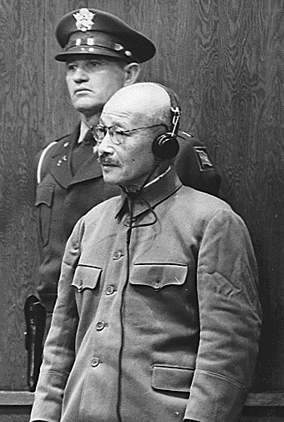
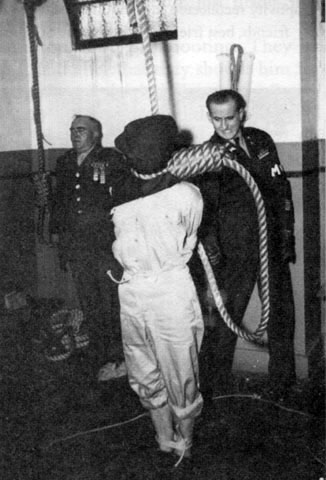
On this date in 1948, seven “Class A” war criminals, including Japan’s wartime Prime Minister Hideki Tojo, were hanged at Sugamo Prison by the American occupation authorities.

Like other Axis heads of state, Tojo was in for a bad end: he shot himself in the chest before American troops could arrest him, but missed his heart even though a doctor had helpfully marked the spot on his chest for him.


Fail.

However inevitable Tojo’s postwar fate, however, he was not exactly of a kind with the likes of Hitler and Mussolini. Indeed, he’d been cashiered from his Prime Ministerial gig in 1944 by the real power behind the throne — the Japanese military.
Unlike the “Fuhrer” and “Il Duce,” Tojo was a reflector, not a creator, of national thought. His word was not law. It was not his command or dictate. He was one among many and not even the first among equals. He was a militarist — misguided, naive, and narrow in outlook; he regarded war as a legitimate instrument of national policy; he apparently believed what he told the court, and failed to recognize the patent contradictions between his contentions and the facts. This had been his undoing.

That’s Robert Butow in Tojo and the Coming of War. Butow argues that the titular authority in Japan (he became Prime Minister shortly before the bombing of Pearl Harbor), a dedicated, patriotic officer of adequate talents but limited vision, came much too late and controlled much too little to be seen as the equal of the European theater’s villains.

The Japan of which General Hideki Tojo became premier was operated by remote control. It was a country in which puppet politics had reached a high state of development, to the detriment of the national welfare. The ranking members of the military services were the robots of their subordinates — the so-called chuken shoko, the nucleus group, which was active “at the center” and which was composed largely of field-grade officers. They, in turn, were influenced by younger elements within the services at large and by ultranationalists outside military ranks. The civilian members of the cabinet were the robots of the military — especially of the nucleus group, working through the service ministers and the chiefs of the army and navy general staffs. The Emperor himself, through no fault of his own, was the robot of the government — of the cabinet and the supreme command, a prisoner of the circumstances into which he was born … Finally, the nation — the one hundred million dedicated souls, the sum and substance of Japan, from whom the blood and toil and tears and sweat of Churchill’s phrase were wrung — the nation was the robot of the throne.

He was the man for his time and place. He fit right in.

Even when being fitted for a noose.

Once Tojo had recovered from his errant self-inflicted wound,* and even though he had been among those opposing surrender even after the atomic bombings, he played ball with the International Military Tribunal for the Far East (whose trial transcripts run to 50,000 pages).

The former premier embraced responsibility, diligently shielding the Emperor from any intimation of guilt (some argue this was the procedure’s entire raison d’etre, from the perspective of both the prosecution and the defense), and walked a dignified and honorable last mile in the courtrooms of the victor’s justice, presenting his perspective as he knew it in the context of a wish for peace between the late antagonists.

1. I deny that Japan “declared war on civilization.”

2. To advocate a New Order was to seek freedom and respect for peoples without prejudice, and to seek a stable basis for the existence all peoples, equally, and free of threats. Thus, it was to seek true civilization and true justice for all the peoples of the world, and to view this as the destruction of personal freedom and respect is to be assailed by the hatred and emotion of war, and to make hasty judgments.

3. I would like to point out their [my accusers’] inhumane and uncivilized actions in East Asia ever since the Middle Ages.

4. In the shadow of the prosperity of Europe and America, the colored peoples of East Asia and Africa have been sacrificed and forced into a state of semi-colonization. I would point out that the cultural advance of these people has been suppressed in the past and continues to be suppressed in the present by policies designed to keep them in ignorance.

5. I would point out that Japan’s proposal at the Versailles Peace Conference on the principle of racial equality was rejected by delegates such as those from Britain and the United States.

6. Of two through five above, which is civilization? Which is international justice? Justice has nothing to do with victor nations and vanquished nations, but must be a moral standard that all the world’s peoples can agree to. To seek this and to achieve it — that is true civilization.

7. In order to understand this, all nations must hate war, forsake emotion, reflect upon their pasts, and think calmly.

The “Class A” convicts not executed along with Tojo were freed afterwards.

Tojo has enjoyed a bit of a latter-day resurgence in the public regard, product of the nationalist right’s resurgence in Japan. The hanged man’s granddaughter Yuko Tojo has waged a tireless campaign to clear him.

Further to that end, his ashes — and those of the other Class A convicts — were covertly added to the controversial Yasukuni Shrine, and remain there to this day. That public tribute to principals of Japan’s bloody foreign occupations has become a hot political football between Japan and other nations, especially China.

But after all, Tojo the man was never a leper, but part and parcel of his times. Small wonder that we moderns hear an echo of the general’s postwar justification for the War in the Pacific from the country that hanged him.

Japan … faced considerable military threats as well.

Japan attempted to circumvent these dangerous circumstances by diplomatic negotiation, and though Japan heaped concession upon concession, in the hope of finding a solution through mutual compromise, there was no progress because the United States would not retreat from its original position. …

Since events had progressed as they had, it became clear that to continue in this manner was to lead the nation to disaster. With options thus foreclosed, in order to protect and defend the nation and clear the obstacles that stood in its path, a decisive appeal to arms was made.

The problematic nature of the war crimes proceedings in postwar Japan (especially vis-a-vis those in Germany) is examined in Yuma Totani’s The Tokyo War Crimes Trial: The Pursuit of Justice in the Wake of World War II. The author discussed her research on the New Books In History podcast.

[audio:http://newbooksinhistory.com/podpress_trac/web/720/0/Totani%20Interview.mp3]

* According to John Dower’s Embracing Defeat, the suicide scenario angered some nationalists because Tojo only “belatedly summoned the will to die,” and “chose the foreigner’s way of the bullet rather than the samurai’s way of the sword, and then botched even this.”

On this day..

2003: Liu Yong, for corruption

On this date in 2003, Liu Yong’s situation took a very abrupt turn for the worse.

The wealthy Communist Party member and Shenyang city legislator had been sentenced to death 20 months before in a corruption case for ordering the murder of a tobacco vendor as part of a mafioso racket of graft, extortion, black marketeering, and kindred mayhem.

When that sentence was reduced on retrial on a showing that Liu’s confession was extracted by torture, public outcry at the appearance of a well-connected insider getting off scot-free led the Supreme Court to take the unprecedented step of yet again re-trying a criminal case itself.

“According to China’s legal system, a criminal case can usually be tried only twice,” as China Daily lightly put it.

Amnesty International is less measured, and alleges that the irregular Supreme Court hearing was ordered by political insiders to buttress the credibility of the country’s anti-corruption drive — and to avoid setting any precedent that evidence of torture should mitigate criminal sentencing. (China certainly found defenders for the trial (the link is to an ugly layout of raw HTML).)

The high court handed down its sentence this very day, after which Liu was immediately hailed to one of China’s mobile execution vans, given a lethal injection, and cremated.

On this day..

1855: The slave Celia, who had no right to resist

(Thanks to Caitlin at Vast Public Indifference for the guest post -ed.)

In 1850, 60-year-old Robert Newsom, a prosperous farmer, traveled forty miles from his home in Callaway County, Missouri to neighboring Audrain County to buy a slave. Newsom was the head of a large and complex household that included several of his grown children, grandchildren, and five enslaved boys and men. His wife had died a few years earlier, a consideration that may have influenced his decision to purchase a female slave, a fourteen-year-old girl named Celia.

From the first day, Newsom treated Celia as his concubine. Testimony given before the Missouri Supreme Court in 1855 indicates that Newsom raped Celia for the first time on the journey home from the slave market. He installed her in a small cabin behind his house, where he continued to rape her on a regular basis over the next five years. During that time, she gave birth to two children.

In the spring of 1855, Celia began a relationship with George, another slave on the farm, and soon discovered that she was pregnant again. At George’s urging, Celia approached Newsom’s daughters and pled with them to protect her from their father during her pregnancy. The oldest daughter, Mary, later testified that Celia had threatened to hurt Newsom if he came to her cabin again, but there is no evidence that either she or her sister intervened.

On the night of June 23, 1855, Robert Newsom went to Celia’s cabin, no doubt intent on raping her yet again. He never returned to his own home.

Although Celia was never allowed to testify in her own defense, investigators reconstructed the events of the night through a combination of physical evidence and Celia’s confession. Fearful of Newsom, Celia had hidden a hefty stick in a corner of her cabin. When Newsom attacked her that night, Celia retrieved her weapon and beat him to death with it. She then dismembered the body and burned it to ashes in her fireplace. The next morning, Celia offered Newsom’s eleven-year-old grandson two dozen walnuts in exchange for his help cleaning out the fireplace and spreading the ashes in the yard.

The jury that convicted Celia of murder accepted her confession as fact, but some elements of her tale do not ring true. As Melton McLaurin observes in his book, Celia, A Slave, the task of cutting enough wood and tending the roaring fire necessary to consume a human corpse in a single night “would have taxed the strength of a healthy woman, and Celia was pregnant and sick” (McLaurin, 49). McLaurin implies that George either helped Celia or was primarily responsible for Newsom’s demise and that Celia may have lied to protect him. George disappeared shortly after the murder and was never arrested or charged.

Celia stood trial for Newsom’s murder in October of 1855 (State of Missouri v. Celia, a Slave). Her lawyer, John Jameson, argued that Celia was legally entitled to defend herself from a would-be rapist under an 1845 law that made any attempt “to take any woman unlawfully against her will and by force, menace or duress, compel her to be defiled” a felony. He requested that the jury be instructed that

The words “any woman” in the first clause of the 29th section, of second article of laws of Missouri for 1845, concerning crimes & punishments, embrace slave women, as well as free white women.

The judge, William Augustus Hall, refused to honor the defense’s motion. Instead, he instructed the jury that a slave had no right to resist her master, even in the case of sexual assault. The jury found Celia guilty and sentenced her to death. (Celia’s child was delivered stillborn in prison.) The Missouri Supreme Court denied her appeal, and she was hanged on December 21, 1855.

Celia’s story is currently part of the interactive Slavery and the Making of America exhibit at PBS.org.

For more information, please see the following books:

McLaurin, Melton A. Celia, a Slave: A True Story. (University of Georgia Press, 1991). Google Books preview

Gordon-Reed, Annette, ed. Race on Trial: Law and Justice in American History. (Oxford University Press, 2002). Google Books preview.

On this day..

1914: Regiment Mixte de Tirailleurs decimated

On this date in 1914, the French army decimated a regiment of its Tunisian soldiers for retreating.

Seriously, decimation? In the 20th century?

Even the most jaded navigator of World War I’s extensive stock of horror may be gobsmacked to find that military executions in this conflict extended to the Roman-pioneered practice of imposing collective punishment on a unit by killing a random tenth of it. Little more is evidently available about this situation online, but the idea of the French military selecting randomly for salutary executions is used in Stanley Kubrick’s Paths of Glory where one officer, charged with providing an enlisted man for trial, simply has them all draw lots.

And according to Gilbert Meynier’s L’Algérie Révélée: La guerre de. 1914–1918 et le premier quart du XX sie`cle (French review), African soldiers’ experience in the Great War with incidents like this tended to underscore France’s colonial domination … and helped contribute to the national identity-forming that would break the French grip on North Africa as the century unfolded.

On this day..