1977: Jerome Carrein, the second-last in France

At dawn this date in 1977, child murderer Jerome Carrein was guillotined in the courtyard of Douai prison. He was the second-last person executed in France’s history.*

He was a vagabond ex-convict who slept most nights in the slough of rural Arleux, cadging food enough off relatives and a pitying local barkeep.


The Marsh at Arleux by Jean-Baptiste-Camille Corot (1871)

It was a more bestial appetite that saw him into the guillotine’s annals: on October 27, he pursuaded an eight-year-old schoolgirl, the daughter of his benefactor publican, to come along with him. Once he had her in the swamps, Carrein attempted to ravish little Cathy Petit. As Cathy struggled, Carrein later explained — he confessed almost immediately — “I saw red. I felt lost in the idea that she would denounce me, so I threw her in the pond.”

Her drowned corpse was discovered the next day.

The growing reluctance of the French state to slice off heads in the 1970s did not express itself in interminable wait times on death row. Carrein was condemned to death on July 12, 1976, during the run-up to Christian Ranucci‘s execution for a similar abduction/child murder.

That conviction was vacated a few months later for a trial irregularity, but the retrial took place in the wake of another high-profile trial: anti-death penalty crusader Robert Badinter had successfully defended a man named Patrick Henry from the guillotine in yet another nationally known child murder case, winning a life sentence instead. There was no small public outcry over this outcome, and Carrein’s prosecutor explicitly called on the jury in his second case to avenge with severity to Carrein the “rape of public conscience” perpetrated by leniency to Henry. (London Times, June 24, 1977)

Pierre Lefrance, speaking for Carrein’s defense, ventured his own appeal to the jurors’ wider sensibilities — in this case, of the growing likelihood that capital punishment was nearing the end of the line in France: “Were the death penalty to be abolished at last in the next year or two, would you wish that Carrein was the last man guillotined in France?”

The invaluable French-language guillotine.cultureforum.net has a forum thread on this case; be sure to note the appearance on page 3 of a poster claiming to be the daughter of Jerome Carrein’s first wife.

* It was also the first execution of France’s last official chief executioner, Marcel Chevalier.

On this day..

1310: Badoer Badoer, Venetian rebel

A Venetian rebel was beheaded on this date in 1310.

Our grim tale actually tacks back to an altogether different death: the sudden January 31, 1308 demise of Azzo VIII d’Este, lord of Venice’s neighbor Ferrara.*

The resulting power vacuum saw Venice under the Doge Pietro Gradenigo tangle for influence in Ferrara with the Papal States of Pope Clement V.

This controversial intervention briefly put a Venetian puppet ruler in charge of Ferrara, but it also led Clement to excommunicate Gradenigo and place La Serenissima under a papal interdict.

The moral force which the condition of society lent to such a measure was immense … It paralyzed trade; it dried up the sources of industrial wealth; it laid a country under every civil and religiou disability; it shed over society an atmosphere of gloom; it affected every relation of life … At home it fomented agitation, gave colour and pretext to the worst motives, and evoked all the latent distempers of the public mind. Abroad, it legitimized rebellion, imparted to moribund antipathies a new vitality, and transformed wavering allies into open enemies. (From History of the Venetian Republic, vol. II, whose detailed narrative of the events relevant to this post continues in Volume III)

Clement also had more temporal weapons to fight with, and he used them to ruthless effect.

In August 1309, papal troops overran the Venetian garrison at the Ferrara fortress of Tedaldo and handled the prisoners like they had the Dolcinians, choking the Po with Venetian corpses.

Conditions were ripe for some disturbances in La Serenissima. The Ferrara thing was a complete debacle, and not only was the same guy still in charge, but his previous foreign policy resume basically consisted of being repeatedly outmaneuvered by Genoa.

Hotheads of three leading families of the Venetian opposition who had vainly counseled neutrality in the Ferrara affair, the Quirini, the Badoer, and the Tieopolo, embarked an audacious plot to mount a coup d’etat toppling the Doge and the whole Ground Council of noblemen by whom he ruled. The conspirators were to act on the morning of June 15 — but hours before that, a vacillating confederate had betrayed them. As a result, when the ferocious Marco Quirini arrived at the Piazza San Marco that morning with his men-at-arms, the Doge had a surprise force waiting to rout him under a furious downpour.

Quirini at least had the honor of dying in hopeless battle for his cause. His son-in-law and co-conspirator Bajamonte Tiepolo, who was to arrive at the same square via the Mercerie, dithered and showed up only when Quirini was already defeated and dead. Legend has it that a woman named Giustina Rosso killed Tiepolo’s standard-bearer dead by hurling (or just accidentally dropping) a mortar upon the rebels as they advanced up the street. (Present-day tourists traversing this upscale shopping street can catch a small bas-relief commemorating this character near the clock tower where the Mercerie opens onto St. Mark’s.)

Tiepolo belatedly charged the square, and was like Quirini repulsed; however, he was able to fall back across the Grand Canal, cutting the bridge against his pursuers, and holed up in a makeshift fortress hoping for reinforcements from the last-arriving of their fellows, Badoer Badoer.

The latter, however, was intercepted on his way to reinforcing the revolutionaries’ position and taken prisoner, which defeat of his hopes led Tiepolo and Doge alike to prefer a negotiated surrender to the charnel house that would have resulted from storming the redoubt. His followers were amnestied and Tiepolo himself sent into exile.

But Badoer Badoer was not covered by this deal. The Council he had proposed to overturn instead tried him for treason, and voted his condemnation on June 22 — a sentence put into immediate effect.

The exiled Tiepolo’s home was razed to the ground and replaced with a column eternally damning his memory:

This land belonged to Bajamonte
And now, for his iniquitous betrayal,
This has been placed to frighten others
And to show these words to everyone forever.

That column today has been removed to a museum — evidently one needs special permission to find it — but a worn stone outside a souvenir shop labeled “Loc. Col. Bai. The. MCCCX” marks the spot where it stood for four centuries.

The plot’s other legacy to Venice was the Council of Ten, a sort of inner secretariat of the Grand Council. Introduced in July 1310 as an emergency measure, the Ten soon became a permanent feature of the state, and an increasingly powerful one into the 17th century. The “temporary” council ended up lasting until the Napoleon finally toppled a by-then tottering Venetian Republic in 1797.

* In the Inferno, Dante accuses Azzo of assassinating his father.

On this day..

1962: Gottfried Strympe, purported terrorist

The novel East German polity was coming in the late 1950s to a crossroads that saw security paranoia ratchet up dramatically.

Emigration to West Germany accelerated considerably as the 1960s began, eventually giving rise to the infamous Berlin Wall.

In the countryside, forced collectivization implemented in 1960 produced resistance all its own. Agricultural output plummeted (the knock-on effects of a 1959 drought helped too); according to Patrick Major’s Behind the Berlin Wall: East Germany and the Frontiers of Power, groceries and everyday household items became markedly more difficult to procure in the early 1960s, sapping productivity throughout the economy as city workers queued for hours and black-market exchanges proliferated.

Following the Soviet Union’s great tradition of attributing economic trouble to running-dog wreckers, East Germany introduced the death penalty for politically motivated economic sabotage* — for example, the 206 cases of arson it attributed among 862 rural fires in 1960. (Figures as per Major.)

Our figure today, Gottfried Strympe, fell foul of these laws. In reality, he was no cackling secret agent but a disturbed loner.

He lurked about the eastern city of Bautzen opportunistically by turns the petty thief or the peeping tom.

Unfortunately for Strympe, who did some spells in psychiatric wards, his deviance extended past the titillation of spying a Hausfrau in her bustier to the much more menacing diversions of pyromania.

The poor man needed a social worker; what he got was the executioner. The charge sheet dramatically attributed his 28 acts of arson (crimes that each caused only minor property damage, and no human casualties) to the inspiration of “West German and American imperialists.”

Strympe, you see, had often visited a father (deceased in 1958) in West Berlin, back before the Wall sealed that city. Of course on those trips, Strympe picked over a Whitman’s sampler of western decadences, from pornography to Social Democracy. On this basis, the Stasi attributed his incendiarism to “terrorism” rooted in “an antisocial attitude strengthened by his stays in West Berlin.”

Strympe had a public show trial, the better that “the population of Bautzen will recognize the danger of communication and travel to West Berlin” (with props of said population — workers’ and civic groups — obligingly supplying the requisite demands for the traitor’s execution).

He was beheaded by Fallbeil at Leipzig on June 21, 1962.

* See Politische Strafjustiz in der Ära Ulbricht: Vom bekennenden Terror zur verdeckten Repression by Falco Werkentin.

On this day..

1979: Bill Stewart, ABC News reporter

On this date in 1979, the American Broadcasting Company journalist Bill Stewart was executed at a somocista checkpoint during Nicaragua’s bloody civil war.

And what is more, the deed was caught on film — pre-emptively balking the crumbling Nicaraguan dictatorship of the ability to, say, blame the killing on the Sandinista rebels.

Warning: This is the execution footage.

Stewart was stopped in a marked press vehicle in Managua, ordered to lie down, and then kicked and shot through the head while colleagues looked on. Though his summary execution by national guardsmen was taped by fellow journos in the convoy, the reasons for it are well into the fog of war: even the identity of the guardsman who pulled the trigger isn’t known. (The commander of the roadblock would claim that it was a “Private Gonzalez” who conveniently died in combat later the very same day.) The immediate “investigation” promised by dictator Anastasio Somoza didn’t really have much chance to get off the ground before Somoza himself had to take to the skies fleeing, on July 17, the collapse of his own regime. Whether the executioner also escaped the revolution, fled into exile, became a Contra guerrilla, or actually did die in the fighting, only God can say.

“The murder of American newsman Bill Stewart in Nicaragua was an act of barbarism that all civilized people condemn,” said U.S. President Jimmy Carter, who of course was backing Somoza.* “Journalists seeking to report the news and inform the public are soldiers in no nation’s army. When. they are made innocent victims of violence and war, all people who cherish the truth and believe in free debate pay a terrible price.”

Stewart’s career and murder are a principal inspiration for the 1983 film Under Fire.

* Or more precisely by this point, backing Somocismo sin Somoza — ease out the unpopular Somoza but keep the same system.

On this day..

1936: Arthur Gooch, the only execution under the Lindbergh Law

This date in 1936 marks the first and only occasion that the federal government hanged a (non-murdering) kidnapper under the Lindbergh Law.

Even before the notorious Lindbergh baby kidnapping case, the “snatch racket” of kidnappings for ransom had claimed a firm foothold among Depression-era America’s moral panics. The bill that would become known as the Lindbergh Law was actually introduced in Congress three months before little Charles Lindbergh, Jr. disappeared out the window of his New Jersey nursery. Its sponsors were Missouri lawmakers concerned that gang-ridden St. Louis was becoming a kidnapping hub, like the high-profile 1931 abduction of Dr. Isaac Kelley.*

The theory behind the bill — and this was particularly relevant to St. Louis, a border port right across from Illinois and accessible via the Mississippi River to the whole Midwest — was that kidnappers could more easily ply their nefarious trade by carrying their hostages over a convenient border and exploiting the respective states’ inability to coordinate with one another. By elevating interstate kidnapping to a federal felony, the idea was to put manhunts into the hands of the FBI, whose jurisdiction was the entire United States.

The Lindbergh case provided just the right impetus for Congress to advance into law a bill that might otherwise have died quietly in committee. There’s just something to be said for being the one with a plan at the right time … even though the Lindbergh baby was found dead four miles away from the house he was plucked out of, and probably never crossed a state line himself.

At any rate, the Lindbergh Law also made kidnapping alone a capital crime, even if the abductee was not harmed. And it is for this that Arthur Gooch ascended into barstool trivia.

Gooch’s life and case are the focus of this 125-page Master’s thesis (pdf), but the long and short of it is that Gooch and a buddy named Ambrose Nix were on the lam after busting out of the Holdenville, Okla., jail, and ended up heading south to Texas.

They committed a robbery in Tyler, Texas on November 25, 1934. The next day, while stopped with a flat at a service station in Paris, Texas — close by the Texas-Oklahoma border — two policemen approached the suspicious vehicle. In the ensuing struggle, Nix managed to pull a gun on everyone and force the subdued cops into the back of their own patrol car, which the fugitives then requisitioned to high-tail it over the Oklahoma border. There they released their captives unharmed. There had never been a ransom attempt.

A month later, Gooch was arrested in Oklahoma — while Nix died in the shootout, leaving his partner alone to face the music.

Arthur Gooch was a career criminal, and the fact that he violated the Lindbergh Law was easy to see, but his crime also wasn’t exactly the scenario that legislation’s drafters had foremost in mind. In fact, Gooch also underscores one of the oft-unseen dimensions of the death penalty in practice: the discretionary power of prosecutors and judges at the intake end of the whole process.

Gooch attempted to plead guilty to his charge sheet, but his judge, former Oklahoma governor Robert Lee Williams, refused to accept it. Williams was explicit that his reason was that the Lindbergh Law’s language required a jury verdict to impose a death sentence.

By contrast, in October of 1934 — a month before the legally fateful confrontation at the Paris service station — a black farmhand named Claude Neal suspected of the rape-murder of a white girl was dragged out of protective custody in Alabama and taken across the adjacent Florida state line, where an angry mob lynched him. Despite the urging of the NAACP, FDR’s Attorney General Homer Stille Cummings completely refused to interpret Neal’s abduction as a Lindbergh Law kidnapping. The two cases even turned on the same phrase of the Lindbergh statute: interstate kidnapping “for ransom or otherwise.” While Cummings decided pre-emptively that “or otherwise” didn’t cover lynch law, one of his U.S. attorneys would go to the Supreme Court in January 1936 to argue for a broad interpretation of that phrase in the context of Gooch’s appeal.

But even without a comparison to Claude Neal’s murder, the justice of executing Arthur Gooch was hotly disputed by a vigorous clemency campaign. The chance intercession of a state line had elevated a small-time crime committed further to avoiding arrest into a capital offense, basically on a technicality. “It would be a rotten shame to hang that boy when a short jail term is his desert,” one Oklahoma City society woman argued to the Jeffersonian Club. “Gooch was given an application of the poor man’s law.” It seems clear that for Judge Williams as for President Roosevelt (who denied Gooch’s clemency appeal) the result was heavily influenced by the political exigencies of pushing a tough-on-crime standard, and by Gooch’s previous history as a crook. (He’d broken out of jail in the first place because he was a member of a group of local hoods in Okmulgee that committed several armed robberies.)

Gooch was philosophical at the end. “It’s kind of funny — dying,” he mused. “I think I know what it will be like. I’ll be standing there, and all of a sudden everything will be black, then there’ll be a light again. There’s got to be a light again — there’s got to be.” We can’t speak to what Gooch saw after everything went black, but it definitely wasn’t “all of a sudden”: Oklahoma’s executioner, Richard Earnest Owen, was an old hand with his state’s electric chair, but the federal execution method was hanging, which Owen had never before performed (and never would again). Gooch took 15 minutes to strangle at the end of the rope.
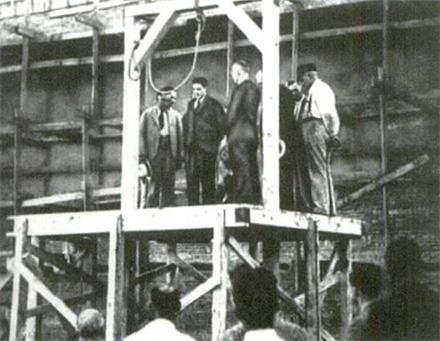

Arthur Gooch on the gallows

* The Kelley kidnapping, unsolved for several years, eventually traced to the strange character Nellie Muench. Readers (at least stateside ones) who follow that trailhead should be sure to keep an eye out for the cameo appearance of Missouri judge Rush Limbaugh, Sr. — grandfather of the present-day talk radio blowhard.

On this day..

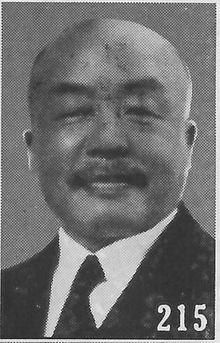
1950: Chen Yi, 228 Massacre author

On this date in 1950, Taiwan’s former nationalist governor Chen Yi was shot for a dalliance with the Reds.

A Kuomintang officer since China’s 1920s Warlord Era, Chen Yi was from 1934 Chiang Kai-shek’s governor of Fujian province — the mainland territory directly across from the island of Taiwan. Chen had the honor at the end of World War II of accepting Japan’s surrender of Taiwan — the occasion commemorated by Taiwan’s unofficial October 25 holiday, Retrocession Day. Postwar, he became governor of that island, back before it was synonymous with nationalist China itself.

His life ended in 1950, when Chiang suspected him of negotiating with the Red Chinese who had overrun the mainland. By that point, however, Chen’s political career was already history, courtesy of the most lasting of his legacies, the 228 Massacre (or more diplomatically … “Incident”).

Taiwan’s new managers — the place had been in Japanese hands since 1895 — made an immediate mess after 1945. Taiwan’s productive economy was essentially siphoned for the civil war the KMT had underway against the Communists, as well as for the venal enrichment of various well-connected mainlanders who hopped over to Formosa for plum assignments that displaced Taiwan’s own local elites.

Billowing inflation fed ethnic resentments, and the whole situation boiled over, as the name implies, on 2/28 of 1947.

On that date, frustrations boiled over* in island-wide protests that turned to riots and even took over administration of Taipei and many other cities. Chen, on whose watch the many grievances had accumulated, suppressed those with enormous violence. Chen regained control of the situation only with considerable violence: well over 10,000 are thought to have been killed in suppression during early March, many of them executed in cold blood by mainland military reinforcements.

An American who had just arrived in China from Taihoku said that troops from the mainland arrived there March 7 and indulged in three days of indiscriminate killing and looting. For a time everyone seen on the streets was shot at, homes were broken into and occupants killed. In the poorer sections the streets were said to have been littered with dead.

There were instances of beheadings and mutilation of bodies, and women were raped, the American said.

Two foreign women, who were near at Pingtung near Takao, called the actions of the Chinese soldiers there a “massacre.” … people were machine gunned. Groups were rounded up and executed.

The man who had served as the town [of Pingtung]’s spokesman was killed. His body was left for a day in a park and no one was permitted to remove it.

While effective in reasserting political power, this didn’t exactly bury the animosities between Taiwanese and mainlanders. It did put an end to Chen Yi’s governorship, however, since it was on his watch that things came to this pass in the first place. Given he then doubled as the author of the bloodbath, he assured himself a place of opprobrium in Taiwanese history.

In 1949, the Kuomintang nationalist government fled rout on the mainland and holed up on Taiwan, implementing an authoritarian state under martial law with a running “White Terror” against dissidence, often broadly conflated with communism. Until political liberalization in the late 1980s, public discussion of 228 was strictly taboo.

Today, there’s enough distance that the event is openly commemorated; indeed, Lee Teng-hui, the politician who embraced Taiwan’s democratic transition around the end of the Cold War, was himself a participant in the 228 protests. There are a variety of memorials and parks remembering 228 in present-day Taiwan … but you’d have to look very hard to find one for Chen Yi.

* The specific boiling point for the protests was a violent confrontation on February 27 when state agents had seized the unlicensed cigarettes of a local peddler. The way things were going, however, there was always going to be something like this to catalyze Taiwanese anger.

On this day..

1800: Suleiman al-Halabi, assassin of General Kleber

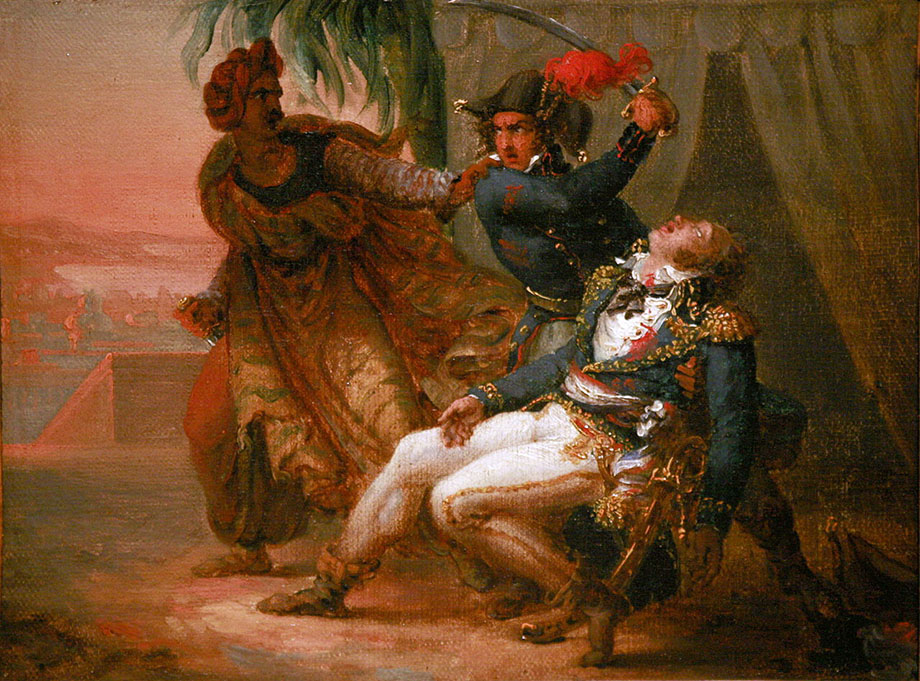
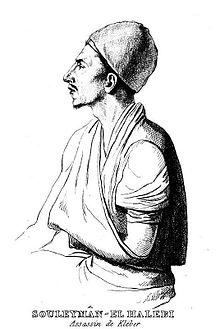
On this date in 1800 — which was the same date they buried his victim — the 23-year-old student Suleiman al-Halabi was put to death in Cairo for assassinating French General Jean Baptiste Kleber.

Casualty of the brief Napoleonic adventure in Egypt, Kleber had received supreme command of the expedition when Napoleon himself returned to France the previous year — a mission which involved running the English naval blockade that trapped the Armee d’Orient.

Kleber, a product of the French Revolution’s military meritocracy who had attained his rank capably suppressing the Vendee royalists, was certainly up to the martial tasks at hand. He routed a larger Ottoman-English-Mamluk force in March of 1800, and then smashed a revolt in Cairo.

But the Napoleonic invasion often figures as a periodization marker for this region: the germ of liberalism and nationalism that would tear apart the Ottoman Empire and set the scene for a recognizably modern Middle East. So it’s somewhat fitting that Kleber would be undone by a figure who could be lifted from the evening news,* the anti-occupation insurgent.

Suleiman al-Halabi (English Wikipedia entry | French) was a Syrian Kurd hailing from Aleppo. (“al-Halabi” means “of Aleppo”)

He had been in Cairo to study, but after a return visit home was induced by the Turks to attend himself to punishing the invader instead. He then made his way back to to Egypt where, disguising himself as a beggar, where he was able to approach the general innocuously and dagger him to death.

The French, of course, had just a few years before this point introduced its most distinctive execution device in place of the ghastly old methods, and employed it with egalite for commoner and king alike. Nor was France, as an imperial power, reluctant about exporting its invention to the every corner of earth.

But in this particular instance, the French decided to prioritize, er, cultural sensitivity.

The committee, after carrying through the trial with all due solemnity and process, thought it necessary to follow Egyptian customs in its application of punishment; it condemned the assassin to be impaled after having his right hand burned; and three of the guilty sheikhs to be beheaded and their bodies burned.

The “guilty sheikhs” in question were men to whom the killer had confided — not his plan, exactly, but the fact that he was on a jihad mission. Hey, close enough.

As for Suleiman al-Halabi himself,

The executioner Barthèlemy sat down on Suleiman’s belly, drew a knife from his pocket, and made a large incision to widen the rectum, then hammered the point of the stake into it with his mallet. Then he bound the patient’s arms and legs, raised the stake the air and mounted it in a prepared hole. Suleiman lived for four hours, and he had lived longer save that, during the absence of Barthèlemy, a soldier gave him a drink which caused his immediate death.

(Impaling victims could live for agonizing days, but the water caused Suleiman, mercifully, to quickly bleed out.)

Not content with going all Vlad the Impaler, the French then paid homage to the invasion’s scientific sub-theme** by shipping Suleiman’s remains back to France for use as an anthropological exhibit.† His skull still remains at the Musee de l’Homme to this day. What’s left in his homeland(s) is a martyr’s memory.

According to the scholar al-Jabarti, whose chronicle is one of the principal sources on this episode, the investigation indicated that Suleiman undertook his mission for no ideology save his family’s desperate need of the purse the Porte was willing to offer. But in the ensuing decades’ growth of nationalism and, eventually, anti-colonialism, the brave young Muslim dying on a spike to slay the French commander could not help but be viewed in an exalted light. (Notably, at the acme of Arab nationalism, the Egyptian writer Alfred Farag celebrated Suleiman as an avatar of resistance in a 1965 play. “I do not kill for revenge,” Farag’s Suleiman avers — and when pressed for the reason, he has a one-word reply: “Justice.”)

* Indeed, the name has been in the news: there’s a Suleiman al-Halabi neighborhood in Aleppo that has seen fighting during the ongoing Syrian civil war. Since it’s even a Kurdish neighborhood one can’t but suspect that it’s named for the man featured in this post; however, I haven’t been able to establish that with certainty. If any reader knows, a comment would be most welcome.

** Napoleon brought a corps of scientists and intellectuals along on his invasion, kicking off the modern Egyptology craze. His mission also uncovered the Rosetta Stone — although that artifact now resides in the British Museum because of the aforementioned naval blockade.

† According to Dark Trophies: Hunting and the Enemy Body in Modern War, phrenologists hailed Suleiman’s skull as an outstanding exemplar of criminality and fanaticism.

On this day..

1578: Ivan Pidkova, Cossack hetman

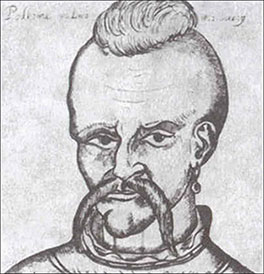
On this date in 1578, Cossack hetman Ivan Pidkova lost his head in Lviv.

Pidkova* — the name means “horseshoe” and alludes to the horsemanship that would be de rigueur for a Cossack leader — had risen by his aptitude to leadership of the Zaporozhian Cossacks in present-day Ukraine.

His death was a bid to promote himself from the steppe to power over neighboring Moldavia, and in fairness to Ivan Moldavia was worth a go.

Its throne was held at that time by a new guy named Peter the Lame, and although the nickname just referred to Peter’s physical deformity, he was a creature of the Ottoman court who scarcely knew Moldavia before he became its vassal ruler in 1574. He was twice temporarily deposed before finally voluntarily resigning in 1591 so that he could retire to the comforts of Italy.

The first deposition came courtesy of our man Pidkova.

Claiming kinship with Peter’s late predecessor Ivan III,** Pidkova seized Iasi and proclaimed himself hospodar of Moldavia until the arrival of Ottoman reinforcements refuted the conceit.

This whole border region between the Polish-Lithuanian Empire to the north and the Ottomans to the south was a perennial trouble spot. Putatively subjects of the Polish crown, the refractory Cossacks were known to raid Ottoman territory illicitly and provoke diplomatic headaches on both sides of the border.

At this particular moment — 1578, that is — the Polish king Stephen Batory had only just concluded a truce with the Ottomans. As Batory had war with Russia to worry about, he was more than keen to keep his southern frontier calm; Polish troops captured the Cossack pretender and had him put to an exemplary death.


Monument to Ivan Pidkova in present-day Lviv. Image (c) stacy2005ua, a prolific photographer of Lviv’s environs whose work can be enjoyed at FaceAndHeart.com or on Flickr, and used with permission.

Ukraine’s national bard Taras Shevchenko celebrated Ivan Pidkova in an eponymous 1839 poem:

There was a time in our Ukraine
 When cannon roared with glee,
A time when Zaporozhian men
 Excelled in mastery!
They lived as masters — freedom’s joy
 And glory were their gain:
All that has passed, and what is left
 Is grave-mounds on the plain!
High are those ancient tumuli
 In which were laid to rest
The Cossacks’ fair white bodies
 In silken cerements dressed.
High are those mounds, serene and dark
 Like mountains they appear,
Their gentle whispers in the wind
 Of freedom’s fate we hear.
These witnesses of ancient fame
 Hold converse with the breeze;
The Cossacks’ grandson reaps the grass
 And sings old memories.
There was a time when in ukraine
 Even distress would dance,
And sorrow in a tavern drank
 In honeyed brandy’s trance.
There was a time when life was good
 In that Ukraine of ours …
Recall it then — perhaps the heart
 May briefly bathe in flowers.

II.

A murky cloud from Liman’s shore
 Covers the sun from sight;
The sea is like an angry beast
 That groans and howls with might.
It floods the mighty Danube’s mouth.
 “My fellows, come with me
Within our barks! The waves are wild.
 Let’s have a merry spree!”
The Zaporozhians rushed out;
 The stream with ships was roiled.
“Roar on, O sea!” they all sang out,
 As waves beneath them boiled.
Billows like mountains round them surged,
 They saw no land, no sky.
Yet not a Cossack heart grew faint,
 Their eagerness ran high.
A bold kingfisher flies o’erhead
 As on they sail and sing;
The brave otaman in the van
 Leads on their mustering.
He strides the deck, and in his mouth
 His pipe grows cold from thought;
He casts his glances here and there
 Where exploits may be wrought.
He curled his long black whiskers,
 He twirled his forelock free,
Then raised his cap — the vessels stopped:
&nbsp:”Death to the enemy!
Not to Sinope, comrades,
 Brave lads beyond all doubt!
We’ll drive on full to Istanbul
 To seek the Sultan out!”
“Well spoken, our fine chieftain!”
 They roared in chorus back.
“I thank you, lads!” He donned his cap.
 Again the seaward track
Beneath their keels began to boil;
 And once more thoughtfully
He paced the deck in mute content
 And gazed upon the sea.

That translation is via The Poetical Works of Taras Shevchenko; the original in Ukrainian can be enjoyed here. The exact text of that poem also comprises the lyrics of this jam:

* Or Ioan Potcoava, as Ivan came from Romanian stock.

** Moldavia’s own “Ivan the Terrible” — no relation to his Russian contemporary, of course.

On this day..

Feast Day of St. Vitus

June 15 is the feast date of the early Christian saint and martyr Vitus.

The 6th century roster Martyrologium Hieronymianum gives us “In Sicilia, Viti, Modesti et Crescentiae”. From this nub grew a legend of the young child of a Roman Senator who turned to Christianity and would not apostatize, fleeing finally to Lucania with his tutor Modestus and his nanny Crescentia and eventually exorcising a demon possessing the son of the Christian-hunting, Empire-quartering Roman sovereign Diocletian. They were all — boy, tutor, and nanny — tortured to death for their troubles; that occurred either by means of or (manifesting God’s customary disdain for the pagan persecutors) after surviving execution in a boiling pot, which has become Vitus’s most typical iconographical emblem. (For example, as seen on the coat of arms of the Austrian town Sankt Veit im Pongau.)


The Martyrdom of St. Vitus, anonymous c. 1450 painting

This story doesn’t have much historical merit, but shrines and chapels to Vitus date as far back as the 5th century so Vitus, whomever he was, had real importance to early Christians.

His cult became especially prominent in medieval central Europe. Prague’s imposing Gothic cathedral bears his name, because Wenceslaus, Duke of Bohemia* allegedly retrieved for it the saint’s arm in a reliquary.**

While many places are dedicated to St. Vitus in Germany, Hungary, and Croatia, the man has red-letter treatment in Serbia — owing to this also being the date in 1389 that the Serbs’ Tsar Lazar was martyred by the Turks at the Battle of Kosovo. As a result, the feast date Vidovdan is a major celebration in Serbia (and to some extent Bulgaria and Macedonia), where it is observed on June 28th — the Gregorian date presently corresponding to the Julian calendar’s June 15th.

The same Vitus who cheers Balkan nationalists trod a completely different path into medical textbooks.

For centuries, Europeans were known to break out in curious ecstatic mass dancing, even sometimes dancing themselves to death. Generally believed today to be psychosocial afflictions, these dancing manias became widely associated with St. Vitus (his patronage includes both dancers and epileptics), whose intercession would be sought to calm the capering souls.

Dancing manias stopped happening in the 17th century or so, but the link between Vitus and involuntary rollick gave the name St. Vitus’s Dance to the condition Syndenham’s chorea — which is characterized by uncontrolled dance-like movement.

* The very Good King Wenceslaus who looked down on the feast of Stephen.

** Speculatively, Sanct Vid might have been selected for Christian veneration in this area to facilitate replacement of the similarly-named Slavic god Svantovid. An active (albeit declining) pagan community persisted in Prague as late as the 12th century.

As with most Slavic deities, Svantovid’s exact characteristics and the extent of his veneration are very poorly documented; however, in 1168, the Wendish fortress of Arkona was conquered by the Danes and the forced Christianization of its inhabitants is commemorated in Laurits Tuxen‘s late 19th century image of Archbishop Absalon casting down Arkona’s idol of Svantovid. (It’s also commemorated by the name of the neo-pagan Russian metal band Arkona.)

On this day..

1972: Sanong Phobang, Thanoochai Montriwat, and Jumnian Jantra

On this date in 1972, three hardened criminals were shot at Bangkok for a savage stabbing murder.

We turn for the particulars here to The Last Executioner, the memoirs of Thailand’s last prison executioner, Chavoret Jaruboon. We’ve posted about him before.

Our setting in 1972 finds Thailand under martial law, an especially nasty interlude during the “three tyrants” era when the dictatorial government had been overthrown from within and was ruling by decree.

One of those decrees came down for Sanong Phobang, Thanoochai Montriwat, and Jumnian Jantra just days after they were arrested for a shocking crime: in the course of trying to pick a woman’s pocket at a bus stop, they’d turned on a bystander who noticed the crime and shouted at the woman to look sharp. The infuriated trio boarded the departing bus, trapped the good Samaritan, and stabbed him to death.

Upon determining that the guys were violent career criminals, the authorities just sent an order to have them summarily shot. Snap executions on executive authority were common in this year.

The criminals heard the execution order read only immediately before the sentence was carried out, although by that time they had inferred their fate from the fact that they had been driven to the death house. (And been given a few moments to write their families. We’re not dealing with monsters here!)

We join our executioner’s narrative, noting that at this early stage in his career he was not yet the man who shot the prisoners, but an “escort” on the execution team who readied the prisoners for the executioner.

Suddenly it hit the three of them that this was it. Thanoochai fell out of his chair and screamed for mercy.

“Please don’t kill me sir. Let me see my mother first, she knows people, let her help me, please let me see her!”

The prisoners hugged each other and cried like children.

… at 5.25pm the other escort and myself led Jumnian out of the tower and over to the execution room. Nobody spoke. I think I half expected him to faint but he didn’t. He had resigned himself to his fate and was like ‘a dead man walking’. We had blindfolded him at the gazebo and when we reached the room we firmly secured him to the cross … Mui [the executioner] readied himself over the Bergmann [MP 34/1] and waited for the flag to drop. He fired one shot, which sent eight bullets into Jumnian’s back. He died instantly.

I headed back with the other escort to collect Thanoochai. He blanched when he saw us but didn’t try to resist as we brought him out of the tower. However, all hell broke out at the execution room. He shocked me by suddenly tearing off the blindfold and shouting out for his mother. He kept insisting that his mother be allowed to see him as she could save him because of who she knows, and implored us not to kill him. All the time he was shouting his pleas his eyes roved around wildly searching for his mother but of course she wasn’t there. She was probably in her kitchen praying for him. The staff just stood there staring at him in horror. He really seemed to think his mother was going to appear and save him.

Then he remembered his friend who had gone before him and began to call out for Jumnian.

“Nian! Are you in there? Answer me man. Do you hear me? Answer me you asshole. Are you dead? Why don’t you answer me?”

The silence was almost cruel, as if he was being taunted in his madness on top of everything else … Thanoochai realised that Jumnian would never reply to his shouts, followed by the realisation that it was also too late for him. He crumpled to the floor in front of the execution room, surrounded by staff, and began to cry quietly. … All his fight had gone now, but he still had not lost hope. As we half dragged, half carried him into the room, he still called out for his mother;

“Please help me Mom, please help me.”

… It took four of us to get him standing in front of the cross … I pushed my knee into his back to force him against the cross so that we could bind him to it. One guy tied his hands up around the cross; another guy tied his weight while the other escort and I tried to stop his squirming. Only when he was completely secure did he finally shut up.

At 5.40pm Mui fired 12 bullets into Thanoochai.

… [after the third, more routine, execution] the room stank of blood, sweat and gun powder. There was a lot of blood from each of the men all over the floor and the sand bags. Unfortunately the floor is never cleaned immediately after a shooting. Sand is just thrown down to blot up the puddles and left there overnight for the inmates, who are in charge of the room, to tidy up the following morning.

At this point, Chavoret Jaruboon muses on the spookiness of the execution cell and the belief among some members of the team that the spirits of the shot haunt the place.

The next morning, he tells of being visited by the mother of the panicked Thanoochai Montriwat, who related a dream:

I dreamt about my son last night. He was crying and when I asked him why he didn’t answer. He just stood there and then blood started to ooze out of every part of his body … He told me he lost his shoes and asked me to get them back. He just kept repeating that. I don’t really understand but I’m afraid he won’t be able to rest in peace, which is why I need your help.

Sure enough, one of the prisoners tasked with tidying up the bodies for delivery to the Buddhist temple had taken Thanoochai’s shoes for himself. Thailand’s future last executioner had them retrieved and delivered to the grieving mother.

She was a good woman and kept begging her son’s victims to see into their hearts if they could forgive her son. She was going to cremate the body and wanted Thanoochai to feel in the consuming flames, the goodness and forgiveness emanating from everyone he had hurt which would fill him with regret and sorrow for his criminal ways. A parent’s love can be the purest love there is; no matter what a child does he is forgiven and still fiercely loved.

On this day..