2007: Not Sina Paymard, saved by a flute

On this date one year ago, a teenager who saved himself with a flute cheated Iran’s hangman by the narrowest of margins.

Sina Paymard had had the hemp about his throat the previous fall for murdering — at the tender age of 16 — a drug dealer in a pot buy gone bad.

The bipolar young musician’s last request was to play the ney (a Persian flute), and in a feat fit for legend, he played so movingly that the family of the victim reprieved him.

This power under Islamic sharia law comes with a price: the reprieve bought time for the families to negotiate alternative financial compensation known as diyeh. Come July, the lad’s family was still $90,000 short, and he was shifted to Tehran’s Evin prison to do the whole thing over again.

Sina’s new execution date received worldwide attention:

… helping them scrape together enough from donors (“notably a substantial donation from a university lecturer”) to make good his escape.

Such are the vicissitudes of the Iranian judiciary that Paymard went from all but dancing on air twice to outright liberty: he’s a free man today, or was as of a few months ago.

Though things worked out for Sina Paymard, other juvenile offenders continue to face the ultimate sanction in Iran — virtually the last outpost of the practice on the globe. Earlier this month, StopChildExecutions.com detailed 138 Iranian prisoners condemned for crimes committed as children; Iran has executed at least two such prisoners this year.

On this day..

1918: Tsar Nicholas II and his family

In the small hours after midnight on the night of July 16-17 90 years ago, the former Tsar Nicholas II, his wife, children, and four family retainers, were shot in a Yekaterinburg basement by their Bolshevik jailers.

Doting family man, vacillating dictator, as weak and rich as Croesus … the doomed Emperor and Autocrat of All the Russias was a man small of stature. His reign emerged under a bad star when 1,300 Muscovites were trampled to death in the crush for his coronation largesse; 18 years later, Nicholas‘s support for Serbia against Austria-Hungary was instrumental in pitching Europe into World War I, a blunder for which he reaped a whirlwind long in the making.

When an anti-Bolshevik force approached Yekaterinburg (or Ekaterinburg), where the deposed royals had been stashed in a commandeered private residence,* Yakov Sverdlov (for whom the city was subsequently renamed) ordered the prisoners shot — not only the tsar, but his beloved wife, their hemophiliac heir, and those four daughters who had to be bayoneted because the state jewels secreted in their corsets shielded them from the gunfire.

The executioners (here’s the account of their leader; here’s another guard’s version) did their best to destroy and conceal the remains, helping fuel subsequent rumors that one of the children had survived and escaped.

Those rumors are only now, with post-Soviet investigation and DNA forensics, being debunked, and not yet to the satisfaction of all comers. This very week, Moscow affirmed (though the Orthodox church has not accepted) that the last of Nicholas’s family had been accounted for:

Modern nostalgia for this unimpressive sovereign is making a minor comeback, with Nicholas absurdly contending in a current poll for the title of “greatest Russian” … supported not only by the miseries of the state that succeeded his, but by the family’s decent and accessible private life.

Even a monarchist — especially a monarchist! — shouldn’t reason that the greatest monarch is the one who drove the bus over the cliff. But much is forgiven a martyr. Indeed, like Charles I of England, the last Romanov monarch has been posthumously saddled with divine sanction; he and all the family are certified “passion bearers”. (Update: And possible future relics!)

A handful of the many books about the Romanovs and their fall

* The Ipatiev House where the tsar was held (and shot) no longer stands. On its spot is a church consecrated five years ago yesterday to the Romanov canonization.

Update: The Romanovs were officially rehabilitated by the Russian Supreme Court on October 1, 2008.

On this day..

1573: Wigbolt Ripperda, Haarlem city governor

On this date in 1573, Wigbolt Ripperda was beheaded in Haarlem’s Grote Markt for having led a stubborn seven-month resistance to a Spanish siege.

Ripperda had been a Calvinist with a hand in the iconoclastic spasm against Catholic churches that had led to the beheadings of Counts Egmont and Hoorn a few years prior.

In the intervening years, relations between the Low Countries and the Spanish crown that ruled them had deteriorated into outright revolt — the germ of the decades-long struggle that would result in Dutch independence.

Haarlem had initially tried to keep its head down in the conflict, but had declared against Spain in 1572. That brought it into the sights of a vengeful Spanish army that greatly outnumbered Haarlem’s 4,000 defenders. Spurning any talk of compromise or capitulation, city governor Ripperda rallied his garrison and held out against the Spanish siege throughout the winter and spring.

In the end, starvation did the work that engines of war could not. Haarlem fell on July 12, 1573.*

Ripperda was beheaded with a lieutenant a few days later, but in winning the battle, Spain had suffered a setback in the war: besides the seven-month delay, other Calvinist strongholds took heart from the effective resistance and got a lot less cowed by the royal army.

While this day’s martyrdom made “Ripperda” a fixture in Haarlem place names, and despite a somewhat illustrious family tree that also includes a signatory of the Peace of Munster and a fascinatingly disreputable 18th century politician, actual Ripperdas are apparently hard to find in present-day Holland. According to American Tom Ripperda, who runs the family site ripperda.org, the name lives on only in the U.S. and Germany.

“In the 1830s the last of the Dutch Ripperdas died,” Ripperda told me. “There are no Ripperdas in the Netherlands since they moved to Germany (about 200 or so) and on to America (about 600 or so).”

* As to the vengeful mass executions visited on Haarlem, John Lothrop Motley conveys this anecdote.

Instead of Peter Hasselaer, a young officer who had displayed remarkable bravery throughout the siege, the Spaniards by mistake arrested his cousin Nicholas. The prisoner was suffering himself to be led away to the inevitable scaffold without remonstrance, when Peter Hasselaer pushed his way violently through the ranks of the captors. “If you want Ensign Hasselaer, I am the man. Let this innocent person depart,” he cried. Before the sun set his head had fallen.

On this day..

1685: James Scott, Duke of Monmouth

On this date in 1685, the haughty Duke of Monmouth mounted the scaffold at London’s Tower Hill to suffer beheading for treason, and tipped the headsman with the words, “Here are six guineas for you and do not hack me as you did my Lord Russell. I have heard you struck him four or five times; If you strike me twice, I cannot promise you not to stir.”*

Upon this tart public reminder of his recent and infamous failure of craft, the eponymous executioner Jack Ketch quite came apart.

Monmouth, certainly, would have appreciated the advance that would bring the guillotine. Beheading by a free-swinging axe was a ghoulishly inexact procedure: bad aim, insufficient force, an untimely flinch, or the tough neck muscles of a grizzled campaigner regularly complicated the process, often to the fury of spectators. Jack Ketch is sometimes reported a sadist, and sometimes a professional hangman so rarely summoned to give a nobleman the chop that he simply lacked proficiency. Either way, he’d been on the job for a generation by this time: his reputation for infelicity with the blade preceded him.

Historical fiction from the perspective of the Duke of Monmouth.

Monmouth, an illegitimate son of King Charles II, had cause to dread Ketch’s offices for the rebellious culmination of a long power struggle with his uncle, the future King James II.

The personal contest between these men for the throne of England was the echo of the decades-old struggles straining the English polity — the Reformation and the reach of royal authority.

As it became known that the king’s brother James had gone from Catholic sympathizer to Catholic convert, Protestants began maneuvering to keep him from inheriting the crown. For three years, Parliament pushed the Exclusion Bill, which would have excluded James from succession.**

Favor among the bill’s supporters settled on the Protestant playboy Monmouth — politically convenient rumors that he was actually a legitimate child began circulating. “Weak, bad, and beautiful,” this unfriendly-to-Monmouth free book has him; whatever he was, his allies in the House of Commons were handily outmaneuvered. The Exclusion measures failed, and in 1685, James II began his reign as England’s last Roman Catholic monarch.

Monmouth’s hopes had been raised, however, and he proceeded to invade England at Dorset with a somewhat ragtag army that was routed by the Protestant royal troops who remained loyal to James at the Battle of Sedgemoor — not quite the last battle fought on English soil, but the last consequential one (the last fought with pitchforks makes a livelier distinction). Monmouth was caught trying to get away in a shepherd’s disguise. Other fugitives of his cause were hunted mercilessly.

The defeated duke was reputedly not above begging the sovereign for his life; obviously, that didn’t work out. But his cause was a popular one, nearing reverence among some commoners. Jack Ketch may have had a case of the butterflies even before the duke undressed him … and as it turns out, Ketch almost left the scaffold worse than his victim.

Here is the scene in Macaulay’s words:

The hangman addressed himself to his office. But he had been disconcerted by what the Duke had said. The first blow inflicted only a slight wound. The Duke struggled, rose from the block, and looked reproachfully at the executioner. The head sank down once more. The stroke was repeated again and again; but still the neck was not severed, and the body continued to move. Yells of rage and horror rose from the crowd. Ketch flung down the axe with a curse. ‘I cannot do it,’ he said; ‘my heart fails me.’ ‘Take up the axe, man,’ cried the sheriff. ‘Fling him over the rails,’ roared the mob. At length the axe was taken up. Two more blows extinguished the last remains of life; but a knife was used to separate the head from the shoulders. The crowd was wrought up to such an ecstasy of rage that the executioner was in danger of being torn in pieces, and was conveyed away under a strong guard.

In the meantime many handkerchiefs were dipped in the Duke’s blood; for, by a large part of the multitude he was regarded as a martyr who had died for the Protestant religion.

Just the sort of soil for posthumous tall tales — that his execution was bogus and he was in hiding to return again, or had been packed off to France to become the Man in the Iron Mask. One possibly better-founded legend is that his head was set back upon its stump to sit him for what must have been a pungent portrait.

Protestant opponents of James were much thicker on the ground than the Duke’s own person, of course. They soon succeeded where Monmouth had failed.

* Slightly different versions of this address from the Duke to the executioner are recorded. Macaulay omits the “if you strike me twice” clause but adds “My servant will give you some more gold if you do the work well”; a more polite (barely) construction suggests “Do not serve me as you did my Lord Russell.”

** The factions in this dispute — the “Petitioners” (supporting the bill) and the “Abhorrers” (supporting the king) — evolved into the Whig and Tory political parties.

Part of the Themed Set: Embarrassed Executioners.

On this day..

1989: Horace Franklin Dunkins, Jr., “just hope that he was not conscious”

Minutes after midnight this date in 1989, Alabama’s executioners electrocuted a developmentally disabled murderer. Nine minutes later, after rewiring the chair, they finally managed to kill him.

Alabama’s fifth execution of the “modern” era initially made the headlines as the nation’s first execution of a mentally impaired prisoner after the Supreme Court’s controversial Penry v. Lynaugh decision (since overturned) green-lighted the death penalty for developmentally disabled defendants.

Horace Franklin Dunkins, Jr. and an accomplice had raped a mother of four, tied her to a tree, and stabbed her to death, an unquestionably horrific crime. A black man with a white victim deep in Dixie … well, his IQ in the high sixties wasn’t going to help him do anything but waive his right to remain silent. The jury at his trial didn’t hear about his borderline mental retardation — Penry would require that juries get that information in the future — and at least one juror later said that little tidbit would have made the difference in Dunkins’s case.

At any rate, the buzz in this morning’s papers wasn’t about the circumstances of Dunkins’s entry into the criminal justice system, but his clumsy exit from it into the great hereafter.

According to the account of a Dr. John Vanlandingham:*

I saw Dunkins in the electric chair and I heard the generator start…. After a short period of time the other doctor … and I were called into the execution chamber. I could see that Dunkins was breathing…. I checked his peripheral pulse, in his wrist, and it was normal. I listened to his heart and his heartbeat was strong with little irregularity…. I told an official that Dunkins was not dead. Dr. – and I returned to the witness room…. I again heard the generator begin.

“I believe we’ve got the jacks on wrong,” the prison guard captain called out. It was flatly not enough current to kill, although it apparently did the killer the favor of knocking him out.

From 12:08 to 12:17, Dunkins sat motionless and seemingly unconscious while the execution team went all MacGyver on Yellow Mama. Once they’d fit Tab A into Slot B into Lethal Electrode C, they were finally able to try again. The doctors pronounced death 19 minutes after the switch had first been thrown.

”I regret very very much what happened,” the Alabama Prison Commissioner, Morris Thigpen, said at a news conference after the execution. ”It was human error. I just hope that he was not conscious and did not suffer.” (The New York Times)

* Dr. Vanlandingham was participating in the execution despite an injunction by the American Medical Association, which considers it a violation of the Hippocratic Oath. Physicians’ involvement (or not) in executions is a thorny ethical issue of its own; Vanlandingham, however, is not the only doctor to break the taboo.

Part of the Themed Set: Embarrassed Executioners.

On this day..

1882: Thomas Egan: 3 tries, 2 ropes, 1 innocent man

On this date in 1882, Thomas Egan was hanged in Sioux Falls in the Dakota Territories (present-day South Dakota) for strangling his wife, Mary.

It took three tries to get the hanging right … and it still turned out they got it wrong: years later, Egan’s stepdaughter copped to the crime on her deathbed.

Egan was the first man hanged (.doc) by state officers in the Dakota Territory; earlier, Jack McCall had been executed there by the feds.

Let’s start with the twice-botched hanging, whose can’t-look-away horror can hardly be improved from its original coverage by The Chicago Tribune (picked up elsewhere as well — such as The Alexandria Post of Douglas County, Minnesota):

A HORRIBLE AFFAIR.

The Execution of Thomas Egan, the Wife Murderer, at Sioux Falls, Dak — The Drop Fails Three Times Before the Culprit is Deprived of Life, Owing to Rotten Ropes.

On Thursday, July 13, occurred at Sioux Falls the first judicial hanging ever done in the territory of Dakota. Nearly two years ago Thomas Egan, who suffered the death penalty, most foully and cruelly murdered his wife, with whom he had lived for nearly a quarter of a century. From evidence produced at the trial it would appear that they had frequent quarrels which at length culminated on this fatal morning in her death. He deliberately sent the children away, and while she was washing dishes at the table came behind her, and after throwing a rope around her neck and strangling her, pounded the life out of her with a club. The body was then thrown through a trap door into the cellar, where it was found three days after, horribly mutilated. The skull was fractured and the head was covered with frightful gashes made by the club. It appeared also as if she were not dead when thrown down, as she was discovered partly reclining against the call [sic] of the cellar, which added to the horribleness of the crime. Eagen [sic] was arrested and tried, and although there was every effort made by his attorneys to save him; he was convicted and sentenced to be hanged at Sioux Falls by Judge Kidder of the Fourth judicial district of the territory.

On Thursday, 13th, after eating a hearty breakfast, hearing the sentence read, and some religious exercises by a Catholic priest, Eagan [sic] was taken to the gallows. All eyes were intently fixed on the prisoner. His face was somewhat pale, but his lips were firm and he seemed to exhibit no sign of fear. He was a straight, heavy-set man, weighing 180 lbs., with a retreating forehead, heavy projecting eyebrows and an ugly looking eye. His general appearance was far from prepossessing. He was dressed in a plain black suit, with clean white shirt, collar and tie, and low shoes. He walked straight up to the platform to the scaffold, taking his place on the fatal trap, turned around and faced the crowd below. The sheriff now asked him if he had any thing to day [sic], but his lips still were kept sealed to his secret, and he shook his head and answered in a low voice, “No.” His legs were now tied, he himself assisting the officer by placing his feet close together. The black cap was put on his head, but not a limb quivered. The noose was adjusted and the fatal moment had come. While the priests were chanting their solemn service, and while the attending officers and crowd were holding their breath in silence, the sheriff touched the trigger which alone kept Thomas Egan from his death. There was a crash as the door flew back against the boards and body, deprived of its footing, shot through the door, and now, horror or horrors!

The rope snaps like a piece of thread, the body drops to the earth with a dull thud, partly on its back, and rebounding rolls over on its face. The crowd are paralyzed with astonishment and fear. An unearthly gurgling sound now breaks forth from the prisoner. His neck is not broken, but the cord is wound tightly about it and he is strangling. A half a dozen men now rush forward, one seizes him by the arm, another by the leg, another by the waist, another by the head. It is seventy-five feet from the ground, where he has fallen, back to the jail-door, and around to the platform of the scaffold he is hurriedly conveyed through the crowd, the broken rope in the meanwhile dangling from his neck, while his horrible groaning strikes terror to the bystanders. Once more on the scaffold, another rope is adjusted and the sickening details once more gone through with, the trap falls again and the half dead man drops once more; but worse. The rope was not fully adjusted before the excited sheriff again touched the trigger and down the body goes a second time but not with sufficient force to accomplish the desired result.

His neck is still unbroken, and the slow process of suffocation is all this time going on. The attendants seize him by the arms and again pull him on the scaffold while the death struggle continues. The first rope is flopping from his neck and he still has life enough, so one says who was on the scaffold, to brace his feet for the third and last fall. If at this juncture some one had mercifully stepped up and put a bullet through his head, it would have been an act which would have certainly been appreciated by the crowd. The rope is finally fixed, the door drops once again, the man shoots down, and there is a snap which is heard all around the yard and outside. There is a shrugging of the shoulders, a twitching of the legs a convulsive shudder and all is still. The body swings slowly around. There is no motion of leg or arm or muscle, and in eight and one half minutes the doctors pronounced him dead, and shortly after the body was taken down. Yes, he is dead at last, and the sightseers heave a genuine sigh of relief. The corpse is now cut down and the pinioned arms and legs released. The dirt was brushed from the clothing and body laid in a coffin, where it was afterwards viewed by the crowd, both outside and inside the jail. The effects of the strangulation were fearfully evidence about the neck. The first cord had embedded itself, but the action of the heart had forced the blood under it and the flesh was swollen, purpled and discolored. There was a sightless stare to the eyes and blood was flowing out of the corners of his mouth. After all those desiring had seen the corpse it was boxed up, and early in the afternoon it was taken to the Catholic burying-ground where it was buried, and with it the club and cord with which he killed his wife.

Nobody in a position to help Egan knew he hadn’t “most foully and cruelly murdered his wife” or that “the horribleness of the crime” stained some other’s soul, of course … but one wonders how the writer thinks he did know it. The obscure considerations of jurymen might well be the most virtuous structural safeguard of the Republic, but as a dependable compass of fact, one might as well scry the entrails of a sacred ox.

It has always seemed misfortunate to the Headsman that journalists prone to the most tedious wheedling over the use of the qualifier “allegedly” to uphold the principle of innocent before proven guilty consider the epistemological certitude of a juridical conviction sufficient to abandon full stop the (admittedly inelegant) qualifier and speak of Revealed Truth. The New York Times would hardly think to make apology for flatly calling Egan — who did keep his peace about the verdict — “the wife murderer”:


… any more than the San Antonio Express-News would regret the assertive headline “Father who killed 3 is executed” mounted atop an article reporting the executed man’s continued insistence upon his innocence. Any good scribe frets more readily about column-inches and legal ass-covering than bickering and arguing over who killed who. But shame if not stylistics merits less awe before the particular sausage-making of the judiciary when such modern cases too turn out to have been cock-ups from start to finish.

In 1993, South Dakota Governor Walter Miller apologized (.pdf) for Egan’s execution. A descendant of Egan’s has written a book about the case, Drop Him Till He Dies: The Twisted Tragedy of Immigrant Homesteader Thomas Egan.

Part of the Themed Set: Embarrassed Executioners.

On this day..

1726: William Fly, unrepentant pirate

On this date in 1726, an obscure boatswain who had mutinied for the liberty of piracy succumbed but did not submit on the gallows in Boston.

Fly overthrew (figuratively and literally — they both ended up in the drink) a tyrannous captain and first mate on a British slave ship in May, reconstituting it Fame’s Revenge, and in a northward journey from North Carolina to New England captured a few less-than-lucrative ships in a month and change.

A minor character in the annals of seaborne pillage. So why should historian Marcus Rediker devote the opening chapter to his Villains of All Nations: Atlantic Pirates in the Golden Age (review) to this man?

[T]he early-eighteenth-century pirate ship was a world turned upside down, made so by the articles of agreement that established the rules and customs of the pirates’ alternative social order. Pirates “distributed justice,” elected their officers, divided their loot equally, and established a different discipline. They limited the authority of the captain, resisted many of the practices of capitalist merchant shipping industry, and maintained a multicultural, multiracial, and multinational social order. They demonstrated quite clearly — and subversively — that ships did not have to be run in the brutal and oppressive ways of the merchant service and the Royal Navy.

Rediker’s sympathetic but unromantic work treats the radical, doomed sphere of resistance pirates offered to the enormous cruelty of the developing Atlantic economy: grinding exploitation of white sailors in the service of the black slave trade under the iron hand of the empire (British, in this case, but hardly exclusive to Old Blighty.)

It bears the trace of Hakim Bey‘s treatment of Temporary Autonomous Zones:

Fleeing from hideous “benefits” of Imperialism such as slavery, serfdom, racism and intolerance, from the tortures of impressment and the living death of the plantations, the Buccaneers adopted Indian ways, intermarried with Caribs, accepted blacks and Spaniards as equals, rejected all nationality, elected their captains democratically, and reverted to the “state of Nature.” Having declared themselves “at war with all the world,” they sailed forth to plunder under mutual contracts called “Articles” which were so egalitarian that every member received a full share and the Captain usually only 1 1/4 or 1 1/2 shares. Flogging and punishments were forbidden — quarrels were settled by vote or by the code duello.

Certainly many men (and women) turned to piracy for many different reasons. Rediker’s work on the systematic brutality in the guts of the imperial economy and the pressures of resistance and coercion they spawned finds an outstanding individual exponent in this day’s victim.

Fly walked indifferently to the gallows; to the astonishment of the spectators, he upbraided the hangman’s poor knot and remade with his own hands the instrument for his own neck — one last use of his seaman’s proficiency with ropes.

On Fly’s turn upon that fatal stage, he would not read from the classics — not cower before his executioners, not salute the majesty of the crown that hung him, not enjoin the mob to straighten up and sail right, and certainly not be cowed on the cusp of the eternal by officious colonial holy roller Cotton Mather’s vain personal bid to convert the corsair:

When the time came for last words on that awful occasion, Mather wanted Fly and his fellow pirates to act as preachers — that is, he wanted them to provide examples and warnings to those who were assembled to watch the execution. They all complied. Samuel Cole, Henry Greenville, and George Condick [three of Fly’s crew], perhaps hoping for a last-minute pardon, stood penitently before the crowd and warned all to obey their parents and superiors and not to curse, drink, whore, or profane the Lord’s day. These three pirates acknowledged the justice of the proceedings against them, and they thanked the ministers for their assistance. Fly, however, did not ask for forgiveness, did not praise the authorities, and did not affirm the values of Christianity, as he was supposed to do, but he did issue a warning. Addressing the port-city crowd thick with ship captains and sailors, he proclaimed his final, fondest wish: that “all Masters of Vessels might take Warning by the Fate of the Captain (meaning Captain Green) that he had murder’d, and to pay Sailors their Wages when due, and to treat them better; saying, that their Barbarity to them made so many turn Pyrates.” Fly thus used his last breath to protest the conditions of work at sea, what he called “Bad Usage.” He would be launched into eternity with the brash threat of mutiny on his lips.

“Bad Usage.” Rediker later defines it as “the violent disciplinary regime of the eighteenth-century deep-sea sailing ship, the ordinary and pervasive violence of labor discipline as practiced by the ship captain as he moved the commodities that were the lifeblood of the capitalist world economy.”

The resistance to a pattern of savage floggings, cheated wages, and the whole spectrum of rough and arbitrary authority on a shipboard dictatorship might be spontaneous and individual in the instant … but it was thick with the stuff of solidarity, and the fraternity of outlawry could make people equal across the boundaries of national rivalry and institutional racism — “Villains of all Nations,” as the title goes.

And the obdurate, like Fly, could every now and then move the pastors who were sent to thunder hellfire at them rather than the other way around.

As it happened, the “stupid” and “impenitent” pirate [Mather uses these words to describe Fly elsewhere] was able to convince the self-righteous minister of at least one primary cause of piracy. During his execution sermon, Mather made it a point to address the ship captains in the crowd, telling them in no uncertain terms that they must hereafter avoid being “too like the Devil in their Barbarous Usage of the Men that are under them and lay them under Tempations to do Desperate Things.”

After the hanging, William Fly’s body was gibbeted as a warning on Nixes Mate, a barely-there speck of an island at the mouth of Boston Harbor. For Rediker, this date marks the end of the Golden Age of Piracy.

Although the full book is worth the buy, a paper Rediker wrote on the subject prior the book’s publication is available free online.

Part of the Themed Set: Embarrassed Executioners.

On this day..

472: Anthemius, twilight emperor of Rome

On this date in 472, one of the last “twilight emperors” of the western Roman Empire — and the last of any conspicuous ability — was beheaded by his rebellious general Ricimer.

Here in Rome’s dying days, the dangerous, centuries-old game for the purple was played with the twist of political triangulation with barbarian kings who had set up permanent shop within the old empire’s borders.

Maybe it was his closet paganism, or his Greek patrician breeding, or the way he slung his toga — whatever it was, Anthemius didn’t have the knack for winning them over.

Born and reared in Constantinople, Anthemius was being groomed for succession in the relatively less treacherous eastern empire when his royal patron (and father-in-law) suddenly got gangrene and died.

The Alan commander who held military power in the east wasn’t into Anthemius, so he got the Al Gore treatment and Leo I got the laurels. Interestingly, although barbarian tribes were establishing themselves as the power behind the throne — and this was even more true in the west — they were not yet prepared to assert the imperial majesty in their own names. That last feeble cultural bulwark, however, would not hold out much longer.

Leo “rewarded” Anthemius for taking it all in stride by appointing him emperor of the perilous west. (He also rewarded the kingmaking barbarian chieftain by having him murdered. “Leo the Butcher,” he’s called.)

That pissed off legendary Vandal king Genseric (or Gaiseric, or Geiseric), who had sacked Rome in 455 and settled into a long career lucratively plundering the Mediterranean. And with good reason: Leo’s idea was for the two emperors jump Genseric.

Now, before this time Leo had already appointed and sent Anthemius as emperor of the west, a man of the senate of great wealth and high birth, in order that he might assist him in the Vandalic war. And yet Gaiseric kept asking and earnestly entreating that the imperial power be given to Olybrius, who was married to Placidia, the daughter of Valentinian, and on account of his relationship well-disposed toward him, and when he failed in this he was still more angry and kept plundering the whole land of the emperor. (Procopius)

That war was a debacle and left Genseric merrily raiding Italy, but Anthemius’ real problem was domestic: his new realm had its own Germanic commander who also preferred to pick his own emperors, and he took an instant dislike to the foreign ponce. Anthemius and Ricimer managed a brief detente, during which the new guy tried to take Gaul back from the Visigoths (no dice), but the two fell to fighting in 472. After a brief siege, Ricimer overran Rome and set up in Anthemius’ place that Genseric-favored Olybrius (who would last all of 39 days).

Anthemius took refuge in one of Rome’s churches — either St. Peter’s or Santa Maria in Trastevere — where he was betrayed, and beheaded by (naturally) Ricimer’s Burgundian nephew.

On this day..

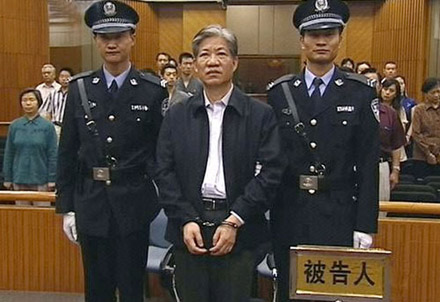
2007: Zheng Xiaoyu, former Director of the State Food and Drug Administration

One year ago today, China made to clean up its image — with public health advocates, if not with human rights advocates — by executing* its former Food and Drugs minister for economic crimes.

Zheng Xiaoyu, China’s drug regulation capo from 1994 to 2005 and only (“only”?) the fourth minister-level official to be put to death in China since the immediate aftermath of Mao Zedong’s reign, was sentenced for extracting bribes from pharmaceutical companies he nominally regulated in exchange for approving their worthless and/or unsafe products.

One bogus antibiotic he rubber-stamped killed ten in China before it was pulled from the market, but it was dangerous Chinese products exported abroad — including lethal pet food ingredients to the United States and a cough syrup that killed dozens in Panama — that lit a fire under the export-driven colossus. The court that rejected his appeal explicitly referenced Zheng’s danger to China’s international reputation — simultaneously shifting focus from structural weaknesses by individualizing them to Zheng’s personal failings.

Zheng Xiaoyu hears his death sentence.

On this same day it announced Zheng’s death, China anxiously unveiled plans to safeguard the food supply for its upcoming turn under the Olympic klieg lights. That acid test is now upon it: opening ceremonies are mere weeks away as of this writing.

It may have been a politically-driven execution and an unusually heavy sentence, but Zheng’s passing was exulted in China. Someone even tried to put his name on a rat poison — rejected for that most distinguished reason of modern capitalism, Zheng’s own intellectual property in his name.

For an interesting dive into the social and legal currents surrounding this case, check out this .pdf edition of Criminal Bar Quarterly.

* The method of execution was not announced, and to my knowledge has not been conclusively documented. Gunshot was the longtime standby for Chinese executions, but China has shifted heavily towards lethal injection in recent years; it’s generally assumed that Zheng suffered the latter fate.

On this day..

1850: The Bab, Prophet of Baha’i

On this date in 1850, a Persian merchant who claimed to be the Islamic messiah was shot in Tabriz for apostasy.

The Bab — the handle means “Gate”; he was born Siyyid `Alí Muhammad — started preaching as a young man in 1844 and attracted a following unwelcome to the orthodox Shi’a clergy and the powers that were.

The Bab would claim to be “that person you have been awaiting for one thousand years”: the Mahdi. And in a John the Baptist-like pose, he would also pledge to be preparing the way for another, “He whom God shall make manifest,” to follow his footsteps.

Authorities cracked down on this subversive faith and its heretical claim to have a divine messenger, hailing the Bab before a clerical tribunal that found him a blasphemer and an apostate. After dawdling a couple of years, the government finally ordered him shot … to which punishment a young disciplie submitted himself voluntarily as well.

Reputedly, the public execution by firing squad was quite a fiasco for the government, and/or a miracle for the Bab. It is said that the entire sizable regiment deployed to volley at the Bab and his devotee managed to miss everything, but to shoot through the rope that was holding the prophet suspended a few meters above the ground. In the Baha’i version, he miraculously disappears from the first execution attempt and is found later calmly conversing with a secretary in his prison cell, at which point he’s (successfully) executed a second time.

A less pious version of the story commencing from the same starting point of unmarksmanlike executioners has the Bab shot out of his rope and availing the smoke of the discharge to scramble out of the courtyard, only to be detained before he could make good an escape.

Inevitable disputes about the succession to this charismatic figure ensued his death, and several claimed to be the Bab’s Promised One. The main current of the tradition evolved into the Baha’i faith, accepting the claim of Baha’u’llah to this position. (A tiny remnant of Babism still persists who dispute Baha’u’llah’s legitimacy and still await the Promised One.)

July 9 is a major holiday for Baha’i, for whom the Bab is a revered figure.

On this day..