1798: Henry Joy McCracken

On this date in 1798, Henry Joy McCracken was hanged by the British for that year’s Irish Rebellion.

The Belfast Presbyterian and cotton trader co-founded the republican Society of United Irishmen in 1791, and spent that revolutionary decade trafficking in ideas that the British crown did not approve at all.

He got busted in 1796 for his radical politics, but ill health prompted his release from prison shortly before the misfortunately ill-organized rising.

McCracken led an attack on Antrim — he dated his call to arms with a French Revolution-esque calendar reboot, “the first year of liberty” — but lost the fight and was captured a few weeks later.

He spurned offers of clemency in exchange for informing on his comrades and was parted at the gallows from his sister, Mary Ann McCracken — herself one of Ireland’s best renowned social reform activists. (She lived to the ripe old age of 96, a furious anti-slavery activist to the end.)

Say what you will about those Irish Republican revolutionaries, they know how to commemorate a body in song:

On this day..

1907: Qiu Jin, Chinese feminist and revolutionary

On this date in 1907, Chinese poet, intellectual and activist Qiu Jin (Ch’iu Chin) was beheaded for plotting an anti-Qing rising.

The daughter of a well-to-do gentry family, Qiu was shunted into the arranged marriage that would have been usual for her milieu.

It did not suit her.

Hers had been an active mind from youth, and after several years of domestic misery, resolved to make her own way in the world, separated herself from her husband, and headed for Japan.

She prepared herself for this journey by an act taxing symbolism as heavily as physique: painfully un-binding her feet. “Unbinding my own feet to undo the poisoned years / Arousing the souls of a hundred flowers to passionate movement,” she wrote in verse while en route to Japan.*

She would later issue a plea for women to emancipate themselves by doing likewise.

[W]e women, who have had our feet bound from early childhood, have suffered untold pain and misery, for which our parents showed no pity. Under this treatment our faces grew pinched and thin, and our muscles and bones were cramped and distorted. The consequence is that our bodies are weak and incapable of vigorous activity, and in everything we do we are obliged to lean on others.

Being thus necessarily dependent on external aid, we find ourselves, after marriage, subjected to the domination of men, just as though we were their household slaves. All our energies are confined to the home, where we are occupied in cutting out clothes, cooking and preparing food, making tea and boiling rice, sprinkling and sweeping, waiting on our husbands, and handing them basin and towel.

In any important business we are prevented from taking the least part. Should a guest arrive, we are obliged to make ourselves scarce and hide in our private apartments. We are not allowed to inquire deeply into any subject, and should we venture to speak at any length in reply to some argument, we are told that our sex is volatile and shallow.

My sisters, do you know where the fault lies that has brought us to this pass? It is all due to women’s lack of energy and spirit. We ourselves drew back in the first instance, and by-and-by that came to be regarded as an immutable rule of conduct.

Sisters, let us today investigate the causes which have led to this want of spirit and energy among women. May it not be because we insist on binding up our girls’ feet at an early age, speaking of their “three-inch golden lilies” and their “captivating little steps”? May it not be, I say, that this process of foot-binding is what has sapped and destroyed all our energy and spirit?

Today my blood is up, and I want to stir your blood as well, my sisters, and rouse you to a sense of your degradation. All women should, in the first place, refuse to adorn themselves with paint and powder, or trick themselves out in seductive guise, realizing that every human being has his own natural countenance given to him by God … In bringing forward this question of unbound feet, my sisters, I want you to realize that the result of having feet of the natural size will be to abolish the evils attendant on injured bones and muscles and an enfeebled constitution — surely a cause for unbounded rejoicing. …

If one day we succeed in wiping out this horrible blot on our civilization, our bodies will begin to grow stronger, and the steps we take in walking will become a pleasure instead of a pain. Having thus regained their natural energy, the whole sex will progress without difficulty, and an endless store of happiness will be built up for thousands of generations of women yet unborn.

But if you shrink from this reform, and wish to retain the pretty sight of small feet beneath your petticoats, you will remain imprisoned to the end of the chapter in the seclusion of your inner apartments, quite devoid of any strength of character, and it will be impossible to manifest the native brilliancy of the female sex. … Let there be thorough enlightenment on the subject of foot-binding, and progress in the matter of equal rights for men and women will surely follow.

That’s being on the right side of history.

In these last days of the decrepit Qing, prophets and revolutionaries with visions of a better tomorrow grew thick on the ground.

Qiu distinguished herself by her eloquence among Tokyo’s Chinese expatriates. Her powerful vision of women reborn as equals, and China reborn as independent and strong, must have had a bit of that personal-is-political vibe.

We sisters must learn to put aside everything we have preoccupied ourselves with before and focus on what we must do for our future — as if our former selves are dead and we have returned to this world in other forms of humanity.

-Qiu Jin in Tokyo, 1904 (Source)

Returning to her homeland, she found wage work as a teacher and her life’s work as her era’s most famous female activist: she artfully combined vocation and avocation by using her school as a cover to train revolutionary fighters.

And if contemporaries had been shocked by her foot un-binding and marriage un-doing, they hadn’t seen anything when it came to gender transgression. Qiu dressed in men’s clothes, rode horseback astride, trained in swordplay, and put out China’s first women’s journal. Her intimate friend — and possibly her lesbian lover — Wu Zhiying, whose biographical essays helped cement Qiu’s posthumous fame, remembered her friend as

forthright. When she happened to meet benighted ones, she would confront them head-on, leaving little room for compromise. People often held this against her. Some even compared her to Sophia [Perekovskaya] and Madame Roland. She would answer [to such appellations] without much thought.

(Quoted in Hu Ying, “Writing Qiu Jin’s Life: Wu Zhiying and Her Family Learning,” Late Imperial China, December 2004)

How it would have crowned the character arc for this once-hobbled housewife had the insurrectionary plot she masterminded with her cousin Xu Xilin succeeded! Maybe it was a little too operatic even for the fates to swallow.

In the event, the hour of the Manchus’ destruction would not arrive for another four years, although it would come at the hands of another secret-society plot.

But Qiu Jin’s got sniffed out by the authorities and busted pre-emptively; our day’s hero made a brave but only symbolic last stand at her school, then was taken into custody and tortured. She yielded a line of poetry, but would not implicate comrades.

“Autumn wind, autumn rain — they make one die of sorrow.”

Qiu Jin was publicly beheaded at Shaoxing. Within five years (and the realization of that revolution she had lost her life pursuing), memorial sites and statues were going up to her memory around China.


Shaoxing statue of Qiu Jin. (cc) image from jensimon7.

* She wrote poetry throughout her life; there are some selections of Qiu Jin poetry translated to English here.

On this day..

1415: Jan Hus, reformer of religion and language

On this date in 1415, Czech theologian Jan Hus was burned at the stake at Konstanz for heresy.

This statue of Jan Hus in Prague’s Old Town is a tourist magnet. image (cc) autumnal fire

Hus might be the most consequential pre-Lutheran Christian religious reformer, and the Hussite faith he founded still persists to this day.

In his own time, Hus expounded a reformist theology inspired by John Wycliffe, and putting Holy Writ into the vernacular was essential to his program. His religious movement found common cause with a Bohemian political interest in exploiting western Christendom’s clown carful of rival popes to stake out greater national independence.

He eventually met his martyrdom by agreeing to come to the Council of Konstanz (Constance) under a guarantee of safe conduct, where prelates were going to sort out their rival popes and do the periodic Church reform thing.

Instead, Hus was seized and imprisoned — you don’t have to keep promises to heretics, see; it’s all a part of this noble era’s expediently plastic sense of honor — and tried and condemned and implored to recant and finally burned alive.*

But the disobedient movements Hus had kindled in life were not so easily reduced to ash.

In the aftermath of the great ecclesiastic’s execution, a significant conflict erupted in Bohemia. For a generation or so of the Hussite Wars, the man’s followers repelled Catholic incursions before they too finally succumbed.

Even then, it wasn’t over (and still isn’t). Though it wasn’t all specifically about the guy named Jan Hus — these things never are — the Catholic powers that be were still fighting and propagandizing against Hus centuries later, into the Counter-Reformation.

Today, the statue of Jan Hus that everyone flocks to see in Prague’s Old Town Square is flanked by a Catholic church on one side … and a Catholic church that’s become a Hussite church on another.


Since all of the above and a great deal more about Hus and Hussites is readily available at the search engine of your choice, we thought — after the above introduction — to redirect our conversation to a dimension of Jan Hus less widely recognized: his foundational role in the development of the modern written Czech language, and especially its use of diacritics. Hus is generally credited as the creator of the haček or caron.

Thanks to friend of the blog Sonechka for helping ferret out this excerpt, from the chapter on Czech by Robert Auty in The Slavic Literary Languages: Formation and Development, ed. Alexander M. Schenker and Edward Stankiewicz, Yale: 1980.

The religious reform movement associated with the name of Jan Hus (1371-1415) had important consequences for the Czech literary language. Knowledge of the Bible was an important element in the reform program of Hus and his followers: the Bible was to be made available to the people in their own language and priests had to be able to expound it in a clear and straightforward manner … The establishment and continuous polishing and revision of the scriptural text played a great part in the development of the written Czech vernacular. Moreover the Czech translation profoundly influenced the earliest Polish versions of the Bible.

Hus’s own views on the language emerge not only from his practice but also from various theoretical utteranes on the subject. It has been shown that in morphology and vocabulary he tried to modernize the language in accordance with the development of natural speech. In phonology however he took up a more conservative position … Hus was also critical of another element of contemporary Prague speech, the proliferation of Germanisms in the vocabulary. In this he took up a position similar to that of many of his countrymen four or five centuries later and castigated those who said handtuch (Ger. Handtuch) for ubrusec ‘towel,’ šorc (Ger. Schurz) for zástěrka ‘apron,’ trepky (Ger. Treppen) for chódy ‘steps,’ knedlík (Ger. Knödel) for šiška ‘dumpling’ and the like. It is interesting to note that many of the Germanisms to which Hus objected have in fact disappeared from the language; yet others have resisted; knedlík, for example, has become fully domesticated.


A Czech knedlík by any other name would still taste as chutný. (cc) image from Michal Sänger.

It is in all probability to Hus that we must ascribe the establishment of the orthography of modern Czech, for this is essentially based on the diacritic system expounded in the treatise known as De orthographia bohemica. Written at the beginning of the fifteenth century, the tract, though it cannot with absolute certainty be ascribed to Hus, is nevertheless held by the great majority of scholars to be his work. …

The revolutionary innovation advocated in De orthographia bohemica was the introduction of the diacritic system, that is to say the extension of the repertory of graphemes by the user of superscript marks. For the consonants the principle adopted was to use the unmarked Latin letters for sounds which (in the contemporary pronunciation) were identical in Latin and Czech, but to indicate specifically Czech sounds by means of a superscript dot over the letter concerned. Thus … č, š, ž, ř … [which] indicated not palatal articulation but non-Latin-ness. …

It seems most probably that he was influenced by the Hebrew practice of indicating by a dot (dageš) variant phonetic realizations of the same grapheme. We know that Hus learned some Hebrew, and this would seem the most obvious source of this orthographic device. …

The diacritic orthography was not immediately accepted, despite the fact that a handful of early fifteenth-century manuscripts employed it. It gained ground in the later fifteenth and especially in the sixteenth century and became adopted as the standard. With the advent of printing in the late fifteenth century the Gothic (black-letter) form of the Latin alphabet was used for Czech books as it was for German. When the forms of the letters were standardized Hus’s lozenge-shaped dot was changed to the ‘hook’ (haček) which lives on as the reversed circumflex of the present-day Czech alphabet. The indication of vowel length, originally similar to a comma, was systematized as an acute accent (referred to in Czech as &#269árka) …

By the time the Hussite wars ended in the 1430’s the Czech language was in use in most spheres of national life. It was established as a medium of administrative and legal documents, and it was increasingly used for learned and technical writings … When we consider that the relative uniformity of the phonological and morphological structure of the language remained unimpaired, and that its orthography was in the process of consolidation, we can establish the mid-fifteenth century as the period of origin of the Czech literary language as a normalized, polyvalent, nationally recognized idiom.

Czechs and their normalized, polyvalent, nationally recognized idiom get a public holiday and all the hačeks they can drink in Jan Hus’s honor today.

* Just to make sure everyone got the point, this same council ordered the remains of the long-deceased Wycliffe exhumed and posthumously “executed”.

On this day..

1934: Ernst Roehm, SA chief

On this date in 1934, in the coda to Hitler’s Night of the Long Knives purge of the Nazi party, the emerging dictator had his longtime ally shot.

Bavarian World War I veteran Ernst Röhm (Roehm) had been a National Socialist brawler of the earliest vintage: after the armistice, he was among the Freikorps paramilitaries to topple the short-lived Munich Soviet. He joined the NSDAP’s predecessor, the German Workers’ Party, before Hitler himself, and he stood trial with the future Fuhrer after helping Hitler attempt the Beer Hall Putsch. They were so tight, Hitler politely ignored Röhm’s open homosexuality.

But most importantly, Röhm was the energetic organizer of the Sturmabteilung, or SA — the party’s private army ready at arms for street battles with Communists, roughing up Jews, Praetorian Guard duty for party brass, and various and sundry other unpleasantries.


An SA brownshirt tosses a book on the pyre at a May 10, 1933 book burning.

Röhm grew the SA like a weed. At well over 4 million men by the time of Hitler’s Chancellorship, it greatly outnumbered the army itself.

This gave Röhm personal designs on absorbing the army into his paramilitary instead of the other way around, and it gave Röhm the literal boots on the ground to manifest his own commitment to the “Socialist” bits of the “National Socialist” project. His noises about the “second revolution” to come after the Nazis had already obtained state power were most unwelcome.

“One often hears voices in the bourgeois camp to the effect that the SA have lost any reason for existence, but I will tell these gentlemen that the old bureaucratic spirit must yet be changed in a gentle or, if need be, an ungentle manner.”

-Röhm, Nov. 5, 1933 (Source)

Well, those gentlemen weren’t about to wait around to be changed in an ungentle manner. Hitler was induced to sacrifice the man who raised him to power in favor of those who could keep him there, personally arrested his old friend and aide-de-camp as the June 30 purge got underway.

A sucker for nostalgia, Hitler didn’t have Röhm killed outright — the fate of many others in those terrible hours — but instead shipped him to Stadelheim Prison in Munich.* After due consideration, though, the treacherous chancellor did what he was always going to do.

Alan Bullock, in Hitler: A Study in Tyranny, described the final scene.

Hitler ordered a revolver to be left in his cell, but Röhm refused to use it: “If I am to be killed, let Adolf do it himself.” According to an eyewitness at the 1957 Munich trial of those involved, he was shot by two S.S. officers who emptied their revolvers into him at point blank range. “Röhm wanted to say something but the S.S. officer told him to shut up. Then Röhm stood at attention — he was stripped to the waist — with his face full of contempt.”

A nice twist of the Long Knife by its wielders: they justified the purge on the grounds of an imminent coup attempt by the dead SA boss,** branding the murders of Röhm and his comrades … the Röhm-putsch.

* The same prison where the White Rose resistance members were later executed.

** Reinhard Heydrich supplied a dossier implausibly alleging Röhm was on the take from the French.

On this day..

1934: Night of the Long Knives

In the dark hours this date in 1934, a bargain with the devil was sealed in blood.

Months before, even mere hours before, it was still possible for longstanding adherents of the National Socialist Workers’ Party to demand the “Socialist” part of the program.

The SA and the SS will not tolerate the German revolution going to sleep and being betrayed at the half-way stage by non-combatants. … It is in fact high time the national revolution stopped and became the National Socialist one. Whether [the bourgeoisie] like it or not, we will continue our struggle — if they understand at last what it is about — with them; if they are unwilling — without them; and if necessary — against them.

Populist, not Bolshevik. (In fact, stridently anti-communist.) Nevertheless, a distinct menace by the have-nots against the haves.*

Especially so because they were the words not of some impotent scribbler but of Ernst Roehm, commander of the the Nazis’ paramilitary brownshirts. And threatening, too, for Adolf Hitler for this same reason: his ascension the previous year to the Chancellorship had entailed terms with a German elite who needed but mistrusted the man’s mass party. Something was going to have to give.

The Communist exile Leon Trotsky’s 1933 analysis of the infant Nazi Germany’s dynamics proved prescient.

The banner of National Socialism was raised by upstarts from the lower and middle commanding ranks of the old army. Decorated with medals for distinguished service, commissioned and noncommissioned officers could not believe that their heroism and sufferings for the Fatherland had not only come to naught, but also gave them no special claims to gratitude. Hence their hatred of the revolution and the proletariat. At the same time, they did not want to reconcile themselves to being sent by the bankers, industrialists, and ministers back to the modest posts of bookkeepers, engineers, postal clerks, and schoolteachers. Hence their “socialism.”

German fascism, like Italian fascism, raised itself to power on the backs of the petty bourgeoisie, which it turned into a battering ram against the organizations of the working class and the institutions of democracy. But fascism in power is least of all the rule of the petty bourgeoisie. On the contrary, it is the most ruthless dictatorship of monopoly capital. … The “socialist” revolution pictured by the petty-bourgeois masses as a necessary supplement to the national revolution is officially liquidated and condemned.

The Night of the Long Knives this date took those blades to the “socialists”, to the men like Roehm whose dreams of redistribution were reckless enough to picture his working-class militia supplanting the German army proper.

As its price of power, the Nazi leadership purged these dangerous elements.

At 2 a.m. this date, Hitler flew to Munich to personally arrest Roehm on the pretext of averting an imminent coup by Roehm’s SA.** Elsewhere in the Reich, coordinated arrests and summary executions destroyed the Nazi party’s “left”, and throughout this date, and continuing into the next, did not scruple to sweep up whatever other conservative elements Hitler considered unreliable.

It was a dangerous but ultimately decisive move. Albert Speer saw Hitler on July 1, and remembered him ebullient at the triumph.

Hitler was extremely excited and, as I believe to this day, inwardly convinced that he had come through a great danger. … Evidently he believed that his personal action had averted a disaster at the last minute: “I alone was able to solve this problem. No one else!”

The final death toll is uncertain. Hitler copped to 77 in a speech to the Reichstag two weeks later which chillingly claimed that “in this hour I was responsible for the fate of the German people, and thereby I became the supreme judge”; it is likely that the true number is much higher. But its effect went far beyond those immediately killed: it tamed the SA’s independence, and permanently subordinated it to the military; and, it brought Adolf Hitler the dictatorial power that would make the succeeding years so fruitful for this blog.

Among those known to have been seized and executed and/or murdered this date:

Roehm himself died on July 2, initially spared for his many good offices for the Nazi cause before Hitler realized he could not leave him alive.

The armed forces, apparently the day’s big winner, would pay a price of their own for the arrangement.

“In making common cause with” the murderous purge, observed William Shirer in The Rise and Fall of the Third Reich, “the generals were putting themselves in a position in which they could never oppose future acts of Nazi terrorism.” As the quid for the quo, soldiers were soon required to swear “unconditional obedience” to Adolf Hitler, and this oath would give countless Wehrmacht officers sufficient reason or excuse to eschew resistance to their leader until much too late.

Barely a month after the Night of the Long Knives, the ancient German President Hindenburg died in office. Hitler, who now commanded the clear allegiance of his nation’s elites and had savagely mastered his own party besides, succeeded the powers of Hindenburg’s vacant office along with those of his own Chancellorship and became the German Fuehrer.

* When the Nazis were knee high to the Weimar Republic, their party program sought such radical stuff as abolition of rentier income, generous old-age pensions, and nationalizing trusts.

** The historicity of any actual coup plot is generally dismissed, although the event is still known in German by the expedient sobriquet the Nazi leadership gave it, Roehm-putsch.

On this day..

1937: Jan Sten, Stalin’s tutor

Anyone who has ever had an unedifying experience of pedagogy ought to be able to sympathize with Jan Sten, the Marxist philosopher once hired to tune up Joseph Stalin’s intellectual credentials and who on this date in 1937 was purged by his former pupil.

This account of Sten’s unfortunate (though hardly atypical) fate comes from the archive of Sten’s personal friend, one Yevgeny Frolov and is printed in Let History Judge: The Origins and Consequences of Stalinism.

Hardly anyone knew Stalin better than Sten. Stalin, as we know, received no systematic education. Without success Stalin struggled to understand philosophical questions. And then, in 1925, he called in Jan Sten, one of the leading Marxist philosophers of that time, to direct his study of Hegelian dialectics. Sten drew up a program of study for Stalin and conscientiously, twice a week, dinned Hegelian wisdom into his illustrious pupil. (In those years dialectics was studied by a system that Pokrovsky had worked out at the Institute of Red Professors, a parallel study of Marx’s Capital and Hegel’s Phenomenology of Mind.) Often Sten told me in confidence about these lessons, about the difficulties he as the teacher, was having because of his student’s inability to master Hegelian dialectics. Jan often dropped in to see me after a lesson with Stalin, in a depressed and gloomy state, and despite his naturally cheerful disposition, he found it difficult to regain his equilibrium. Sten was not only a leading philosopher but also a political activist, an outstanding member of the Leninist cohort of old Bolsheviks. The meetings with Stalin, the conversations with him on philosophical matters, during which Jan would always bring up contemporary political problems, opened his eyes more and more to Stalin’s true nature, his striving for one-man rule, his craft schemes and methods for putting them into effect … As early as 1928, in a small circle of his personal friends, Sten said: “Koba will do things that will put the trials of Dreyfus and of Beilis in the shade.”This was his answer to his comrades’ request for a prognosis of Stalin’s leadership over ten years’ time. Thus, Sten was not wrong either in his characterization of Stalin’s rule or in the time schedule for the realization of his bloody schemes.


Komar and Melamid‘s ironic 1981-1982 Stalin and the Muses travesties sycophantic Socialist Realism exaltations of Uncle Joe, like these. (More by K&M)

Sten’s lessons with Stalin ended in 1928. Several years later he was expelled from the party for a year and exiled to Akmolinsk. In 1937 he was seized on the direct order of Stalin, who declared him one of the chiefs of the Menshevizing idealists.* At the time the printer had just finished a volume of the Great Soviet Encyclopedia that contained a major article by Sten, “Dialectical Materialism.” The ordinary solution — and such problems were ordinary in those years — was to destroy the entire printing. But in this case the editors of the encyclopedia found a cheaper solution. Only one page of the whole printing was changed, the one with the signature of Jan Sten. “Dialectical Materialism” appeared over the name of M.B. Mitin, the future academician and editor in chief of Problems of Philosophy, thus adding to his list the one publication that is really interesting. On June 19, 1937, Sten was put to death in Lefortovo prison.

Seen in that light, a hostile review on RateMyProfessors.com doesn’t sound so bad at all.

* Menshevizing idealism — here’s an official Soviet definition from the 1970’s — was among Stalin-era “polemical by-words for philosophical heresy.” (Robert Tucker, “The Rise of Stalin’s Personality Cult,” The American Historical Review, Apr. 1979)

On this day..

1943: Wilhelm H., pensioner and vandal

(Thanks to Meaghan Good of the Charley Project for the guest post. -ed.)

On this day in 1943, a retired transport worker known only as Wilhelm H. was executed for high treason. He was seventy-four years old and had no prior criminal history.

His crime? Writing messages in a public toilet. The story of the events that lead to his death is recorded in Tom Lampert’s work of documentary history, One Life, which is the sole source for this account. Unfortunately Mr. Lampert did not disclose Wilhelm’s last name.

The story begins in August 1942, when Wilhelm wrote the following inscription in a public toilet in Berlin:

Hitler, you mass murderer, you must be murdered, then the war will be over.

Good citizens who saw the graffito promptly reported it to the authorities and it was erased. However, the exact same message appeared in the same location twice more over the next eight weeks.


Nazis and graffiti: still a going couple. (cc) image from kejoli.

On October 28, 1942, a local resident finally caught Wilhelm H. red-handed writing the subversive message on the wall, and made a citizen’s arrest.

Wilhelm initially denied having written anything and the police couldn’t find any writing implement on his person, so they were forced to let him go for lack of evidence. Two weeks later, however, when questioned again by authorities, Wilhelm admitted he had written the message. When asked why, he replied that wartime inflation had reduced his pension to a pittance. He and his wife got only 78.80 reichsmarks a month and had to pay 34.05 of that in rent.

Wilhelm held Adolf Hitler responsible for the war and hence his own privations, and as he felt incapable of action himself he resolved to call other people to rise against the Führer. He said he believed things would be better if the Führer wasn’t there anymore.

The senior district attorney turned his case over to the People’s Court, saying, “Even if the seventy-three-year-old accused does not otherwise appear to have ever engaged in harmful political activities, the suspicion that a crime has been committed here according to paragraphs 80ff. of the Penal Code [conspiracy to commit high treason] cannot be dismissed.”

During the pretrial investigation it waslearned that Wilhelm was born in Klein-Reitz in 1869. He had an elementary school education and worked as a farm laborer until the age of twenty, after which he did military service for three years. Once his term of service ended he moved to Berlin and worked for the next thirty-five years as a transport laborer. He retired on a disability pension. He had never been politically active and his neighbors described him as quiet and reclusive.

In January 1943, Wilhelm was indicted on three counts:

  • calling for the Fuhrer to be killed;
  • treasonously attempting to alter the constitution of the German Reich through violence, whereby the crime was aimed at influencing the masses by means of the written word; and,
  • aiding and abetting the enemy during a war against the Reich and harming the military powers of the Reich.

A physician at the Plötzensee Prison certified that Wilhelm was mentally and medically fit for trial. The trial itself, on March 8, 1943, lasted only an hour. Wilhelm was convicted of all charges and sentenced to death. The court stated:

The wording of the inscription … is clear. There is nothing about the sentence or its meaning to quibble over. Given H.’s selection of a public location, the inscription must be regarded as a call on the populace to kill the Führer of the German Reich. Nor can there be any doubt about the seriousness of H.’s intentions here … as his repeated writing on the inscription demonstrates beyond any doubt.

Since H. wrote his demand quite legibly in crayon on the wall, it could be read by all German comrades visiting the toilets, and this in a neighborhood made up primarily of manual laborers. In addition, the designation of the Führer as a mass murderer and the claim that the war would be over if the Führer were dead both created the appearance of oppositional movements in the Reich and stirred up visitors of the public toilets against the Führer and his Nazi regime, inciting them to acts of violence…

And all of this because H. desired greater buying power for his pension and because he himself wanted to lead an “adequate and contented” life. H.’s old Marxist views — evident in his past votes for the Social Democratic Party — resurfaced at the moment when he believed National Socialism didn’t offer him enough for his personal needs. He has placed the life of the Führer and the fate of the entire German people at risk in a reckless and wanton manner, and all this merely for his own personal well-being. In so doing, H. has expelled himself from the community of German people, who share a common destiny, and thus passed sentence on himself. He deserves to die … The People’s Court has thus sentenced H. to death, a punishment which, given the heinousness of the crime, also takes into account popular German sentiment.

Joseph Goebbels himself, Germany’s Minister of Propaganda, voiced his support for the death sentence. Wilhelm H. was calm and did not resist when he was taken to the guillotine on May 20, 1943.

On this day..

1691: Jacob Leisler, “a Walloon who has sett at the head of the Rable”

On this date in 1691, Jacob Leisler was executed in New York, a New World casualty of the Glorious Revolution back in the mother country.

In an era when transatlantic communication moved at the speed of a galleon, the 1688 overthrow of England’s Stuart monarchy initiated an agonizing period of political uncertainty in Albion’s far-flung American provinces.

And to the question of who was really in charge were appended the many local political issues of the colonies — religious, economic, political.

One of the empire’s dominant fault political fault lines in the foregoing years had been the succession to follow England’s last Catholic monarch, James II. For Calvinists whose dynastic champion was the House of Orange, the marriage of their guy William III to James’s daughter raised the prospect of an eventual claim on the English throne. Those hopes seemed dashed when James fathered a son, to the elation of Catholics who now aspired to a lasting Catholic line.

When word reached New York, still a majority-Dutch city thanks to its original mother country, of the ascent of that their countryman William III and England’s Protestant establishment had forcibly disinherited the infant prince and his dad, it did not take long for local Dutch factions to run off the former King James’s plenipotentiaries. (An irony, since New York was named for that very same now-deposed King James: he’d been the Duke of York when it was seized for the Dutch in the 1660s.)

That ex-monarch’s brief reign had seen the establishment of a much-resented Dominion of New England, welding together everything from New Jersey to Maine into a super-colony whose high-handed boss was arrested by a Boston mob. (He sailed for England.) That gentleman’s lieutenant, in New York, likewise absconded as his own authority crumbled … a sort of American Glorious Revolution shadowing the one across the pond.

The Frankfurt-born Leisler was a colonial mercantile magnate, one of the 17th century’s wealthiest New Yorkers, notable for his Orangist sympathies and Calvinist religious inclination. It was to this important private citizen (who was also a militia captain) that de facto executive power fell in the New York colony — and it was indeed the New York colony specifically, since the reassertion of local prerogatives and pre-1685 administrative units had been one of the immediate consequences of the shakeout in America.
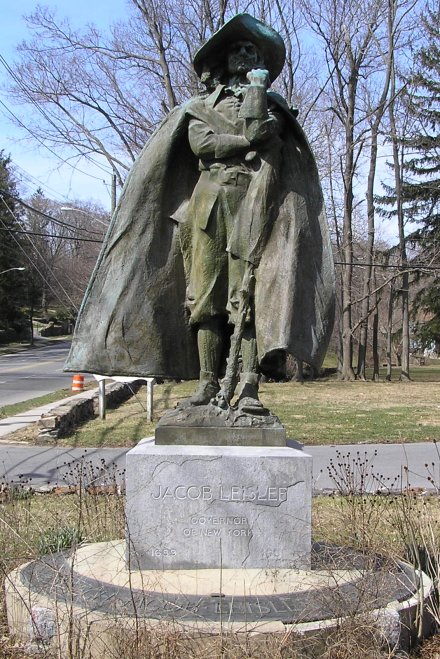

Statue of Jacob Leisler in New Rochelle, N.Y. — which Leisler helped create as a settlement for refugee Huguenots.

And once in the saddle, the Dutch Calvinist Leisler essentially ran a populist administration against the colonial oligarchy, which replied by vilifying him as a “usurper” and “rebel”.

Internal politics in New York and its neighbors during those months make fascinating reading.* Quakers and Catholics aligned against Protestants. Albany aligned against New York, until Leisler brought the former to heel. Clergy chose up sides. Leisler summoned a sort of proto-continental congress of colonial representatives (all the way to the West Indies) to hash out their situation.

And what was that situation? There had been a revolution, after all, and there was no agreed-upon representative of the royal authority present in New York. An assembly of militia leaders had asked Leisler to assume leadership, so was he really outside his rights to treat as his the London dispatches addressed to “such as, for the time being, take care for preserving the public peace and administering the law in New York”?

It’s a moment whose ferment of democratic energy can be read to presage the next century’s (proper) revolution.

Yet it was also not a revolution in the Cromwellian, world-turned-upside-down sense. For the English polity, and certainly for the conduct it preferred in its frontier possessions, continuity was the order of the day. Even in England herself, William and Mary were more than pleased to govern with Tories who could see their way to releasing their fealty to the Stuarts.

There was an empire to run, after all.

From that standpoint, Leisler’s anti-oligarchical policies and fractious disputes with other colonial elites were a bad business. There’s no sense in letting France make inroads because your governors are bickering over predestination or some such.

So formally, the realm’s new rulers continued all non-Catholic personnel in their posts. With the Dominion governors ejected, it was just a matter of dispatching fresh executives to take over. It’s just that this process required months … during which Leisler was managing New York the way he figured it ought to be managed, and his enemies were consequently painting him as a rebel.

Leisler pronounced himself, this whole time, anxious to submit his authority to the new governor upon the production of proper credentials. If he was surprised that the new monarchs tendered appointees of the very same factions recently expelled,** Leisler showed it only in his exactitude for procedure: because of a logistical cock-up, an aide to the new colonial governor arrived first, and when Leisler refused to hand over his fort without the royal warrant, a tense standoff ensued. It was resolved when the real governor, Henry Sloughter of ominous name, finally showed up.

Sloughter had his “predecessor” immediately arrested, along with others of his circle and harshly tried for treason and murder by a court stacked with anti-Leisler political enemies.†

Ultimately Leisler was condemned to die along with his secretary and son-in-law Jacob Milborne, but even Sloughter was loath to enforce the sentence. The story goes that Leisler’s most implacable foes had to get Sloughter drunk to put his signature on the death-warrant. (Sloughter died a couple of months later himself, for maximum operatic effect.)

On Saturday morning, May 16, 1691, the largest crowd ever gathered in New York City stood, rain soaked and weeping, all eyes fixed as a limp body was cut from the gallows and placed on the block. With a clean blow, the executioner’s ax cut off the head of the “halfe dead” Jacob Leisler — loyal lieutenant governor or rebel tyrant, depending on one’s point of view. Amid the “shrieks of the people,” fainting women (some “taken in labour”), and tumultuous jostling for “pieces of his garments” and strands of his hair, as “for a martyr,” the newly arrived and unfortunately named royal governor, Henry Sloughter, worried that his decision to execute Leisler might not, after all, end the “diseases and troubles of this Government.” Indeed, for years afterward New Yorkers bitterly divided over Leisler and the 1689 uprising that, in the wake of England’s Glorious Revolution, had led to his assumption of power in the provincial government.

-David Voorhees, who elsewhere contends that these divisions “continue to inform American politics to the present day.”*

A few years later, a more Leisler-friendly Parliament restored the dead man’s estate to his heirs, a sort of implicit admission that the whole head-chopping thing might have been a bit much.

This character figures to bear more historical consideration than he has heretofore enjoyed; further to that end, there’s a Jacob Leisler Papers Project devoted to marshaling at New York University the primary documents connected with Leisler.

* See, for instance, David Voorhees in “‘to assert our Right before it be quite lost’: The Leisler Rebellion in the Delaware River Valley” in Pennsylvania History, Winter 1997 — and, Voorhees again in “The ‘fervent Zeale’ of Jacob Leisler,” The William and Mary Quarterly, July 1994.

** Literally so: Francis Nicholson, whom Leisler ousted from New York, tried to get himself appointed governor; he was instead sent to Virginia and continued in royal service in the colonies for decades to come.

† e.g., Joseph Dudley, one of Leisler’s judges, whose penchant for authoritarian justice has been noted elsewhere in these pages.

On this day..

1883: Joe Brady, the first of the Invincibles

“All patriots on earth must respect him (Joe Brady).”

John Boyle O’Reilly

On this date in 1883, Britain set about the grim work of avenging the assassination of its Irish plenipotentiaries by hanging Joe Brady at Kilmainham Gaol.

“He was brought up as a stonemason,” the May 15, 1883 London Times recalled of the by-then-hanged man, “of herculean strength, his occupation developing the muscular power of his arms, which told with such terrible effect when he drove the knives into the bodies of his victims.”

Those knife-driven bodies belonged to Irish civil servant Thomas Henry Burke (a quisling figure, in the eyes of Irish nationalists) and the English politician Lord Frederick Cavendish, who were jumped while taking a stroll in a Dublin park on May 6, 1882.

The authors of their destruction — beyond Joe Brady, personally — were the splinter of radical Fenians known as “the Invincibles”, who figured on the vincibility of the collaborators and informers who made British control of Ireland possible. Especially their vincibility to stonemason-wielded surgical knives.

Efficient, and surely less than genteel, police work busted up the cell after those spectacular homicides, inducing leadership figures to turn state’s evidence against their subordinates. Four more men consequently hanged in the month following Brady’s execution. The stool pigeons got to walk.

History did not delay her verdict on these characters.

While Invincible-turned-informer James Carey was promptly murdered in retaliation, Brady et al joined nationalist mythology as martyrs who “died a Fenian blade.”

Ballad of Joe Brady

I am a bold undaunted youth, Joe Brady is my name,
From the chapel of North Anne Street one Sunday as I came,
All to my surprise who should I espy but Moreno and Cockade;
Says one unto the other: “Here comes our Fenian blade”.

I did not know the reason why they ordered me to stand,
I did not know the reason why they gave me such a command.
But when I saw James Carey there, I knew I was betrayed.
I’ll face death before dishonour and die a Fenian blade.

They marched me up North Anne Street without the least delay,
The people passed me on the path, it filled them with dismay.
My sister cried, “I see you Joe, if old Mallon gives me lave,
Keep up your heart for Ireland like a true-born Fenian Blade.

It happened in the Phoenix Park all in the month of May,
Lord Cavendish and Burke came out for to see the polo play.
James Carey gave the signal and his handkerchief he waved,
Then he gave full information against our Fenian blades.

It was in Kilmainham Prison the Invincibles were hung.
Mrs Kelly she stood there all in mourning for her son.
She threw back her shawl and said to all:
“Though he fills a lime-pit grave,
My son was no informer and he died a Fenian blade.”

And if the Times‘ report (the same May 15 article) is to be believed (reporters weren’t actually allowed to witness the execution itself), Brady wore that invincible conviction to the scaffold.

“Up to the last moment,” the paper reported, “he retained the animal courage which he displayed in the deed itself, which, though dastardly as regards the unarmed men whom he attacked, was daring in its other circumstances.”

Speaking of animal courage.

Our man Brady, very famous in Ireland around the turn of the century, makes a little appearance in the referential soup of James Joyce’s Ulysses* for animal spirits of a different sort: a conversation about his hanging provides the departure point for a Joycean meander into the phenomenon of scaffold priapism.

–There’s one thing it hasn’t a deterrent effect on, says Alf.

–What’s that? says Joe.

–The poor bugger’s tool that’s being hanged, says Alf.

–That so? says Joe.

–God’s truth, says Alf. I heard that from the head warder that was in

Kilmainham when they hanged Joe Brady, the invincible. He told me when they cut him down after the drop it was standing up in their faces like a poker.

–Ruling passion strong in death, says Joe, as someone said.

–That can be explained by science, says Bloom. It’s only a natural phenomenon, don’t you see, because on account of the …

And then he starts with his jawbreakers about phenomenon and science and this phenomenon and the other phenomenon.

The distinguished scientist Herr Professor Luitpold Blumenduft tendered medical evidence to the effect that the instantaneous fracture of the cervical vertebrae and consequent scission of the spinal cord would, according to the best approved tradition of medical science, be calculated to inevitably produce in the human subject a violent ganglionic stimulus of the nerve centres of the genital apparatus, thereby causing the elastic pores of the CORPORA CAVERNOSA to rapidly dilate in such a way as to instantaneously facilitate the flow of blood to that part of the human anatomy known as the penis or male organ resulting in the phenomenon which has been denominated by the faculty a morbid upwards and outwards philoprogenitive erection IN ARTICULO MORTIS PER DIMINUTIONEM CAPITIS.

* As was Brady’s getaway driver James “Skin-the-Goat” Fitzharris, who became a national celebrity by serving a long prison sentence for refusing to inform on anyone.

On this day..

1649: Robert Lockyer, Leveller

On this date in 1649, Robert Lockyer (or Lockier) was shot before the scenic backdrop of London’s St. Paul’s Cathedral* for the Leveller-inspired Bishopsgate mutiny.

These weeks following the epochal execution of the late king Charles I were also the climax of a pivotal intra-party conflict among the triumphant Parliamentarians … one whose class dimensions map a lot more readily to a modern template. Levellers were, “in a small way, the precursors of the ‘Socialists’ of 1849” in the words of this popular history.

The prosperous gentry represented by the Grandee faction were just fine with the whip hand they’d obtained in government by overturning the monarchy; against them were arrayed the more radical Levellers (or “Agitators”) who could not fail to notice that they had no say in electing the Parliament upheld by their victorious arms, and an oligarchy governing them that bore a suspicious resemblance to the supposedly defeated nobility.

So there was that.

Meanwhile, up in high statecraft, Oliver Cromwell was preparing to make his name accursed of Ireland by smashing up the island and the Grandees hit upon an arrangement as expedient for fiscal ambitions as for territorial: the soldiers assigned to this expedition would have the opportunity to opt out of it, for the low low price of forfeiting the substantial back pay they were due from those years of civil war — pay whose fulfillment was naturally a chief Leveller demand.

How did this cunning plan to pillage the soldiery’s pensions to conquer Ireland go over in the ranks? Reader, not well.

Since the same reason that shall subject them unto us in generall, or any of us singly, may subject us unto them or any other that shall subdue; now how contrary this is to the common interest of mankind let all the world judge, for a people that desire to live free, must almost equally with themselves, defend others from subjection, the reason is because the subjecting of others make(s) the subdued strive for Dominion over you, since that is the only way you have left them to acquire their common liberty.**

So there was that, on top of that.

Grumblings gave way to refusals to march, and the refusal by a regiment stationed in Bishopsgate to leave London lest it also leave its leverage soon became the eponymous mutiny of this post — the Bishopsgate Mutiny.

Grandees quelled this particular insubordination without need of bloodshed, but thought it meet to deliver a little anyway as proof in this fraught political environment against the next such affair. Six of the soldiers drew military death sentences; Cromwell pardoned five, but let known Leveller/Agitator firebrand Lockyer go to his death over the appeals of Leveller leaders like John Lilburne and Richard Overton.

The signal was unmistakable — certainly to the thousands who donned Leveller colors to follow Lockyer’s funeral procession through London.

In the days following Lockyer’s execution, several Leveller-inspired regiments would openly rise … what proved to be the movement’s last great stand, efficiently crushed by Cromwell.

*The Parliamentarians had twisted high church dogmatists by putting Old St. Paul’s Cathedral to profane use as a cavalry stable, which employment actually made it a sort-of suitable place for a military execution. (The current structure was rebuilt on the same site after the previous church succumbed to the Great Fire of London.)

** From Mercurius Militaris, quoted by Norah Carlin, “The Levellers and the Conquest of Ireland in 1649,” The Historical Journal, June 1987 — which, however, makes the case that while the Levellers were obviously not cool with the pay expropriation, their opinion on the Ireland conquest in the abstract was far from uniformly anti-imperial.

On this day..