1870: Kumoi Tatsuo

On this date in 1870, Japanese samurai Kumoi Tatuo was beheaded for attempting to topple the Meiji government.

Briefly a bureaucrat under the restored emperor, Tatsuo like many samurai grew disillusioned with the new state and its eclipse of the old ways.

Suspected of plotting an attack on senior government officials, he was arrested and beheaded with eleven others.

At death, I fear no dying;
In life embrace not living;
The brilliance of the sun
Is rivaled by integrity.
Execution has no terror,
Though it be a boiling cauldron;
But how insignificant my poor person,
Against the Great Wall!

-Kumoi Tatsuo

Tatsuo’s verse would later inspire the developing People’s Rights movement against the Meiji government’s authoritarianism, as well as nascent pan-Asianism.

Still, where art’s concerned, everyone is a critic. Japanese intellectual Shiga Shigetaka, addressing another young poet around the turn of the century, implored him to rise above Tatsuo.

You are only twenty-seven or -eight of age and your future is greatly promising. Above all, you must aim to be a great man in maturity and, without becoming content with temporary honor, work hard from this moment, striving to leave a name imperishable for a thousand years in the history of English literature. Tatsuo … has left nothing for the history of Japan, let alone for the history of the world. It is merely that because his poems are inept (they are, yes, inept when viewed in Chinese literature), because they meet the taste of those without a discerning eye as readers, a handful of students, who just want to feel good, recite them. You must draw your own conclusion from Tatsuo’s example.

On this day..

1909: Valgrand in place of Fantomas

On this date* in 1909, in the first novel of the hit French Fantomas crime serial, the title character escapes the guillotine by having a duped actor beheaded in his place.

Fantomas’s Wikipedia entry calls the character “a transition from Gothic novel villains of the 19th century to modern-day serial killers“: he’s a swashbuckling anti-hero who’s a master of disguise and perfectly okay with getting his hands bloody.

His own personal Javert, an inspector by the name of Juve who has stalked him for years,** has finally managed to have Fantomas convicted of a murder and sent to await execution. (Here’s a synopsis of the book.)

The widow of that crime’s victim — also Fantomas’s lover — subsequently contrives to arrange a tete-a-tete with an actor then portraying Fantomas’s lurid crime spree on the Parisian stage. She wants him to come in costume, which excites the actor as a seriously macabre kink: little does this Valgrand suspect that his own tete will be swapped for the murderer’s by next light.

That following day finds a drugged Valgrand infiltrated into Fantomas’s cell, in a sort of travesty of the noble Sydney Carton‘s guillotine switcheroo. Still suffering the effects of the potion his supposed inamorata has plied him with only hours before, and still made up to resemble the condemned man, he’s incapable of objecting as he’s hustled to the scaffold.

Juve was watching the unhappy wretch, and could not restrain a word of admiration.

“That man is a brave man! He has not even turned pale! Generally condemned men are livid!”

The executioner’s assistants had bound the man upon the plank; it tilted upwards. Deibler grasped the head by the two ears and pulled it into the lunette, despite one last convulsive struggle of the victim.

There was a click of a spring, the flash of the falling knife, a spurt of blood, a dull groan from ten thousand breasts, and the head rolled into the basket!

But Juve … sprang towards the scaffold. He thrust the assistants away, and plunging his hands into the bran that was all soaked with blood, he seized the severed head by the hair and stared at it.

“Good God!” he cried in tones of anguish.

“It isn’t [Fantomas] who has just been put to death!” Juve panted brokenly. “This face has not gone white because it is painted! It is made up — like an actor’s! Oh, curses on him! Fantomas has escaped! Fantomas has got away! He has had some innocent man executed in his stead! I tell you Fantomas is alive!”

And so he was … to the tune of a staggering 32 books over three years. Eat your heart out, J.K. Rowling.

Fantomas on the silver screen

This series has enjoyed a number of adaptations to the screen, and indeed it’s a media milestone as well since the books were cranked out at record pace by a team of writers working simultaneously on modular chapters to meet publication deadlines that fed immediately into cinema deals. There were also comic and radio spinoffs, though they’re not known to have been forward-thinking enough to have had a website.

In the classic first silent adaptation of Fantomas in 1913 (the book was published in 1911), poor Valgrand catches a break: he’s recognized and spared beheading at the last moment. There’s a very thorough guide for viewing that film here.

* The book situates the action where Valgrand is seduced and tricked on December 18, and the narrative makes it clear that the execution itself is at dawn the next morning.

It can be placed in 1909 because a guard mentions the execution of Henri Duchemin, a real historical figure guillotined earlier in 1909. (That year marked a resumption of executions in France; a death penalty opponent serving as President of the Third Republic systematically blocked executions from 1905 through 1908.)

Lady Beltham, whose feminine wiles spring the master criminal, subsequently commits suicide in 1910, which leaves only the one possibility.

** Juve is a big fan of the then-trendy, now-discredited system of Bertillonage; Fantomas consistently runs circles around this “scientific” crime-fighting. Academics, if you please?

Through the incorporation of Alphonse Bertillon’s anthropometrics — the dominant mode of criminal investigation at the time –, as both the narratological and criminological impetus for its exponentially serialized representations of criminality, Fantomas articulates resistance to the representational strategies of the numerical classification of criminals as a means of social and “scientific” control, while compelling the ongoing modern capitalist cycle of mass literary production and consumption.

-Nanette Fornabai, “Criminal Factors: ‘Fantômas’, Anthropometrics, and the Numerical Fictions of Modern Criminal Identity,” Yale French Studies, No. 108 (2005)

On this day..

1849: Anna Koch of Appenzell

This date’s pastoral story of adolescent avarice — and impressive disobedience at the scaffold — comes to us from the tiniest of Swiss cantons,* as related in this public-domain text


Anna Maria Koch and Magdalene Fessler were girls — each about seventeen years of age — living in Gonten in the year 1849. On June 12 of that year the dead body of the latter was found lying in a ditch in one of the village pastures. There were upon it no marks of violence, and a coroner’s jury was led to conclude that the girl had come to her death by falling into the ditch in the dark. A little later, the discovery was made that on June 10 Anna Koch had sold to a silversmith in Gonten a chain, a locket, and a rosary. These articles on examination were proved to have belonged to Magdalene Fessler. Anna Koch was placed under arrest and asked to make explanation. The story related by her is as follows: –On the Sunday following Frohnleichnamsfest she met Jean-Baptiste Matezenauer, a young man of the village, and he gave her the articles of jewellery, saying that he had found them. He told her that she must sell the things and put the money in a bag which she was to hide in a field. She must then take with her a friend, stroll through the field and, as though by chance, spy the bag, pick it up and say, “Oh! I have found something!” With the money she was to buy a wedding dress, Matzenauer promising in a short time to marry her. Matzenauer was arrested and confronted with his accuser. He protested innocence, but the girl adhered to her story. She did even more, she enlarged upon it. She said that on the morning of Frohnleichnamsfest she had been in Matzenauer’s company; that he had then told her he meant to kill Magdalene Fessler in the afternoon, and had asked her to station herself in the field where the ditch was. This, she said, she had done, and that while there she saw Matzenauer drag thither the body of his victim. Despite the inherent improbability of her whole account, the girl vehemently reiterated it, each time challenging Matzenauer to a denial. At last the bewildered inquisitorial fathers before whom the examination was being conducted — perhaps with some recollection of the efficacy of torture in eliciting actionable testimony in the case of Landamman Suter — ordered Matzenauer to be brought under the lash. This was done, but without the hoped-for result. Matzenauer remained obdurate.

The case dragged on till November 13. It was then suddenly terminated by the confession of Anna Koch that she alone had planned and committed the murder. The details of the confession were substantially these: –She, a poor girl, had for a long time felt hurt in pride that she had not the money with which to provide herself the chains and trinkets commonly worn by the girls of her acquaintance. So keen was this feeling that finally she resolved to purchase a chain from one of the silversmiths of Gonten and trust to fortune to enable her to pay for it. She obtained the chain, but failing to pay for it by the time agreed on with the silversmith, was asked to return it. The necessity of doing so was fully impending when, on Frohnleichnamsfest, she met Magdalena Fessler in the churchyard, at the beginning of afternoon service. The latter had about her neck a beautiful chain, and Anna Koch, seeing it, was prompted to kill her, take the ornament, sell it, and with the money realised meet her own debt to the silversmith. She told her friend that she had lost her rosary, and asked her to go with her to find it. The two girls walked on together, soon passing into the field containing the ditch. As they were crossing the latter on a plank Anna Koch pushed Magdalene Fessler, causing her to lose her footing and fall into the water. She then jumped into the ditch herself, seized the head of her victim and, holding the mouth open with her fingers, kept the head under water until death ensued from strangulation. Having made her confession, Anna Koch asked that she might suffer the extreme penalty for her crime. Young people of her acquaintance petitioned the Great Council for a pardon. This was refused, the vote standing only six for pardon and ninety-six for punishment. Decree was then entered that the guilty one be beheaded on the block.

The day before that fixed for the execution (the latter being December 3) the condemned girl spent quietly in prayer and in communion with her confessor. She expressed herself as being entirely reconciled to her fate and, in fact, as anxious to meet it. But when led forth on the day of execution, her manner changed. The wild instincts of her Appenzell nature reasserted themselves. She declared that she could not and would not die, and with fierce cries drowned the voice of the officer who read her death-warrant before the people. The reading finished, four strong men seized the girl and bound her on a sled. Thus secured she was dragged to the headsman’s block in the market-place. But here a fresh difficulty was encountered. On being released from the sled her struggles were so frantic and determined that the executioner could not perform his task. After several vain attempts he sent the Reichsvogt (the same mediaeval official personage that had figured at the execution of Dr. Anton Leu and Landamman Suter) to report the situation of affairs to the Great Council and ask advice. The reply returned was that the headsman must do his duty. After an hour and a half of cries and resistance on the part of the condemned, her head was firmly secured to the block by the braids of her hair, and the fatal stroke given.


Gonten (it’s the long collection of buildings along the valley road, at the base of the slope) and environs. (cc) image from Michael Beat.

* Appenzell Innerrhoden is the smallest canton by population, and is larger by area only than the urban canton of Basel-City.

On this day..

1783: Johanna Catharina Höhn, by Goethe’s vote

“To think is easy. To act is hard. But the hardest thing in the world is to act in accordance with your thinking.”

-Goethe

On this date in 1783, Johanna Catharina Höhn lost her head for infanticide … thanks to the vote of the man who wrote the most recognizable infanticide story in literature.

Eleven years before, then-22-year-old Johann Wolfgang von Goethe had been a firsthand witness to the trial of another infanticide who ultimately lost her head. This case very likely inspired the character Gretchen in Goethe’s best-known work, Faust.

Faust was a lifelong project for the author, but evidently the same could not be said of empathy for infanticidal mothers.

As a Privy Councilor to Carl (or Karl) August, Grand Duke of Saxe-Weimar-Eisenach, Goethe was presented with the case of Höhn, a 24-year-old unmarried servant girl who cut her newborn son’s throat.

Infanticide was an Enlightenment wedge issue touching not only evolving standards of humane criminal justice, but “as the main eighteenth-century area of conflict surrounding social repression and female sexuality.”*

Was it justice to put mothers to death for infanticide? Was it efficacious for a state to do so — given that such crimes were committed in a state of desperation that might negate deterrence, and that the offenders attracted the pity of potentially unruly scaffold mobs?

And if the executioner’s sword** was not depended upon to keep women keeping it in their britches, what social policies ought to replace it?

Infanticide and its prevention was the favorite theme of the criminologists of that time. [Christian] Rothenberger calls attention to the wide discussion of means to care for the poor, to the evil effects of luxury, and then to a “formliche Kindermordlitteratur.”† [L.W.] Seyffarth, the editor of the best edition of [Johann Heinrich] Pestalozzi‘s works, says: “The question how infanticide might be stopped was at that time a burning one.”

The great interest in infanticide can best be brought to view by the contest for a prize of 100 ducats offered by [Karl Theodor] von Dalberg, intendant of the Mannheim theater, for the best essay on the subject: “What are the best and most practicable means to eradicate infanticide without promoting prostitution?” The contest closed at Whitsuntide, 1781. The offer of the prize was published in most of the newspapers and magazines of that time and was generally accompanied by editorial comments. The editorial in August Ludwig Schlozer‘s magazine Briefwechsel is typical. “There are crimes committed among us,” the editor writes, “which are the most horrible and at the same time the most common, and among these is infanticide; crimes which are related to virtues, virtues which develop into vices, and among these too is infanticide; crimes which experience teaches are not made less frequent by increasing the severity of the punishment, while not to punish them would bring disgrace to mankind and destruction to law and order, and among these too is infanticide … How long shall we lead to the block these unfortunate girls as sacrificial victims, whose love and the natural weakness of their sex, whose adornment of innocence and modesty has made them to be mothers and murderesses?

The Duke inclined very strongly to the progressive answer gaining ground at the time, and when Hohn’s case surfaced, he put to his aides the prospect of eliminating the death penalty for infanticide and replacing it with other legal sanctions.

Those aides produced a mixed response. Goethe, perhaps the duke’s closest advisor, was ultimately in a position to exercise decisive influence on whether to adopt the duke’s proposal. (Whether it was the decisive influence is a matter of some dispute.)‡

Despite his sensitive portrayal of the fictional Gretchen/Margarete in Faust, the great writer took a distinctly retrograde stance on sparing actual flesh-and-blood women … and Goethe’s position, which he formally voted only 24 days before the execution, carried the day.

The evidence is clear that there was substantial (though not necessarily unanimous) agreement with the duke’s proposal to abolish the death penalty for infanticide.

… Without doubt, then, Goethe’s vote carried considerable weight. How could it not? He was the duke’s best friend and thus easily the most powerful member of the Council after Carl August because of his immense influence over him … [and] Goethe unquestionably cast his vote to retain the death penalty for a crime that was widely seen in his time as resulting from social injustice and harbouring wide potential for extenuating circumstances (in principle, not only in particular cases). His vote thus ran entirely counter to his depiction of the case of Margarete in Faust, in which ‘extenuating circumstances’ abound. While the question of Goethe’s guilt is a moral one that need not concern us, his part in the responsibility for retaining the death penalty for infanticide and thus also for the execution of Johanna Hohn is crystal-clear.*

A Weimar journalist called it “state murder.”

Hohn’s body was delivered to a Jena professor for anatomization.

A recent German book, Goethes Hinrichtung (Goethe’s Execution), novelizes the case.

* W. Daniel Wilson “Goether, his Duke, and Infanticide: New Documents and Reflections on a Controversial Execution,” German Life and Letters, January 2008. This volume includes the (German) text of the previously unpublished Halsgericht, a very detailed “script” for the actual execution. This volume of German Life and Letters also features a ceremonious dialogue between der Scharfrichter, the executioner, and der Richter, the judge, conveying possession of the criminal and legal direction for her punishment, which would all have been enacted in public in the doomed woman’s presence.

** Hohn was beheaded with a sword; this was itself a “mercy,” as she could have been dispatched by drowning.

† Most notably, Die Kindermörderin by Heinrich Leopold Wagner (both German links).

‡ Note that the consideration at the level of the Privy Council was formally about whether to abolish the death penalty for infanticide in general — not directly about Hohn’s case, which proceeded on a separate track. It seems to be generally agreed that Goethe and all other parties understood Hohn would live or die based on the statutory decision.

On this day..

1674: The Chevalier de Rohan and Franciscus van den Enden

On this date in 1674, the former Grand Huntsman of France was beheaded in Paris for conspiring to betray Normandy during the Franco-Dutch War.

Your basic debt-mired noble and court cad, the Chevalier de Rohan (French Wikipedia link) through an accomplice “intimated that Normandy was very much dispos’d to a revolt, & that if hee would send a fleet with 6 thousand men, & armes for twenty thousand, with necessaries for sieges & two million of livres, that there was a greate man who would engage himself upon the assurance of thirty thousand crownes pension …”

The correspondence was discovered and Rohan arrested, but his role in the plot was sufficiently anonymized that even an absolutist state didn’t have the goods to convict him. Meanwhile, Rohan’s accomplice was hunted to ground and killed in Rouen during the attempt to arrest him.

This left the authorities in the position, common to every cop show and not a few real-life cases, of requiring a confession from the accused to proceed at all. Rohan’s friends realized this too, and tried desperately to warn him against self-incrimination.

Persons attached to the chevalier de Rohan went every evening round the Bastile, crying through a speaking trumpet, “La Tuanderie is dead, and has said nothing;” but the chevalier did not hear them. The commissioners, not being able to get any thing from him, told him, “that the king knew all, that they had proofs, but only wished for his own confession, and that they were authorized to promise him pardon if he would declare the truth.” The chevalier, too credulous, confessed the whole. Then the perfidious commissioners changed their language. They said, “that with respect to the pardon, they could not answer for it: but that they had hopes of obtaining it, and would go and solicit it.” This they troubled themselves very little about; and condemned the criminal to lose his head. He was conducted on a platform to the scaffold, by means of a gallery raised to the height of the window of the armoury in the arsenal, which looks towards the little square at the end of the Rue des Tournelles. He was beheaded on November 27, 1674.

It is hoped that, should the reader ever become a person of police interest, s/he will recall from Rohan’s example that inspectors do not have suspects’ best interests in mind.

A couple of other nobles also lost their heads along with our chevalier.

Hanged for his trouble was Franciscus van den Enden (English Wikipedia page | Dutch), the elderly Dutchman — and accused Dutch agent — who recruited these toffs for the purpose of seizing Le Havre.

Van den Enden is an interesting, perhaps underappreciated, radical intellectual of secular-democratic persuasion (he attracted the suspicion of atheism, and his Vrye Politijke Stellingen made an unabashed case for democratic government). He’s best known for being a schoolmaster of philosopher Baruch Spinoza; W.N.A. Klever, in an October 1991 paper in the Journal of the History of Philosophy (“A New Source of Spinozism: Franciscus Van den Enden”) traces the connections between the philosophy of the master and that of the pupil and rather dramatically argues that

Van den Enden must be considered as a kind of “Proto-Spinoza.” … He was the hidden agent behind Spinoza’s genius … [t]he origin of Spinoza’s anomalous philosophy.

A variety of (untranslated) references to the “Proto-Spinoza” from 17th century correspondence are available here.

Those inclined more towards geopolitics than philosophy might enjoy Victor Magagna’s podcast lecture on the great-power calculus driving France’s conflict with the Netherlands — which, as we have noticed in these pages, claimed the life of the longtime Dutch leader Johan de Witt.

On this day..

Feast Day of St. Cecilia, patron of music

This is the feast day of the early Christian saint Cecilia.

There’s more than serendipity in that name’s pop culture connection: Cecilia is the patron saint of music for the rather slight reason that her heart sung only for God even when she was forced to marry the pagan Valerian. Seriously, Christianity didn’t have any early martyr with a stronger biographical context for a portfolio as significant as music?*

Being the go-to divine intermediary for something this big made Cece a popular saint centuries after her martyrdom, supposed to be either later in the 2nd century or early in the 3rd. (As with many other martyrs’ legends, Cecilia survives several executions before the Romans finally manage to cut her head off.)

Musician and songwriter Paul Simon knew enough St. Cecilia lore to explicitly use her in her musical-patronage role in a different song, “The Coast” (lyrics). The song “Cecilia” deepens immensely if it’s understood as mixed frustration and exaltation with the minstrel’s inconstant artistic muse.

Nor would that be the only 20th century musical homage for this accessible saint. In a more traditional vein, Benjamin Britten set to music a W.H. Auden poem about Cecilia, creating the Hymn to St. Cecilia.

Blessed Cecilia, appear in visions
To all musicians, appear and inspire:
Translated Daughter, come down and startle
Composing mortals with immortal fire.

Fans of classical music should hit YouTube for Handel’s Ode for St. Cecilia’s Day, which appropriately premiered on this date in 1739. Here’s a nibble:

* So far as we know, blogging remains a niche of divine patronage as-yet unfilled. We propose to accept the protection of the patron saint of lost causes.

On this day..

1793: Philippe Egalite, hoisted on his own petard

On this date in 1793, Philippe Egalite was hoisted on his own petard.

To hoist with one’s own petard actually has an older derivation, dating to siege warfare engineers whose primitive bombs, petards, were liable to detonate unexpectedly and gave their makers a “hoist.”

Still, the phrase sounds like something that ought to come right out of the French Revolution, redolent (as are petards themselves: the explosive word is from the French “to fart”) of angry mobs hoisting aristocrats, as was their wont, up on pikestaffs and lampposts and … petards. Whatever those are.

Philippe Egalite — the Duke of Orleans, as he was known for most of his life — was such an aristocrat: in fact he was royalty, the First Prince of the Blood and a cousin to Louis XVI.

And he was the member of the royal house who most vibed on the revolutionary spirit of the times, literally bankrolling the Jacobins before the Revolution. Hilary Mantel* notes that Orleans made the Palais Royal “into a sort of demagogue’s shopping centre — Paris’s most volatile public space, crammed with cafés and bookshops, a gathering place for the disaffected. In July 1789, three days of orchestrated violence began there, and culminated in the taking of the Bastille.”

Now that is a petard.

Philippe’s class-traitor politics obviously exposed him to the wrath of the monarchists — a particular irony since the man’s son Louis-Philippe, was France’s last king from 1830 to 1848 — but as usual in Paris during the Terror, it was the the Revolution devouring its children that did him in.

Despite taking up during the Revolution the very Republican name Egalite by which we know him, and despite Egalite‘s vote in the Convention in favor of guillotining Louis XVI (this is sometimes described with more melodrama than accuracy as the “decisive” vote), and despite his many years’ prior revolutionary sympathy, the Duke of Orleans was rounded up with the rest of the available Bourbons when the French General Dumouriez‘s spring 1793 defection prompted a panicky revolutionary purge in Paris. Philippe’s own son, the future king, had gone over with Dumouriez to the Austrians.

Rosebud

The Duc d’Orleans employed Choderlos de Laclos, author of the notoriously delicious Dangerous Liaisons.

As an individual citizen turned politician turned guillotinee, Egalite doesn’t much stand out in those perilous years: one more vulnerable Convention delegate outmaneuvered by Robespierre et al.

As the Daddy Warbucks of the Rights of Man, however, Egalite was a titanic figure for his contemporaries. Not many held him in high personal esteem, but movements need moneybags, and the Prince of the Blood bankrolled his from the bottomless revenues he earned on estates that would dwarf entire departements.

The Duke of Orleans and those around him, according to George Armstrong Kelly in “The Machine of the Duc D’Orléans and the New Politics” (The Journal of Modern History, Dec. 1979)

invented something novel in the history of French politics: the massive use of wealth, research, and propaganda** for the purpose of forming public opinion and swaying public policy. No doubt there are analogues among the Romans and the eighteenth-century English; but here we are almost reminded of the Rockefellers and Kennedys.

Orleans was accused of generating all this mayhem to make his own bid for the throne; those accusations may even hold a bit of truth. Such machinations remain for the conspiratorial among posterity a shadow-play upon the wall; one is left to guess at their potential dimensions from shreds of evidence and the vying vituperations of various contemporary revolutionary factions.

But if extant, such schemes were fatally compromised by the mediocrity of the figurehead who lost his head this day. Though a revolutionary in his philosophy, he was still a doughy Bourbon scion in his soul, and heir to the many shortcomings that characterized that dynasty in its decadence.

Dissolute in the enjoyment of privilege; irresolute in the conquest of power; blithely rearing wolves to his own destruction. That was some petard.


Philippe Egalite and his onetime lover Grace Elliott are the titular characters of the 2001 Eric Rohmer movie The Lady and the Duke.

* Hilary Mantel is the same author who penned the acclaimed historical novel Wolf Hall, about Thomas Cromwell.

** Kelly claims that Egalite funded Marat.

On this day..

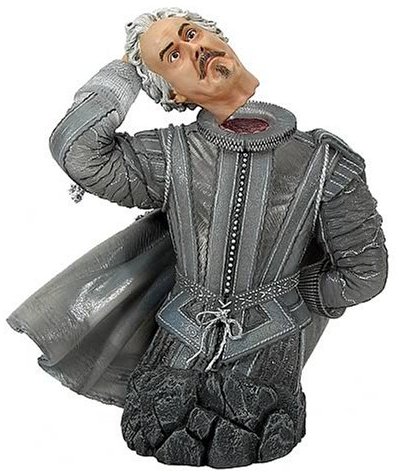
1492: Sir Nicholas de Mimsy-Porpington, Nearly Headless Nick

(Thanks to Elizabeth M. Hull for the guest post. -ed.)

Post-mortem resident of Gryffindor House, Hogwarts School of Witchcraft and Wizardry, Hogsmeade, U.K.

A minor character in J.K. Rowling’s Harry Potter saga, Nearly Headless Nick remains one of the most memorable. Executed — badly — on Halloween of 1492, Sir Nicholas de Mimsy-Porpington became the ghost of Gryffindor House. The school has about 20 resident ghosts: the Grey Lady (Helena Ravenclaw) and the Bloody Baron of Slytherin House died violently as well, in a murder-suicide.

Rowling says that her editor suggested that she cut a ballad Mimsy-Porpington wrote about himself from The Chamber of Secrets. In the song, the ghost claimed to have been executed for “a mistake any wizard could make,” a “piffling error,” a case of wizardry gone wrong. Asked by Lady Grieve (otherwise unknown) to straighten her teeth, Mimsy-Porpington seems to have given her a tusk. “They” imprisoned the piffler immediately, though he cried all night that he could fix his mistake, and his beheading followed the next morning.

Unfortunately for Mimsy-Porpington, his was not the only incompetence: “they’d mislaid the rock/Where they usually sharpened the axe”! The “cack-handed twit” of a headsman said “this may sting a bit” to the gibbering wizard, and swung the axe in the air. Alas, unable to sharpen the blade, the executioner was reduced to bestowing numerous blows: “But oh the blunt blade! No difference it made,” the ghost sang,

My head was still definitely there.
The axeman he hacked and he whacked and he thwacked,
“Won’t be too long,” he assured me,
But quick it was not, and the bone-headed clot
Took forty-five goes ’til he floored me.

(The full ballad is here and here; the original handwritten version can be seen here.)

After repeated strokes of the edgeless axe, Mimsy-Porpington finally expired. On festival occasions, he re-enacts his near-beheading, a show quite popular with the Hogwarts student body (Prisoner of Azkaban, p. 159).

However, the bone-headed, cloddish headsman was unable to completely behead the wizard. As Ron Weasly notes, the ghost is merely nearly headless.


Nick, as played in the Harry Potter films by John Cleese. Rowling’s own original sketch of Nearly Headless Nick is here.

While he gets a great deal of pleasure from entertaining Hogwarts residents by swinging “his whole head . . . off his neck and . . . onto his shoulder as if it was on a hinge” (Sorceror’s Stone, p. 124), his condition limits his access to the dizziest heights of post-mortem society. Beheading was an aristocratic execution, meant to bring a swift death to the privileged, those able to hunt legally in their lifetime. In the afterlife, the beheaded aristocrats have established a “Headless Hunt” Club, and have blackballed Mimsy-Porpington, who misses their entrance requirements by that much: “‘half an inch of skin and sinew holding my neck on.'” Unable to participate in Club sports like “Horseback Head-Juggling and Head Polo,” Mimsy-Porpington is denied admission into the elite society (Chamber of Secrets, p. 124).

Sadly, their scorn for his crippling condition is not limited to exclusion from their company.

Mimsy-Porpington’s five hundredth Deathday anniversary party, held on Halloween 1992, welcomes hundreds of ghosts from as far away as Kent to a feast of rotten fish, putrid, “maggoty haggis,” and a tombstone cake with grey icing, while an orchestra of 30 musical saws plays waltzes. The Deathday Boy’s speech is interrupted by the members of the Headless Hunt: “Sir Properly Decapitated-Podmore” begins a game of Head Hockey, sending his own head sailing past the humiliated Mimsy-Porpington as he tries to address his guests (Chamber of Secrets, p. 132-7).

Somehow the courageous Gryffindor ghost overcomes this diabolical heads-up-manship and several months as a petrified cloud to live a useful afterlife, helping Harry many times. Most significantly, in the final pages of The Order of the Phoenix, a traumatized and grieving Harry turns to Mimsy-Porpington, hoping to discover a way to keep his dead friend and guardian Sirius Black alive. “‘You’re dead,'” Harry says, “‘But you’re still here, aren’t you? … People can come back, right? As ghosts. They don’t have to disappear completely.'” Mimsy-Porpington gently tells Harry that he can only “‘walk palely'” where his living self once trod, “‘neither here nor there,'” hovering between life and death for fear of the unknown. However, Black risked his life joyously and died laughing; he will not linger between death and life. Harry must live on without him.

There may be historical precedent for Mimsy-Porpington’s death in the botched execution of James Scott, Duke of Monmouth (1685), when the notorious Jack Ketch took five blows to kill the rebel, and finally had to use a knife to sever the last “skin and sinew” connecting the head to the corpse. Monmouth’s hairstyle in portraits from the late 1600s resembles that drawn by Rowling in her sketch of Nearly Headless Nick, although that sketch shows a beard style from the early 1600s, nearly 70 years earlier. Moreover, the ghost enters Harry Potter’s life wearing an Elizabethan neck ruff and says that he has not eaten in nearly 400 years, implying a death in the late 1500s.

In spite of this wibbly-wobbly timeline, Mimsy-Porpington’s deathdate establishes the firm chronology of Rowling’s series: the five hundredth anniversary of his death in 1492 would fall in 1992; therefore the events of Chamber of Secrets (published in 1997) must occur in 1992. The dating of the series is confirmed five books later by the tombstones of Harry’s parents, who died on Halloween Day, 1981 (Deathly Hallows, p. 328). For J.K. Rowling, death, the last enemy — not life — marks the measure of this world’s time.

On this day..

1268: Conradin of Swabia

On this date in 1268, 16-year-old boy-king Conradin was beheaded in Naples with his best friend.

This short-lived son of German king Conrad IV inherited his call on the purple at the age of 26. 26 months.

While the infant king worked on his ABC’s in Swabia, different regents tried to keep his Sicily and Jerusalem thrones warm in the far-flung empire.

Knowing an opportunity when he saw it, Conradin’s uncle and “regent” Manfred usurped him in Sicily, tipping over the first domino in a peninsular political chain that would fell both relatives. With Manfred’s accession, the rival power of the papacy now faced an active military strongman at its doorstep — and it, in turn, sponsored French noble Charles of Anjou to oppose, and eventually overthrow, Manfred.

By the time all this played out, Conradin was, if not exactly a seasoned man of the world, at least old enough to hear his voice cracking and start noticing girls. By the standards of medieval Europe, that was plenty old enough to press his injured rights in battle.

Accordingly, Conradin — Corradino, to the Italians — led Hohenstaufen boots down the boot to reclaim Sicily. No dice.

His captor’s attitude was summed up in the sentiment, Conradi vita, Caroli mors — “Conrad’s life is Charles’s death,” somewhat doubtfully ascribed to the counsel of Pope Clement IV — so when you think about it, it was no more than self-defense to cut short that vita. And his buddy’s, too, since the scaffold was already hired for the day.


Conradin of Swabia and Frederick of Baden Being Informed of Their Execution in Prison in Naples, by Goethe buddy Johann Heinrich Wilhelm Tischbein. Did either try the Sicilian Defence?

He turns to clasp with longing arms his friend,
And turning, sees the fatal blow descend,
Then presses with his lips the severed head,
Last greeting of the dying to the dead.
One quivering flash, a shock that is not pain,
And those he parted death unites again.
So perished Conradin, but legends tell
That as the trenchant blade descending fell,
An eagle, that, unseen by human eyes,
Had poised aloft, down swooping from the skies,
For one short instant hovered o’er the slain,
And dyed his pinions with a crimson stain,
Then wildly shrieked, and upward soaring sped
To witness for the blood unjustly shed.

-Tribute in purple poetry by William John Rous (Here’s a more prose-y review of Conradin’s campaign and demise)

This upward-soaring, crimson-pinioned raptor saw off the Hohenstaufen dynasty of the Holy Roman Empire.

In the unstable years that followed, as rival princes and factions jockeyed for influence, there’d be some serious nostalgia for the bygone Hohenstaufens. But there is opportunity as well as peril in change, and though it may be that this fractious realm was neither Holy, nor Roman, nor an Empire, it emerged from its interregnum with its first Habsburg ruler — of many.

What’s left of Corradino di Svevia (and Frederick of Baden) lies entombed at a Neapolitan church, watched over by a monumental 19th century marble sculpture of the youth.

On this day..

1943: Leonard Siffleet, beach beheading

On this date in 1943, Australian World War II commando Leonard Siffleet was beheaded on Aitape Beach in Papua New Guinea, along with two Ambonese, H. Pattiwal and M. Reharing

A photograph of the Japanese soldier Yasuno Chikao an instant before he strikes off Siffleet’s head was taken from the body of a Japanese casualty later in the war. Published in Life magazine, it became one of the war’s most iconic photos.

On this day..