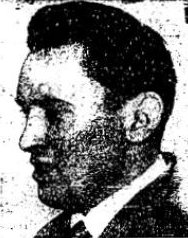
New Zealand got itself permanently out of the execution business after hanging Walter Bolton this date in 1957 for the murder of his wife.
The 68-year-old farmer was condemned after his wife finally succumbed to a year-long bout with some mysterious recurring ailment — and the post-mortem revealed long-term arsenic poisoning. Since Bolton turned out to have been having an affair with his wife’s sister, the pieces just fell right into place.
Jurors found these circumstances credible enough to stretch Bolton’s neck, but there’s the small problem that Walter Bolton himself also tested for arsenic poisoning.
The defense argued that the farm’s wells must have soaked up the poison from sheep dip.
But if you like your wrongful executions more sinister than dunderheaded, you might turn a wary eye to that adulterous sister-in-law, Florence Doherty, who committed suicide a year after Bolton hanged. This 2001 Investigate magazine argues (beginning on p. 24 of the pdf) that Doherty may have been a serial arsenic poisoner.
(Bolton’s hanging was also botched, to complete the official dog’s breakfast.)
It was rather the First World’s collctive mid-20th century move away from capital punishment. Various abolition efforts building in the 1950’s finally led to a 1961 free vote on the matter, in which ten members of the conservative National Party broke party ranks to eliminate the death penalty for all ordinary crimes. (Decades later, a Labour government also eliminated the death penalty for treason; New Zealand has only ever hanged one person for that crime.)
On this date in 1952, Iraq hanged Yosef Basri and Shalom Salah for an alleged Zionist bombing campaign in Baghdad.
The most remarkable thing about this campaign is that it was perpetrated against Iraq’s Jews — and if these men’s conviction was rightly secured, it was conducted by other Jews for the purpose of driving those Iraqi Jews to emigrate to the still-tenuous new state of Israel.
As the 1940s closed, well over 100,000 Jews lived in Iraq, a populace legendarily* dating to the Biblical Babylonian exile.
While this community had at certain moments in centuries past been the very flower of the diaspora, it was justifiably nervous here in the perilous 20th century.
In 1950-51, the Iraqi government offered its Jewish citizens an emigration window from a homeland tense with anti-Jewish hostility — at the same time the Israeli government was practically begging them to come. (The cost: give up Iraqi citizenship permanently. Iraq seems to have expected only a few thousand to depart.)
Against the grain of this “monstrous” mutuality of interest stood the natural obstacles for any emigre: affection for the familiarity of one’s native lands, the trauma and uncertainty of uprooting … plus the specific problem that most stood to lose their illiquid wealth either by hasty firesale disposal or (as eventually happened) outright confiscation. Particularly pending clarity in property remuneration, many Iraqi Jews were initially wary about departing.
Iraqi Jews also dismayed Zionist recruiters with their “lack [of] a Zionist outlook and even a Zionist instinct.”**
But these stick-in-the-Mesopotamians would soon receive some explosive encouragement: a headline-grabbing series of attacks on Jews and Jewish establishments during the emigration window encouraged thousands to seize the moment.
“The pace of registration for the citizenship waiver was slow in the beginning, but it increased as tensions rose between Jews and their neighbors and after acts of terror were perpetrated against Jewish businesses and institutions – especially the Mas’uda Shem-Tov Synagogue [bombed January 14, 1951]”
Israel historian Benny Morris summarizes the situation in this Q&A from 2009:
Iraqi Jews being airlifted to Israel.
Ultimately, Israel’s Operation Ezra and Nehemiah, named for two Old Testament prophets who led the Biblical Israelites out of bondage, relocated virtually the whole of Iraqi Jewry to Israel — more than 120,000 people. Today, virtually no Iraqi Jews remain.
Morris’s conclusion that Israeli intelligence did not engineer the bombing campaign that so spectacularly served its statecraft is the subject of vociferous dispute. It’s also, perhaps, a bit finely cut: a handful of zealots in the local Zionist underground, sensitive to the local sentiment and keen on the urgency of the brief denaturalization opportunity, might have undertaken the project freelance without actual straight-from-Jerusalem coordination.
Amazingly, this notion that some species of Zionist agents bombed Iraqi synagogues (pdf) in the interests of the Levant’s demographic future was commonly believed not only by Iraqi Arabs but by emigre Iraqi Jews themselves. Their suspicions can hardly have been allayed when a similar misadventure went down in Egypt a couple years later.
The inevitable dispute over the factual question can’t help but roll over into everything else that’s disputatious about the Zionist Entity.
An account already exists between us and the Arab world: the account of the compensation that accrues to the Arabs who left the territory of Israel and abandoned their property … The act that has now been perpetrated by the Kingdom of Iraq … forces us to link the two accounts . . . We will take into account the value of the Jewish property that has been frozen in Iraq when calculating the compensation that we have undertaken to pay the Arabs who abandoned property in Israel.
–Moshe Sharett, Israeli Foreign Minister, March 1951**
This sort of opportunistic ethnic arithmetic obviously loses its limited suasion to the extent that Jews can be held to have driven Jews out of Iraq — which is not to say that goring this or that ox is necessarily the reason for any one scholar’s taking this or that position.
One might, however, be less inclined to extend that benefit of the doubt to the Kingdom of Iraq itself. That realm was very pleased to point the finger at its absconding Jewry.
Our Zionist cadres, Yosef Basri and Shalom Salah, were hanged by that Iraqi Entity for three grenade attacks in the bombing series. Basri repudiated his confession in court, plausibly claiming it had been tortured out of him. (A third Jew was also convicted but not executed: Yehuda Tajar is the man Morris refers to, who returned to Israel after spending the Fifties imprisoned in Iraq.)
“Long live the state of Israel,” were their last words.
But not all “beneficiaries” of their alleged efforts shared the sentiment.
“That is God’s revenge on the movement that brought us to such depths,” one Iraqi Jewish refugee in the Holy Land reportedly exclaimed.**
Just where guilt really lies in all of this has been contested (pdf) ever since, a matter that mere hooded functionaries such as your author can hardly address with authority.
Jews Done It …
… They Never Did
* Not necessarily literally; the Mongol invasions are supposed to have broken the cultural chain of Jewish habitation of Babylon, with the city re-populated later by other Jewish migrants not of a lineal connection back to Nebuchadnezzar‘s conquests.
** Quoted by Yehouda Shenhav in “The Jews of Iraq, Zionist Ideology, and the Property of the Palestinian Refugees of 1948: An Anomaly of National Accounting,” International Journal of Middle East Studies (Nov., 1999)
On this date in 1952, Steve Suchan and Lennie Jackson were hanged at Toronto’s Don Jail for the murder of a policeman.
Lennie Jackson (top) and Steve Suchan
Both Such and Jackson were members of the Boyd Gang, a swashbuckling troupe of show-stealing bank robbers in post-World War II Toronto … but in the timeless mold of the folkherooutlaws.
Not hanged with them (or ever; he died in British Columbia in 2002) was the gang’s leader and namesake, Edwin Alonzo Boyd.
The wartime commando legendarily launched his stick-up career by robbing a bank so unrecognizably made-up that he was able to walk back in and change a $20 without notice a few days later.
Boyd’s further exploits (and occasional close scrapes: he seemed to have a gift for not getting hit when people shot back at him) plundering banks, and then escaping jail with the cohorts who became the “Boyd Gang” to plunder some more, threw a splash of color across the headlines of staid 1950s Ontario that moved newspapers.
When the Boyd Gang stuck up a bank and it made the front page, people started cheering for them, because it put some excitement in their lives. And of course the interesting thing about Edwin was, if there is such a thing, he was a “good” bad guy.*
Jackson and Suchan were two of that group who helped author the Boyd Gang’s most notorious larcenies. And they put a screeching halt on the “fun” of the Boyd gang’s crime spree in March 1952 when they shot a Toronto cop dead at a traffic stop.
Suddenly, it wasn’t just the banksters getting hurt. The crooks couldn’t dodge the ensuing manhunt.
But somehow the quartet of criminals locked up in the Don Jail with this murder rap hanging over them actually managed to escape again, hours ahead of their arraignment. It turned out to be the bandits’ last great exploit, worth only a few days of liberty before they were recaptured.
Jackson and Suchan went from trial to gallows — said to be a badly botched hanging — in mere weeks. Boyd and another gang member named Willie Jackson (the two Jacksons weren’t related) drew long prison sentences from which they were paroled in 1966.
On this date in 1957, Lithuanian anti-Soviet partisan Adolfas Ramanauskas-Vanagas (Lithuanian link) was shot in Vilnius.
Ramanauskas-Vargas himself was born in the U.S., but his Lithuanian family soon returned to the motherland, where Adolfas grew up and supposedly just taught seminary during the war years. (Code for, he collaborated in the Holocaust.)
Bands of anti-Soviet partisans formed in these anti-Soviet states, as elsewhere in Eastern Europe — the evocatively named Forest Brothers. Ramanauskas-Vanagas joined up.
Absent western support which was not forthcoming, these nationalist guerrillas were overmatched against the Red Army — but the movements held out in their secret wilderness fastnesses for years, and in the case of at least a few intransigent individuals, decades.
Ramanauskas-Vanagas, the South Lithuania commander, wasn’t captured until late in 1956. He enjoyed the customary favors of his KGB captors, and after torture, the Lithuanian SSR Supreme Court sentenced him to execution. (His wife got a trip to the gulag.)
Fifty-nine minutes after midnight on this date in 1950, five Soviet cadres were condemned to death in a secret trial on trumped-up charges of treason in one of Stalin’s party purges. An hour later, they were shot.
The “Leningrad Affair” saw Uncle Joe — with the urging of other henchmen jockeying for the imminent post-Stalin succession — liquidate the excessively independent leaders of Russia’s other capital.
During the late World War, the “hero city” Leningrad withstood a withering 28-month Nazi siege stretching from the very first weeks of war into 1944.
In those days there was something in a man’s face which told you that he would die within the next twenty-four hours …
I shall always remember how I’d walk every day from my house near the Tauris Garden to my work in the centre of the city, a matter of two or three kilometres. I’d walk for a-while, and then sit down for a rest. Many a time I saw a man suddenly collapse on the snow. There was nothing I could do. One just walked on. And, on the way back, I would see a vague human form covered with snow on the spot where, in the morning, I had seen a man fall down.
One didn’t worry; what was the good? People didn’t wash for weeks; there were no bath houses and no fuel. But at least people were urged to shave. And during that winter I don’t think I ever saw a person smile. It was frightful. And yet there was a kind of inner discipline that made people carry on.
-A survivor of the siege
This horror cost the lives of a million Leningraders, and tour guides will be sure to point out the physical scars still to be seen.
But the city never fell, and its resistance wrote one of the 20th century’s awe-inspiring monuments to human perseverance. Dmitri Shostakovich, caught in the city himself, composed one of the Great Patriotic War’s most famous musical anthems, defiantly performed by the Leningrad symphony itself during the actual siege, and broadcast on Soviet radio and around the world.
One result of a city’s being carved away from its country — and of consequence to this date’s victims — was that it put Leningrad on increasingly autonomous footing.
Voznesensky, who literally wrote the (incautiously heterodox) book on The Economy of the USSR during World War II
And as the war receded, the men who administered Leningrad were left with an unusual scope of action … bolstered by their recent reputation for anti-fascist heroism. The so-called “Leningraders” had become an embryonic rival power center.
[t]he executions of October 1, 1950, were only the tip of the iceberg … The Leningrad Affair probably claimed more than 1,300 victims, including over 100 who were shot, nearly 2,000 people who were dismissed, and many arrseted.
This day’s victims (though not all those persecuted) were officially rehabilitated during the Khrushchev era; responsibility for the Leningrad Affair even served to condemn one of its authors, NKVD torturer Viktor Abakumov, to death in the 1950s.
But compared to the corpse motel of 1930s USSR, this purge was distinctly small potatoes. One of its survivors — a man who could easily have been condemned on the same evidence that doomed the likes of Kuznetsov — was politician Alexei Kosygin, later to emerge as one of the USSR’s leading liberalizers in the 1960s and (in the words of Canadian Prime Minister Pierre Trudeau) “the forerunner of Mikhail Gorbachev.”
On this date in 1951, the first two foreigners — Italian merchant Antonio Riva and Japanese bookseller Ruichi Yamaguchi — were convicted and immediately executed in Beijing for a supposed plot to assassinate Mao Zedong.
“the streets they passed through [en route to execution] were thronged with people who expressed their feelings .. . with shouts of ‘Down with imperialism! Suppress counterrevolutionaries! Long live Chairman Mao!'”
No relation.
Riva (English Wikipedia entry | Italian) was a World War I fighter ace who had relocated to Beijing/Peking in the 1920s to peddle aircraft and training the Chinese Koumintang.
(In 1936, Riva married Catherine Lum, the daughter of American wood block artist Bertha Lum and sister of Eleanor Peter Lum, who took after mom.)
When the guys those planes were being used against won the Chinese Civil War, Riva mulled an expedient departure, but reportedly declared (Spanish link) that he could do business under any regime type.
The Communist government decided he had a different sort of business in mind. Citing Chinese state media, the London Times (Aug. 18, 1951) described the plot thus:
the conspirators planned to fire mortar shells at a reviewing stand outside the Tien An gate of the forbidden city in Peking during a procession to celebrate China’s national day on October 1 last year.
Several others, both Chinese and foreigners, drew long prison sentences as part of the “conspiracy” uncovered in a one-hour trial. The most illustrious of those was the Italian bishop Tarcisio Martina.*
Though Riva and Yamaguchi were the first foreigners officially executed by the new Chinese government, they were far from the last. All the more remarkable, then, that in a country that carries out thousands of executions per annum, Antonio Riva is thought to have been the last European citizen put to death there until Akmal Shaikh in 2009.
The Shaikh case helped rekindle interest in Riva’s execution — a timely confluence, since a recent book, L’ uomo che doveva uccidere Mao, critiqued the case against the Italian aviator.
* American diplomat Col. David Barrett, safely beyond the reach of the Maoists at Formosa, was a supposed ringleader.
On this date in 1953, English serial killer John Christie was hanged by Albert Pierrepoint for the murders of six women.
The sex-killer is most infamous, though, for a different death: that of Timothy Evans, a neighbor and fellow client of Pierrepoint whom Christie had stitched up three years before for strangling Evans’s wife and child.
Back then, the respectable Christie was the star witness against Evans. Evans tried in vain to blame Christie (“this perfectly innocent man,” Evans’s prosecutors scoffed) for the murders.
Nobody knew then that Christie had strangled an Austrian prostitute during sex back in 1943, nor that he had done a gassing-strangulation-rape job the following year.
Both their bodies were both buried in the garden at 10 Rillington Place: the first inhabitants of what would be the British Isles’ most notorious corpse hotel.
Strangulation sex killings would become the definitive Christie m.o. after Evans hanged. He got himself a no-fault divorce by throttling his wife in bed late in 1952, then raped and strangled at least three other women whom he had invited back to his pad. The remains of each were secreted in the apartment’s nooks and crannies.
This is Richard Attenborough as Christie doing his thing to Evans’s wife (he’d later confess to that crime) in the 1971 flick 10 Rillington Place.
Christie seemingly could’ve gotten away with it all, if it weren’t for his penny-wise and pound-foolish decision to move out of the charnel house early in 1953 and let someone else stumble upon the remains. (Christie had quit his job the previous December, and hocked his strangled wife’s stuff to make ends meet for a while. He was homeless when the subsequent manhunt tracked him down.) There was even a human femur being used to prop a fence.
Having quite a lot of damning evidence, and Christie’s confession besides, his lawyer went for a hail-Mary insanity defense, but Christie didn’t even bother with an appeal when that didn’t take.
But there was the small matter of that other gentleman hanged back in the day for a strangulation murder, all the while unsuccessfully accusing his then-respectable neighbor Christie.
An inquiry launched by the government very conveniently concluded that (Christie’s confession notwithstanding) Evans was indeed guilty of killing his wife. Two stranglers in the same place at the same time, and the one had just happened to try to blame the other one when he was accused.
For obvious reasons, this whitewash was greeted skeptically and — though the two-killers theory does still have its defenders — officially reversed when Evans was posthumously exonerated in 1966.
General Valle was shouldered out for his affiliations with the former regime: throughout the months following the coup, the Peron party was systematically proscribed and its leaders barred from politics.
In exile, Peron urged radical action by these disenfranchised followers, and Valle attempted to mount a revolt in June 1956.*
This operation was well-scouted by the government, and crushed instantly — with a couple dozen of its adherents summarily shot. (Spanish link)
Well, the Peronist party slogan was, “Our Lives for Peron.”
Valle avoided the initial slaughter, but he was captured in an apartment in Buenos Aires on this date and shot at the city’s National Penitentiary in the evening.
“Shot for trying to overthrow the government” doesn’t quite sound off the scale of typical coup outcomes, but in Buenos Aires in 1956, these executions were shockingly disproportionate relative to the handling of many recent unsuccessful coups. Actually, the Aramburu government had just that February repealed the death penalty as a statutory option for plotting a coup.
But it wasn’t using statutes to handle the Valle coup: it declared martial law, and handled subversives at its own discretion. (It rescinded martial law and ceased any further executions on June 13.)
The authorities’ brutal response was something of a turning point in Argentine political relations and culture. Throughout the Peronist decade even the harshest critics of the regime could not accuse it of executions of this sort, even though coups had been attempted against it. Bloodshed on this scale for political reasons was unprecedented in the political and military history of Argentina.
Aramburu himself would catch a bit of the blowback for authoring this “turning point”: in 1970, the former president was kidnapped (Spanish-language site) by the pro-Peron Montoneros guerrillas and himself summarily executed shortly thereafter — allegedly in specific retaliation for having shot Gen. Juan Jose Valle.
And the literary fallout was hardly more complimentary. Argentine writer Felix Luna penned La Fusilacion (The Firing Squad) the next year;** set during Argentina’s 19th century civil wars, it’s plainly informed by that country’s more contemporaneous problems.
* Valle’s top co-conspirator was another general, Raul Tanco. In a strange coda, Tanco managed to escape execution by claiming asylum in the Haitian embassy. Pro-government gunmen kidnapped him from that refuge and turned him over to the army, but in a gesture of diplomatic courtesy, Aramburu returned Tanco to the embassy unharmed, with apologies to the Haitians for the breach of decorum.
Sixty years ago today, Timothy Evans was hanged at Pentonville Prison still protesting his innocence of murdering his wife and daughter — three years before a neighboring tenant was revealed to be a serial killer.
A drunkard with a tempestuous marriage, Timothy Evans didn’t look like a compelling innocence case when he walked into a police station and confessed to killing his wife while attempting to administer an abortifacient.
Evans’s confession didn’t add up, and he kept changing it — to indicate the involvement of neighbor John Christie. The “botched abortion” angle got complicated when the Evans’s older, un-aborted daughter also turned up dead: like her mom, she’d been strangled.
But the dim suspect’s iterative interpretations of how his family wound up throttled had left his credibility in tatters by the time he came to trial insisting that the confession was wrong. And you’d have to admit that the looming shadow of Executioner Pierrepoint presented a compelling reason to disbelieve his latest revisions.
The jurors disbelieved.
Evans swung.
Three years later, that very Christie who had so smoothly inculpated Timothy Evans, was arrested for a killing spree that turned out to have lodged at least six corpses hidden on the same premises at 10 Rillington Place.
Here was a man desperately and (to the public) implausibly implicated by a convicted murderer recently hanged: that this man subsequently turned out to be a prolific serial killer did a job to undermine public confidence in the death penalty.
Christie himself hanged for his own crime spree in 1953. He admitted to murdering Beryl Evans, Timothy’s wife, though never to killing daughter Geraldine.
Little more than a decade after that, England’s gallows fell into disuse.
On this date in 1951, the made-for-tabloids killer couple Raymond Fernandez and Martha Beck were electrocuted at New York’s Sing Sing prison for murder.
He was a toupeed middle-aged lothario with a knack for conning personal ad denizens. She was a lovelorn obese single mother* with a serious dark side. Together — through a chance meeting through the personals — they became the Lonely Hearts Killers.
Martha Beck started off as just another of Raymond Fernandez’s targets: charm them, promise engagement or undergo a faux-wedding, and then rob them. He’d pulled this off a few times before; he might have even killed at least one of them.
Fernandez did the love ’em and leave ’em routine with Martha, whom he soon realized was penniless. But their passionate hotel rendezvous had been spied by the local bluenoses, who promptly got Martha fired for her indiscretions. She showed up unannounced at Fernandez’s door, and pushed her way right into his life.
Ere long, they were cohabiting — lurid media accounts would later savor their “abnormal sexual practices” and their, er, lifestyle relationship. She caused near-riots among the crush of spectators at their circus trial when she got into specifics of freaky stuff like voodoo fetish play.
“A request from Mr. Fernandez to me is a command,” Martha testified. Since this was so — though the power dynamic between them really seems to have run in the other direction — she willingly joined in Mr. Fernandez’s scam, posing as his “sister” when he went to meet and charm his next mark.
Once such assets as could be had were signed over, the pigeon was disposed of: often, they’d just make the “honeymoon” so unbearable that the target got the picture and left, so humiliated she wouldn’t dare come forward with the story.
And sometimes — nobody seems to know exactly how many times — Raymond and Martha killed together.
Martha (whose own sob story of ostracism and childhood neglect is really quite sad) supplied much of the vengeful energy that impelled the murders. One of their victims was a woman Beck attacked in a jealous rage when Fernandez actually slept with her. (The “sister” would often impose on the sleeping arrangements to obstruct consummation.)
The Lonely Hearts Killers’ crime spree is thoroughly covered elsewhere. It carried them to Michigan, a non-death penalty state where they were arrested. There, they confessed in a ploy to draw a local sentence and avoid execution.
Michigan instead extradited them to New York to stand trial in a sweltering courtroom and on every Gotham newspaper’s daily headlines for the murder of a Long Island widow. That confession given in Michigan helped seal their fate in New York.
Though separated from one another on death row (but they kept up the treacly correspondence), Martha and Raymond were joined in death.
On International Women’s Day of 1951, both were executed in New York’s electric chair, along with two unconnected, run-of-the-mill murderers.
My story is a love story. But only those tortured by love can know what I mean … in the history of the world, how many crimes have been attributed to love?
-Martha Beck
Given the newspaper ink spilled over these two, it’s no surprise that they’ve inspired plenty of subsequent writers and directors. The Honeymoon Killers (review) is a creepy 1970 classic, with a couple of latter-day imitators.
* She abandoned her two kids to the Salvation Army when she hitched her wagon to Fernandez.

 The 68-year-old farmer was condemned after his wife finally succumbed to a year-long bout with some mysterious recurring ailment — and the post-mortem revealed long-term arsenic poisoning. Since Bolton turned out to have been having an affair with his wife’s sister, the pieces just fell right into place.



 A drunkard with a tempestuous marriage,
  On this date in 1951, the made-for-tabloids killer couple Raymond Fernandez and Martha Beck were electrocuted at New York’s Sing Sing prison for murder.