1951: Antonio Riva and Ruichi Yamaguchi

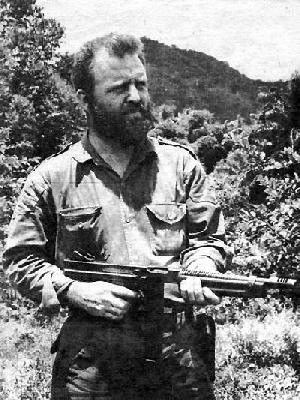
On this date in 1951, the first two foreigners — Italian merchant Antonio Riva and Japanese bookseller Ruichi Yamaguchi — were convicted and immediately executed in Beijing for a supposed plot to assassinate Mao Zedong.

According to Time magazine’s coverage of the affair, Radio Peking said that

“the streets they passed through [en route to execution] were thronged with people who expressed their feelings .. . with shouts of ‘Down with imperialism! Suppress counterrevolutionaries! Long live Chairman Mao!'”


No relation.

Riva (English Wikipedia entry | Italian) was a World War I fighter ace who had relocated to Beijing/Peking in the 1920s to peddle aircraft and training the Chinese Koumintang.

(In 1936, Riva married Catherine Lum, the daughter of American wood block artist Bertha Lum and sister of Eleanor Peter Lum, who took after mom.)

When the guys those planes were being used against won the Chinese Civil War, Riva mulled an expedient departure, but reportedly declared (Spanish link) that he could do business under any regime type.

The Communist government decided he had a different sort of business in mind. Citing Chinese state media, the London Times (Aug. 18, 1951) described the plot thus:

the conspirators planned to fire mortar shells at a reviewing stand outside the Tien An gate of the forbidden city in Peking during a procession to celebrate China’s national day on October 1 last year.

Several others, both Chinese and foreigners, drew long prison sentences as part of the “conspiracy” uncovered in a one-hour trial. The most illustrious of those was the Italian bishop Tarcisio Martina.*

Though Riva and Yamaguchi were the first foreigners officially executed by the new Chinese government, they were far from the last. All the more remarkable, then, that in a country that carries out thousands of executions per annum, Antonio Riva is thought to have been the last European citizen put to death there until Akmal Shaikh in 2009.

The Shaikh case helped rekindle interest in Riva’s execution — a timely confluence, since a recent book, L’ uomo che doveva uccidere Mao, critiqued the case against the Italian aviator.

* American diplomat Col. David Barrett, safely beyond the reach of the Maoists at Formosa, was a supposed ringleader.

On this day..

1797: Gracchus Babeuf, for the Conspiracy of Equals

If the “revolutionary extremist” exists at all as an identifiable type, he exists in purest incarnation in Gracchus Babeuf. No revolutionary better fits the description “narrowminded to the point of genius”; few have defined their heaven more clearly or crusaded so fanatically, ascetically, so religiously to bring it to earth.

Gracchus Babeuf: The First Revolutionary Communist

On this date in 1797, Francois-Noel Babeuf lost his head for the Conspiracy of Equals — the last Jacobin upheaval of the French Revolution, or the first Communist upheaval of post-Revolution modernity.

Francois-Noel — he styled himself “Gracchus” after the populist Roman tribunes — was a young man of Desmoulins‘ generation but from a considerably more hardscrabble background. Like the starry-eyed Dantonist scribbler, Babeuf discovered himself a brilliant journalist and pamphleteer with the onset of the Revolution; he did several prison stints during various revolutionary phases of the early 1790s for his too-radical-for-school opinions.

He did another in 1795 under the French Directory for his firebreathing rag Le Tribun du Peuple, which was particularly unfashionable stuff during the post-Robespierre Thermidorian regime.

Nothing daunted, Babeuf emerged from prison the leading apostle of the Parisian proletariat which had by then been decisively separated from power.

The order of the day was class consolidation with the spoils of the aristocracy apportioned among a new oligarchy of wealth. As France rushed headlong towards Bonaparte and Bourbon restoration, Babeuf was the man left to rally “the party which desires the reign of pure equality.”

The French Revolution was nothing but a precursor of another revolution, one that will be bigger, more solemn, and which will be the last.

The people marched over the bodies of kings and priests who were in league against it: it will do the same to the new tyrants, the new political Tartuffes seated in the place of the old.

Manifesto of the Equals, 1796

One can see why later revolutionaries — Marx included; Babeuf makes a cameo in the Communist Manifesto — would adopt this sort of thing as a harbinger of the next century’s revolutions.

And if the Directory had known who Nicholas II would be, it would have had no intention of going the way of his family.

Instead, it shut him down in February, 1796: Napoleon Bonaparte personally carried out the operation, just days before he wed Josephine.


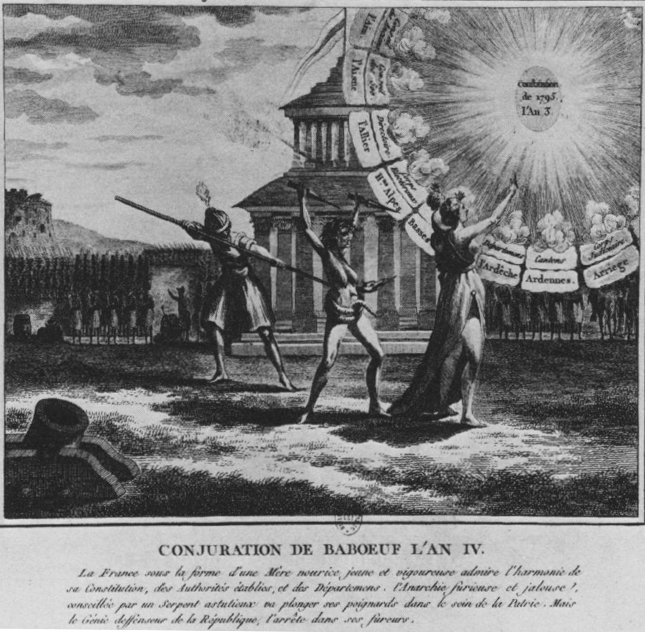
The Babeuf Conspiracy. Anonymous French print.

Babeuf’s party comes down to us as a “conspiracy,” under which word the state would charge him and which his follower Philippe Buonarroti would later rebrand the “Conspiracy of Equals”. It was not so much a grassy-knoll type of conspiracy as it was an underground organization.

When its adherents placarded Paris with the seditious “Analysis of the Doctrine of Babeuf” as the city endured a potentially dangerous economic crisis in April 1796, the government was put to a test of its strength.

It passed.

Having infiltrated Babeuf’s network, it arrested the principals on the eve of the Conspiracy’s intended insurrection. They were hailed out of Paris (a safeguard against sympathetic risings) to the commune of Vendome and there put on trial.* Babeuf and his associate Augustin Alexandre Darthe were condemned to death on May 26th and guillotined the very next day.

The last gasp of the French Revolution dropped with their heads into the basket.

Revolutionary Babeuvism, however, had scarcely just begun.

I don’t know what will become of the republicans, their families, and even the babies still at their mothers’ breasts, in the midst of the royalist fury that the counter-revolution will bring. O my friends! How heart-rending these thoughts are in my final moments! … To die for the fatherland, to leave a family, children, a beloved wife, all would be bearable if at the end of this I didn’t see liberty lost and all that belongs to sincere republicans wrapped in a horrible proscription.

-Babeuf’s last letter to his family

* The trial of Babeuf was itself a jurisprudential milestone: it was the first French trial to be transcribed verbatim.

What might look today like a nifty little advance for efficient judicature was bitterly controversial in 1797. The French Revolution had overturned an ancien regime practice of professional magistrates accepting legal testimony by written deposition and deciding matters behind closed doors. The liberte, egalite, fraternite way would instead demand that testimony be given live in the courtroom where citizen jurors could weigh its credibility.

Babeuf’s lawyer, Pierre-Francois Real, protested against the court stenographers, arguing that “The law insists that the system of written depositions not be restored in any way. That system will undoubtedly return if any means are used to save testimony given orally.”

There’s a fascinating disquisition on the curious and contradictory development of this issue and the way it “violates … common assumptions about the advance of textuality in the West” during the French Revolution in Laura Mason, “The ‘Bosom of Proof’: Criminal Justice and the Renewal of Oral Culture during the French Revolution” The Journal of Modern History, March 2004.

On this day..

71 B.C.E.: The followers of Spartacus

… a Thracian of Nomadic stock, possessed not only of great courage and strength, but also in sagacity and culture superior to his fortune, and more Hellenic than Thracian. It is said that when he was first brought to Rome to be sold, a serpent was seen coiled about his face as he slept, and his wife, who was of the same tribe as Spartacus, a prophetess, and subject to visitations of the Dionysiac frenzy, declared it the sign of a great and formidable power which would attend him to a fortunate issue.

-Plutarch, The Life of Crassus

On an uncertain date roughly around this time in 71 B.C.E., some 6,000 survivors of the shattered rebel slave army of Spartacus in Rome’s Third Servile War were crucified along the Appian Way.

The specific chronology of this legendary warrior, leader of the last major slave revolt against Rome, is necessarily foggy, but in fine, he broke out of a gladiators’ camp in 73 B.C.E. and went on to lead a slave army some 100,000 strong up and down the Italian peninsula for two solid years, repeatedly stomping Roman forces sent to suppress him.

His motivations remain mysterious; if one likes, one can project back on him an anachronistic anti-slavery project, but it’s more likely he was just trying to get by day by day as the greatest empire* on the planet harried his every move and internal divisions tore at the rebel camp.

Nevertheless, Spartacus and army prospered, and plundered, in the very heart of that empire, and gave Senators reason to fret the security of their capital even as their legions carried Roman arms from Spain to Palestine.

The army (for the gladiators organized it with military discipline, realizing a mob would be easy prey for Rome) was trapped, at last, at the toe of the Italian boot by Roman plutocrat Crassus, later to become a patron of, and fellow triumvir with, Julius Caesar. Abandoned by pirates with whom the slave army attempted to negotiate passage, it was a desperate situation. Spartacus, writes Appian, “crucified a Roman prisoner in no-man’s land to demonstrate to his own troops the fate awaiting them if they were defeated.”

Duly inspired, Spartacus and his army broke out of the Roman circumvallation around February of 71 B.C.E. Hemmed in by a second Roman force, the slaves turned to fight their pursuer, Spartacus dramatically sticking a blade into his own warhorse before the fight as another one of those conquer-or-die pregame speeches.

In The Spartacus War, Barry Strauss estimates April of 71 B.C.E. for that decisive battle. The slaves lost it; Spartacus died in combat, and his ancient calumniators vied to sing his heroism on the field.

But 6,000 survivors did not go down fighting to the death. These, Crassus staked out along one of Rome’s principal highways, the carcasses left to disintegrate there for months or years.

He’s easy to admire now,** but slave revolts scare the bejeezus out of slave societies, and the Spartacus rising would keep generations — centuries — of Romans sweating about a potential repeat. (At least, elite Romans, the ones whose voices remain for us.)

Their pejorative take on Spartacus (aside from his personal valor and martial excellence, for which even hostile writers gave him credit) was long the received wisdom on this upsetter of divinely established social order. “From a small and contemptible band of robbers,” sniffed Saint Augustine of the gladiators, “they attained to a kingdom.” They “enjoyed whatever pleasures they wished, and did what their lust suggested.”

The present-day reader’s readiest association is likely the much more admiring — and famously homoerotic, which is now yet another connotation for the gladiator’s name — Stanley Kubrick classic Spartacus, which turns 50 this year and gave to the cinematic canon the stirring “I’m Spartacus!” scene as the captured slave army defiantly embraces death.

This episode is completely ahistorical, but so what? One of the wildest things about this sword-and-sandal production is how much of it isn’t made-up. Like the premise: in the lifetime of Julius Caesar, a few guys busting out of gladiator school using nothing but kitchen utensils threatened for two years to turn the Eternal City and its far-flung realms upside-down.

* Okay, still a republic, if you like. But those days were fast coming to a close.

** Especially for modern leftist radicals; Marx and Che Guevara were both big fans; German communists Rosa Luxemburg and Karl Liebknecht named their movement for Spartacus, and it was during Berlin’s “Spartacus Week” that they were murdered.

A number of sports clubs in the former Soviet bloc also carry the Spartacus name, including Russian football power Spartak Moscow as well as several clubs in Bulgaria, which currently governs most of the rebel slave’s ancestral homeland of Thrace.

A few books about Spartacus

On this day..

1968: Lin Zhao, martyr poet

On this date in 1968, a “rightist” student whose critique of the Cultural Revolution was not blunted by the rigors of imprisonment was informed that her jail sentence had been changed to execution — which was immediately imposed at Shanghai’s Longhua Airport.

Utterly obscure at her death, Lin Zhao’s memory was tended by those closest to her, passed down like samizdat to latterly emerge out of Mao’s shadow.

An impassioned young intellectual at Peking University and a dedicated Communist with an irrepressible sense of justice, Lin Zhao once called Mao the “red star in my heart” and actually supervised the execution of a landlord during the country’s land reform push in the early 1950s.

But she also refused to temper or retract her criticisms of China’s path when the government abruptly reversed its brief flirtation with pluralism.

In 1960, after circulating a petition for fallen Communist (but not orthodox Maoist) Marshal Peng Dehuai, Lin was arrested, and eventually sentenced to a 20-year term.

It is here that the judicious person discovers the error of her ways, and accepts such terms as she can make for herself.

Not Lin Zhao.

Lin kept writing. Poetry, political manifestos, letters to the newspaper — hundreds of thousands of “reactionary” words. When they took away her ink, she opened her veins and wrote in blood.

By the end, official maltreatment and Lin’s own hunger strikes had wasted her away to less than 70 pounds. She was literally plucked from her prison hospital bed on this date by soldiers who drug her (gagged) to a show trial and execution. But like Marshal Peng, she never bent.

“Better to be destroyed,” she told her doctor, “than give up one’s principles.” (He’s quoted in Out of Mao’s Shadow: The Struggle for the Soul of a New China.)

Somehow, many of her hematic scribblings (saved by the prison, for possible use against her down the road) were smuggled out to her loved ones.* Somehow, they made their way to filmmaker Hu Jie, who put Lin Zhao back on the cultural map with the banned but well-received 2004 documentary Searching for Lin Zhao’s Soul (or In Search of Lin Zhao’s Soul).

This movie can actually be seen in its entirety in 10-minute installments on YouTube as of this writing.

Lin Zhao was posthumously exonerated by a Shanghai court in 1981. Despite Hu Jie’s efforts, she is still little known in her country, or abroad.

Phosphorescent green light never goes out
And lighting up souls every night
Preserving the soul
Letting go the crippled body
Burning into ashes in misfortune
Someday with a red flower on the head
Recognizing the blood stains
Just as copying a bright red flower
Impossible to paint the real color

One of Lin Zhao’s poems, inscribed on her tomb

* Stanford’s Hoover Institution also holds a collection of Lin Zhao papers.

On this day..

1938: Arkadi Berdichevsky, Jon Utley’s father

On this date in 1938, Arkadi (or Arcadi) Berdichevsky, a Russian Jew run afoul of the (pre-KGB) NKVD, was executed in the Arctic Circle prison town of Vorkuta for leading a prisoners’ hunger strike.

Though the powerful whom Stalin purged are well-known to the student of Russian history, Berdichevsky is just one of the countless obscure Soviet citizens who disappeared into the gulag never to emerge again.

Berdichevsky had something most of his fellow-victims did not: an English wife.

Freda Utley and her son Jon Utley — the couple cannily gave the boy his mother’s foreign last name to make it easier to emigrate if it should come to that, as indeed it did — left the USSR and Freda’s communist youth for fame as (paleo)conservative giants.

While young Jon — just two years old when his father was whisked out of their Moscow flat by the spooks — came of age, Freda Utley naturalized as an American and turned against her former ideology with the zeal of the converted.

Berdichevsky’s widow, Freda Utley, published this book in 1940 about her disillusionment with communism. This work and many others by Utley are also available as free pdfs from FredaUtley.com.

She savaged the U.S. government officials who “lost China”, and testified at Sen. Joseph McCarthy’s behest in the latter’s 1950’s red-hunt. (Utley also supplied McCarthy some research. She defended Tailgunner Joe until her death in 1978.)

Along the way, Freda Utley learned the date of her husband’s death, but never the circumstances.

That discovery fell to Jon Utley, who made his own fortune in business and became a conservative activist/intellectual himself, notable for his anti-imperialist position. (Utley writes regularly for antiwar.com, and opposed the recent Iraq blunder.)

In 2004, Jon Utley finally obtained the remarkably detailed records revealing that it was a firing squad rather than cold or malnutrition that took his father’s life. Utley then personally visited the sites of that Calvary in the Komi region of Russia.

Jon Utley gives a video interview about the experience and about his own path as an anti-communist here, but most especially recommended for our purposes is his written account of finding his father: HTML form here; pdf here.

On this day..

1979: Gu Shan, of The Vagrants fame

It’s the spring equinox, but here at Executed Today, this date brings no bunnies or pastels.

However, in the spirit of softness, it brings this time only a fictional execution.

On this date in 1979, Gu Shan, the central character of Yiyun Li‘s novel The Vagrants gets a bullet to the heart in the Chinese town of Muddy River. The novel traces the lives of several townspeople in Muddy River who are touched by Shan’s death.

The short life of Gu Shan is secondary to the action of the novel itself: first a revolutionary, then a counter-revolutionary, the 28-year-old is imprisoned for acting against the government. As she sits in jail, she continues to write, and the scribbles in her journals are used in a retrial to garner a death sentence.

In a town of 80,000, her actions can be both consequential and inconsequential, but the people around her are a wholly forgotten lot. In a sense, then, Shan is important mostly because she’s noticed, and, as the saying goes, that really ties the room together.

The story tracks a cluster of characters who interact on the streets but live very different — almost uniformly bleak — lives. These range from Nini, a deformed girl whose mother was brutally assaulted by Shan when the latter was a revolutionary (a crime for which Shan suffered no consequences) to Bashi, the deranged son of China’s best Korean War-era pilot, who mutilates Shan’s corpse and shows a mild obsession for a 7-year-old boy.

Muddy River plays host to dozens of other characters connected to the execution, and Li paints a vividly depressing picture of China immediately after Mao Zedong’s death. The town is a collection of sad lives mired in moral depravity brought about by destitution and Party corruption. The most positive events transpire in quarters in a portable toilet.

Assuming you’re not looking for a pick-me-up on this equinoctial day (and why would you be at this blog if you were?), The Vagrants is well worth the read.

On this day..

1961: William Morgan, the Americano

On this date in 1961, American William Morgan — once an anti-Batista rebel — was shot in Havana’s La Cabana fortress for counter-revolutionary activity against the Castro government.

The high school dropout and army washout went to Cuba around late 1957 or early 1958.

He’d had an unsettled life, this Morgan. He’d been a convict, a circus sideshow, a wanderer. But he was about to make his name.

This strange gringo soon to be nicknamed “El Americano” walked into the Escambray Mountains and joined a group of anti-Batista rebels that was unaffiliated with Castro’s 26th of July Movement. Morgan won the respect of Cubans for his courage and his evidently un-mercenary commitment to the cause.

Fatally for him, that cause was a constitutional-democracy take on opposing the Batista dictatorship.

Morgan was stridently anti-Communist and not shy about saying so.

“There isn’t anyone in Cuba who doesn’t know where I stand-Fidel, Raul, or anyone. I am anticommunist. I don’t like them.”

That attitude would put him on a collision course with the only other foreigner to hold a comandante rank among the anti-Batista guerrillas: Argentinian Ernesto “Che” Guevara.

Those two men’s columns nearly exchanged shots when Guevara was dispatched by Castro to reach an understanding with Morgan. Morgan and Guevara came to terms that day — there was a revolution to be won, after all — but animosity would remain between these two impassioned freedom-fighters whose visions of freedom could never be reconciled.

They personify the competing choices before post-Batista Cuba, in those first years when Cuba kept to a tenuous hold on non-alignment.

Morgan supported that revolution; he even made the headlines for dramatically foiling a Dominican-backed plot to topple Castro in 1959.

But it was Guevara who was the future. More radical July 26th members won senior spots in the new administration, while outsiders like Morgan got assignments like frog-farming. Geopolitical events saw Cuba sliding into the Soviet camp.

Disenchanted, Morgan started plotting for real.* It didn’t work.

He was caught in late 1960, held incommunicado for a period, then tried, convicted and condemned two days before his execution (along with fellow-traveler and -plotter Jesus Carreras Zayas (Spanish link)) after nightfall March 11, 1961.

Morgan’s execution was carried out by a fellow Yanqui, Herman Marks — himself destined to run afoul of the Castro regime down the road. (Marks fled back to the U.S.) The sympathetic account of el Americano‘s death is quite the flowery affair, with the Cubans kneecapping Morgan when he defiantly refuses to kneel.

Castro himself is sometimes said to be present, the shadowy observer issuing the fatal commands to which Morgan will not bow, like the insouciant silhouette of Stalin behind a screen at trials where his former henchmen were purged.

A poetic touch, though one would think a head of state might have more pressing business than personally orchestrating executions: and indeed, it seems that Fidel actually spent that evening at a diplomatic reception with Soviet and Chinese ambassadors. Two months later, Castro officially declared Cuba a socialist state.

And as with Morgan, so with many of his brethren-in-arms from the Escambray Mountains. It took Havana the better part of the 1960s to suppress anti-communist “bandits” in Morgan’s old stomping-grounds — Cuba’s (successful) War Against the Bandits.

* There’s more skullduggery in Morgan’s shadowy life than this post has space for, but theories exist that the Dominican plot he “foiled” was actually one he had been an earnest participant in before it was sniffed out by Cuban security, with the war hero Morgan forced to betray it.

On this day..

1939: Stanislav Kosior, Vlas Chubar and Pavel Postyshev

On this date in 1939, a couple of “New Bolsheviks” recently flying high after helping purge the Old Bolsheviks had their own reversals of fate culminate with a bullet to the head.

Stanislav Kosior* (or Kossior), a Pole who ran the Ukrainian Communist Party for much of the 1930’s, and Vlas Chubar, a Ukrainian politburo member who had once served as Prime Minister, were shot this day along with Pavel Postyshev,** once Stalin’s personal representative to the Ukraine.

Left to right: Kosior, Chubar, and Postyshev — the first and last on post-rehabilitation Soviet stamps.

Though these obviously died because of parochial party politics under the terrifying reign of Stalin — and all were accordingly rehabilitated after Stalin’s death — posterity has another bone to pick with them: the Ukrainian famine known as the Holodomor.

Their portfolios included carrying out the forced collectivization to which the famine is generally attributed. Participation was strongly encouraged.

“Join the collective farm or else off to the Solovets Islands.”

Chubar

It was a grim time: starving peasnts dared not touch collectivized foodstuffs slated for use elsewhere on pain of execution themselves.† (Kosior won the Order of Lenin for his achievements in agriculture.) These Soviet VIPs themselves faced very similar pressure to implement Moscow policy and party line with exactitude … and very similar consequences for any perceived failure. (Kosior, too steely to succumb to torture, finally broke when his captors raped his teenage daughter in front of him.)

State organs adapted to the fall of these powerful men with Orwellian aplomb. “Radio Kosior” was renamed “Radio Kiev” overnight with its namesake’s arrest. Secret police chief Lavrenty Beria personally expropriated Chubar’s dacha. And

there is an account of a case in the Ukraine in which fifty students were charged with forming an organization to assassinate Kossior, who had been named as one of the senior intended victims in the great Moscow Trials. A year’s work on this case, which was a structure of great intricacy, had been performed by the interrogators. In 1938, however, it became known that Kossior himself had been arrested as a Trotskyite. Everyone thought that the students would be released. But a new interrogation immediately started, and they were beaten up for having lied to the NKVD. After a few days, the stool pigeons in the cells let them know what they were supposed to confess this time. It was to change their deposition, putting the name of Kaganovich for that of Kossior. The NKVD could not face the trouble of constructing a completely new fabrication. Finally everything was in order, and the students were sent off to labor camps.

A Ukrainian court recently named Kosior, Chubar and Postyshev among eight individuals personally responsible for the Holodomor.

* When Kosior was assigned to Moscow in 1938, he was replaced in the Ukraine by a good friend: future Soviet Premier Nikita Khrushchev. (According to Nikita’s son.) To judge by the ferocity and extent of the purges Khrushchev oversaw, he took to heart the lesson from his predecessors’ fall.

** But on the plus side, Russians’ and eastern Slavs’ (continuing) tradition of putting up New Year’s trees in at least partly attributable (Russian link) to a Postyshev epistle to Pravda in 1935 calling for same. (The New Year’s yolka was a religious/tsarist tradition that had been discontinued after the Russian Revolution, but like many such cultural artifacts proved amenable — with Postyshev’s nudging — to secular/Communist reappropriation.)

† The nature of the Holodomor is the subject of furious present-day wrangling: can the mass starvation accurately be classed as a “genocide”? Especially given that such a finding could expose Russia and/or Russians to legal liability, there’s something of a difference of opinion on the matter between Kiev and Moscow.

On this day..

1960: Oliviu Beldeanu, for the Berne incident

On this date in 1960, Romanian anti-communist Oliviu Beldeanu was executed at Jilava prison for a headline-grabbing protest he’d orchestrated in Switzerland five years before.

Beldeanu (here‘s his Romanian Wikipedia page) was the ringleader of a group of Romanian exiles who’d commandeered the Romanian embassy in Bern(e) in February 1955.

The aptly-named Berne Incident was meant to be a symbolic protest — Communist symbols smashed, damaging secret correspondence released, that sort of thing — but it did also result in an embassy driver being shot to death.

These “legionary fascist groups”* and “traitors abroad,” (pdf) (in the official lexicology of Bucharest) were handled fairly gently by Switzerland, predictably keen to stay clear of diplomatic incidents.

Beldeanu et al drew lenient prison sentences from which they were released early.

And that would have been the end of it … but a Communist cloak-and-dagger operation after the ex-cons were freed lured Beldeanu to Berlin. He was kidnapped by the East German Stasi and flown to Romania, there to be subject to a perfunctory trial and speedy execution.

* “Legionary fascist” denunciations — associating the Switzerland activists with Romania’s notorious Iron Guard — cited by Paul Nistor, “The five who scared … America, too. The immediate effects of the attempt in Bern (1955) over the Romanian diplomacy”, Valahian Journal of Historical Studies, Dec. 2009.

On this day..

1940: Isaak Babel

On this date in 1940, Isaak Babel, “the greatest prose writer of Russian Jewry,” was shot in Moscow.

The Odessa-born 45-year-old had managed the difficult trick of maintaining a high-profile writing career in the 1930s Soviet Union without abandoning his artistic integrity. (This meant he published a lot less in that decade, which fact was held against him in his trial: “deliberate sabotage and a refusal to write.”)

A pre-revolutionary friendship with Maxim Gorky and an early affinity for the Bolsheviks had helped see him through such transgressions against Communist ideology as describing Red atrocities during the Russian Civil War, and writing a play about the underbelly of Soviet society.

Babel remains beloved today for that very reason; his Odessa Tales collection of short stories about Jewish gangsters still charms Russians and foreigners alike.

But Gorky died in 1936, and without that elder statesman’s protection, Babel’s insufficiently lockstep scribbling laid him increasingly liable to public denunciation for, e.g., “aestheticism.”

And as sickle follows hammer, miscalibrated revolutionary ardor in Stalin’s Russia led in 1939 to that dread knock on the door, that stay in Lubyanka Prison, that inevitable “confession” of Trotskyism, and that bullet to the head after a perfunctory trial.

Babel’s work is recent enough that it’s mostly not freely available in English. A couple in English and several in Russian are linked here; literary criticisms with plentiful excerpts of Babel’s work are available here, here, and here, among many other places.

Babel was officially rehabilitated during the Khrushchev era.

On this day..