1826: The Decembrists

On this date* in 1826, five leaders of the Decembrist revolt were hanged at St. Petersburg’s Peter and Paul fortress for their abortive eponymous uprising eight months before.

The most renowned and romantic of Russia’s hapless liberals, the Decembrists were a secret clique of idealistic young officers, many of whom had cut their teeth chasing Napoleon’s grande armee out of Russia in 1812.

In Russia’s complex interaction with the West — its ideas, its political institutions, its ways of life — these were the westernizers, who saw constitutionalism as the way of the future.

Upon the mysteriously sudden death of Tsar Alexander I, an irregular succession to the second-oldest surviving brother, Nicholas I, gave our day’s doomed and gallant youth cause to occupy St. Petersburg’s Senatskaya Square to uphold the rights of the first brother — and more to the point, to uphold the constitution to the extent of constraining the monarchy.


Decembrists at Senate Square, as depicted by Karl Kolman.

Uh … Now What?

This badly organized affair failed in its aim to attract the mass of soldiery and, constitutionalists as its organizers were, did not even aim at mobilizing the general populace.

After the initial heady rush of marching into the square in the name of liberty, the Decembrists were left in a standoff against a much larger force of loyalists. When the latter started shooting, that was that.

Those that survived faced trial, with five — Peter Kakhovsky, Kondraty Ryleyev, Sergei Muravyov-Apostol, Mikhail Bestuzhev-Ryumin and Pavel Pestel — initially sentenced to drawing and quartering.

“Mere” hanging was deemed sufficient for the purpose. That would be about the maximum embrace of liberalism by the Russian autocracy, whose lesson from the uprising was to crack down against any hint of forward-thinking politics — ultimately an unsuccessful strategy for the Romanov dynasty.

St. Petersburg’s Senate Square — renamed Decembrist Square by the Soviet government — where the action happened. The iconic equestrian statue of Peter the Great, commissioned by Catherine the Great and unveiled in 1782, witnessed it all; the statue acquired its enduring moniker, “The Bronze Horseman”, from a poem of the same title penned in 1833 by Alexander Pushkin, a friend of several Decembrists.

One of the greatest works of Russian literature, Pushkin’s “Bronze Horseman” weaves an ambiguous Decembrist-tinged critique of cruel imperial power and overreach into a complex narrative of St. Petersburg whose upshot is still up for lively literary debate. “The Bronze Horseman’s crag rose up before the poet on an empty square,” wrote one historian, “washed with the blood of those who rebelled on December 14, 1825”

Appalling there
He sat, begirt with mist and air.
What thoughts engrave His brow! what hidden
Power and authority He claims!
What fire in yonder charger flames!
Proud charger, whither art thou ridden,
Where leapest thou? and where, on whom,
Wilt plant thy hoof?

“They don’t even know how to hang you …”

When the hangings were carried out, Kakhovsky, Muravyov-Apostol and Ryleyev all had their ropes break; while some in the crowd anticipated the old prerogative of mercy for any prisoner who survives an execution, they just got re-hung instead. “Unhappy country,” quipped Ryleyev as the fresh nooses were fixed up, “where they don’t even know how to hang you.”**

Other Decembrists not condemned to the unreliable craftmanship of the Russian gallows were shipped to Siberia, where they invigorated the cultural life of the Lake Baikal city of Irkutsk — many of them famously followed by their “Decembrists’ wives,” an iconic type that continues to denote heroically sacrificial loyalty since the women had to renounce their own right to return to European Russia.

These, at least, had a place to call their own, however distant. But the class of Russian elites to which they belonged would be thrust into a trackless wilderness by their failure (in the Decembrist rising and otherwise) to carve out some distinct place for themselves. Russia’s long reckoning with modernity still had many years to run.


A worn postcard of a 19th century Russian painting depicting (perhaps) a political prisoner in the Peter and Paul Fortress.

* July 25 was the date on the Gregorian calendar; per the Julian calendar still in use in Russia at the time, the date was July 13.

** Ryleyev was quite the saucy one, having fought a “mysterious” duel with Pushkin in 1823, and instigated (and served as second at) a famous St. Petersburg jilted-love duel in 1825 that cost the lives of both antagonists.

A poet himself and a romantic to the point of fanaticism, Ryleyev wrote odes extolling executed national heroes like Artemy Volynsky and Severyn Nalyvaiko, seemingly alluding (as in this excerpt from the latter work) to his anticipation of joining them.

I know full well the dire fate
Which must upon the patriot wait
Who first dare rise against the foe
And at the tyrant aim the blow.
This is my destined fate

On this day..

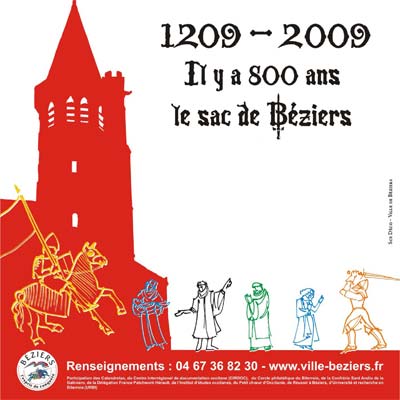
1209: Massacre of Beziers, “kill them all, let God sort them out”

Today the French town of Beziers remembers the 800th anniversary of the first sack and massacre of the Albigensian Crusade.

Rome was alarmed by the advent in southern France of a mass religious movement, Catharism, with such scandalous doctrines as spirit-body dualism and not giving tons of money to Rome.

Naturally, God said to cut them to pieces.

Beziers was the first town invested by the invading crusader army, left to its fate as the Cathars mustered in Carcassone. Interestingly, this particular city did not so much present that familiar spectacle of Christians killing Christians who thought differently — unless the thought in question was about handing over their neighbors to a throng of land-grabbing nobles.

Part of the Catholic faith did itself honor this day: those Biterrois who refused to abandon to the glories of martyrdom the Cathars in their midst, who are thought to have numbered merely a few hundred. So when the walls fell, it was mostly orthodox Catholics killing orthodox Catholics.

Well, what’s a crusading army with other cities to sack supposed to do?

“Kill them all”

After the fortified city embarrassingly got itself captured within hours by camp followers, Caesar of Heisterbach recorded one of history’s more quotably infamous instances of prayerful deliberation:

When they discovered, from the admissions of some of them, that there were Catholics mingled with the heretics they said to the abbot “Sir, what shall we do, for we cannot distinguish between the faithful and the heretics.” The abbot, like the others, was afraid that many, in fear of death, would pretend to be Catholics, and after their departure, would return to their heresy, and is said to have replied “Kill them all for the Lord knoweth them that are His” (2 Tim. ii. 19) and so countless number in that town were slain.

Or, in glorious Latin:

Caedite eos. Novit enim Dominus qui sunt eius.

And so they did.

And they killed everyone who fled into the church; no cross or altar or crucifix could save them. And these raving beggarly lads, they killed the clergy too, and the women and children. I doubt if one person came out alive … such a slaughter has not been known or consented to, I think, since the time of the Saracens. (William of Tudela, cited in Cathar Castles)

Ten to twenty thousand are thought to have been slain this day — in what proportions Catholic and heretic, only God can say.

On this day..

Feast Day of Saint Peter and Saint Paul

June 29 is the shared feast day (in both the Latin and Greek rites) of the two biggest wheels in first century Christianity, Saint Peter and Saint Paul.

Tradition holds that both men were martyred in Rome during the persecutions of Emperor Nero after Rome burned: Paul beheaded, Peter crucified upside-down at his own request not to die in the manner of his lord.* Some traditions have both being put to death on the same day; others do not.

Concrete dates** are going to be hard to come by, of course, and the purported historical doings of New Testament Christians are inextricably conjoined to theological ox-goring.

But it is their lives and not their deaths that make them memorable, and to judge by the conquest of the faith they propounded, their feast day honors are richly deserved. Some scholars with no fear for their soul will tell you that Paul in particular can be rated a more consequential historical person than the Nazarene himself, having formulated the doctrine and conducted the ministry needed to turn a dead-end Jewish sect or inchoate reform movement into a surging universal religion that would play to Praetorians.

[flv:http://www-tc.pbs.org/wgbh/pages/frontline/video/flv/1610/jc7.flv 440 330]

More from this program — and other resources on early Christianity — at this Frontline page.

While linked on this day, Peter and Paul appear in the Bible as sometime rivals. One might well speculate at the dynamics between them: Peter, after all, got his commission straight from the Savior himself; the upstart Saul of Tarsus, late of the Jewish establishment, arrived fired with the zeal of the converted and went from persecuting Christians to appropriating their doctrine, even calling Peter out publicly.

However they sublimated that awkwardness, their respective offices as Apostle to the Jews (Peter) and Apostle to the Gentiles (Paul) allude to an oft-explored problem whose resolution would prove decisive for the nascent faith: did Christianity require adherence to the strict Mosaic law?

The stakes: would anyone outside of already-existing Jews actually want to convert?

Paul looks like the firebrand, boldly and tirelessly enacting his revolutionary faith-alone revelation (so central to the Protestant Reformation 15 centuries later) on the pacified highways and sea lanes of the Pax Romana; Peter seems the compromiser (or a vacillator), instinctively granting precedence to the Jewish tradition but being carried along by events towards Paul.

Peter is seen in the Bible acceding to Paul’s opposition to making Greeks eat kosher and circumcise, and even persuading the most august Judaizer and leader of the Jewish Christians at Jerusalem, Saint James.

Amongst these illustrious names, we may perceive or imagine — “through a glass darkly”, as it were — what must have been a blossoming multitude of contending beliefs and practices.

Paul made Christian doctrine amenable† to the practices that would make it a phenomenal evangelical success (and separate it from the faith of Abraham), but on that same winners-write-history basis one is entitled to wonder whether the authority of Peter and James have been appropriated ex post facto by the Biblical writers of the Pauline party. If so, you wouldn’t say his reputation has suffered for it: the pope still claims to speak as “the unworthy heir of St. Peter” … and in St. Peter’s Basilica.

Whatever the faithful and the merely interested may speculate about their historicity, their names are on the founding charter of Christianity.

I have fought the good fight, I have finished the race, I have kept the faith. Now there is in store for me the crown of righteousness, which the Lord, the righteous Judge, will award to me on that day … (St. Paul, 2 Timothy 4:7-8)

A very few of the very many books about Peter and Paul and their times

* See the apocryphal Acts of Peter.

** Italian archaeologist Margherita Guarducci, however, argued that Peter’s death could be assigned to a precise date: October 13, 64. We can pose against this skepticism that Peter ever went to Rome at all, a sometime Protestant hobby-horse supposed to undermine the primacy of the Holy See.

† But not so decisively that he wasn’t soon at loggerheads with the Jerusalem Jewish Christians again.


Update: Just as this post was getting set to publish, the Vatican announced the discovery of what it claims may be the oldest image of St. Paul, a 4th century fresco uncovered in a Roman catacomb.

On this day..

1777: William Dodd, mind wonderfully concentrated

On this date in 1777, they hanged the macaroni parson at Tyburn.

High-living, Cambridge-educated vicar William Dodd achieved this emasculating nickname for his frippery — macaroni (or maccaroni) being 18th century slang for a sort of outrageous continental metrosexual.*

He came particularly in for public ridicule when he was caught trying to bribe his way to a lucrative ecclesiastical position, financial hardship from his lifestyle having driven him to the desperate need for a pay hike. (In sorer straits later, he would sum up his life: “my greatest evil was expense. To supply it, I fell into the dreadful and ruinous mode of raising money by simonies. The annuities devoured me.”

Playwright Samuel Foote skewered the recently-humiliated Dodd on the stage in The Cozeners as “Dr. Simony,” described in the scrambled boast of “Mrs. Simony”:

not a more populous preacher within the sound of Bow-bells: I don’t mean for the mobility only … with a cambric handkerchief in one hand, and a diamond ring on the other: and then he waves this way and that way; and he curtsies, and he bows, and he bounces, that all the people are ready to — but then his wig, madam! I am sure you must admire his dear wig … short, rounded off at the ear, to show his plump cherry cheeks, white as a curd, feather-topped, and the curls as close as a cauliflower…

Then, my doctor is none of your schismatics, madam; believes in the whole thirty-nine! and so he would if there were nine times as many.

Three years after Foote’s cruel pen gave Dodd’s name immortality, the divine himself was (so he should think) ushered into eternity, after he got caught passing a forged bond against the revenues of his onetime student Lord Chesterfield.

Condemned to die for the offense,** a longer-than-usual lag from sentence to execution gave Dr. Simony leave to follow that classic Calvary of errant clerics with a mien of pious self-flagellation that helped his case raised a public outcry for clemency.

Samuel Johnson was among thousands of Britons who petitioned for mercy, and in Johnson’s case, went a bit further to ghost-write a piece in Dodd’s name, “The convict’s address to his unhappy brethren”. It was when the litterateur’s hand was suspected behind this prose† that Johnson made his quotable, tweetable remark,

“Depend upon it Sir, when a man knows he is to be hanged in a fortnight, it concentrates his mind wonderfully.”

Dr. Johnson, nevertheless, was the true author, and the old scribbler used it to express some of his particular opinions on the proper staging of gallows-theater.

It is the duty of a penitent to repair, so far as he has the power, the injury which he has done. What we can do, is commonly nothing more than to leave the world an example of contrition. On the dreadful day, when the sentence of the law has its full force, some will be found to have affected a shameless bravery, or negligent intrepidity. Such is not the proper behaviour of a convicted criminal. To rejoice in tortures is the privilege of a martyr; to meet death with intrepidity is the right only of innocence, if in any human being innocence could be found. Of him, whose life is shortened by his crimes, the last duties are humility and self-abasement. We owe to God sincere repentance; we owe to man the appearance of repentance.—-We ought not to propagate an opinion, that he who lived in wickedness can die with courage.‡

William Dodd (together with another criminal, Joseph Harris: there’s a wonderful profile of this forgotten youth here) had occasion to do just that this day in 1777. Dodd became the last person hanged for forgery at Tyburn.

Updated: According to Wendy Moore, there was an posthumous attempt at resuscitation, which was known to work sometimes.

Dodd, himself a big death penalty opponent from his former public perch, gave a sermon the very year of his eventual death titled The Frequency of Capital Punishments Inconsistent with Justice, Sound Policy and Religion, critiquing “voluntary destruction” of human life and its inconsistency with “the humane and benevolent spirit which characterizes the present times.”

He was also — which helps explain the revival attempt — a big supporter of the Humane Society, which sought to apply the developing science of the Enlightenment to the problem of resuscitating the (near-)drowned. (The Royal Humane Society’s motto today is lateat scintillula forsan, “a small spark may perhaps lie hid.”)

Dodd preached an enthusiastic sermon to this body in 1776, expansively anticipating its work for analogous “various other kinds of sudden and accidental death” such as “malefactors executed at the gallows, [which] would afford opportunities of discovering how far this method might be successful in relieving such as may have unhappily become their own executioners by hanging themselves.” Dodd’s own engagement with both the medical and the theological questions at stake in resuscitation surely conditioned his own anticipation under the noose that, if revived, he might live on as a “renovated being.”

(Dodd’s involvement with the Humane Society is detailed in Kelly McGuire’s “Raising the Dead: Sermons, Suicide, and Transnational Exchange in the Eighteenth Century,” Literature and Medicine, Spring 2009.)

It was, surely, an astounding time to live; no less so, to die. And the mysterious border between the two might be re-engineered by human ingenuity.

As Lord Byron (a man with his own fascination for the scaffold) wrote in Don Juan,

What opposite discoveries we have seen!
(Signs of true genius, and of empty pockets.)
One makes new noses, one a guillotine,
One breaks your bones, one sets them in their sockets;

Bread has been made (indifferent) from potatoes;
And galvanism has set some corpses grinning,
But has not answer’d like the apparatus
Of the Humane Society’s beginning
By which men are unsuffocated gratis:
What wondrous new machines have late been spinning!

* The lyrics of “Yankee Doodle Dandy” (“stuck a feather in his hat and called it macaroni”) may be the most recognizable modern-day relic of this lexicon.

** Dodd made a groveling plea to the jury in the face of overwhelming evidence against him, at one point bold enough to appeal to injury his death would inflict upon those who lent him money: “I have creditors, honest men, who will lose much by my death. I hope, for the sake of justice towards them, some mercy will be shown to me. ”

† Dodd could write a little himself; he had a theological tract and a commentary on Shakespeare already to his name, and at Newgate cranked out Thoughts in Prison, a collection of sub-Villon poetry.

‡ In an addendum that would have warmed the cockles of the Roberts court, Johnson-as-Dodd also opined,

Every man reposes upon the tribunals of his country the stability of possession, and the serenity of life. He therefore who unjustly exposes the courts of judicature to suspicion, either of partiality or error, not only does an injury to those who dispense the laws, but diminishes the public confidence in the laws themselves, and shakes the foundation of public tranquility.

On this day..

1389: Saint Tsar Lazar, after the Battle of Kosovo

On this date (by the Julian calendar then in use) in 1389, Stefan Lazar Hrebeljanovic — that’s Tsar Lazar to you — led the armies of Moravian Serbia against the expanding Ottoman Empire at the Battle of Kosovo.

The Serbs were defeated — thereby plunging, in the national mythology, into a half-millennium of Turkish domination. Lazar was supposedly* captured and beheaded.

For a generation, Lazar had firmed up his authority as the most significant Serbian autocrat outside the Ottoman orbit. The gravity of that orbit, however, grew more powerful with each passing year; soon, it would devour Byzantium.

Here in the 14th century, the Turkish expansion took on vassals in southeastern Europe. For a prince in the marches, a reckoning had to come due.

Of course, some Serbian lords and other Christian rulers were prepared to owe fealty to the Turks.

In the national epic poem The Battle of Kosovo, our day’s hero receives divine visitation charging him to choose between the treasures of earth and those of eternity, perhaps the author’s critique of European nobles who joined the infidel.

‘Lazar! Lazar! Tsar of noble family,
Which kingdom is it that you long for most?
Will you choose a heavenly crown today?
Or will you choose an earthly crown?
If you choose the earth then saddle horses,
Tighten girths- have your knights put on
Their swords and make a dawn attack against
The Turks: your enemy will be destroyed.
But if you choose the skies then build a church-
O, not of stone but out of silk and velvet-
Gather up your forces take the bread and wine,
For all shall perish, perish utterly,
And you, O Tsar, shall perish with them.”

Lazar built the church.

This particular battle grew into one of mythic importance in the national memory of Serbia: the sacred apogee of national honor, even the bulwark of Christendom upon which the Islamic wave broke.**

Its site, “Kosovo Polje” or the “Field of Blackbirds” near Pristina, is a monument to the Serbian and Orthodox cause; that it is located, as its name suggests, in the province forcibly detached from Belgrade by NATO during the Kosovo War makes it a politically touchy bit of topography. Nationalist outfits like the Tsar Lazar Guard are violently displeased with Albanians having say-so about the place.

Not surprisingly, the record of the time suggests less a Balkan Thermopylae than that old historical standby — shifting relationships of collaboration, resistance, and negotiated boundaries amid Ottoman advances and (sometimes) reverses.

Lazar’s own son and heir Stefan Lazarevic became an Ottoman ally; when the Ottomans were themselves invaded, he shifted his alliance to a different regional power, Hungary. His successor, Durad Brankovic, became estranged from that alliance and eventually fought against the Hungarians in the Second Battle of Kosovo … as an Ottoman vassal.†

Be that as it may, St. Vitus’ DayVidovdan in Serbo-Croatian — which is now observed on its Gregorian calendar date of June 28th, remains one of the most sacred days on the Serbian calendar (it’s also the feast day of Lazar, a saint in the Orthodox tradition).

Vidovdan obtained another layer of meaning in 1914, for it was June 28 that Yugoslav nationalists then under the heel of a Christian empire assassinated Austro-Hungarian Archduke Ferdinand and ignited the First World War.

* It’s the predominant version of legend but not a settled historical fact that Lazar was actually beheaded as a prisoner. He may have simply died in battle, or of wounds taken sustained in the fight.

** Subject, like all good myths, to opposing interpretations.

† At the Second Battle of Kosovo, Serbian forces captured the fleeing Hungarian ruler, John Hunyadi, and his eldest son, Laszlo.

On this day..

1942: The village of Lidice, for the assassination of Reinhard Heydrich

On this date in 1942, the Germans visited upon the Czechoslovakian village of Lidice one of the most notorious butcheries of World War II: the physical destruction of the town, and the execution of most of the adult population, in revenge for the assassination of Reichsprotektor Reinhard Heydrich.

Heydrich had power of life and death in Nazi-occupied Bohemia and Moravia, and did not scruple to use it.

“The Hangman of Prague” was no mere functionary, but a Nazi grand wizard from way back, who’d had a hand in the Third Reich’s most terrifying greatest hits — the Night of the Long Knives, Kristallnacht. Just four months before this date, Heydrich had chaired the Wannsee Conference.* (Watch Kenneth Branagh as Heydrich ride herd over a gaggle of bureaucrats to get the Final Solution up and running in Conspiracy.) Hitler called him his “man with the iron heart.”

So he was a natural target for the Czechoslovakian army-in-exile and their British handlers, made more so by his lordly disdain for common-sense security safeguards.

Zipping along a predictable route in an open car, he was a sitting duck for a hit squad, who gave the Nazi bastard a mortal shrapnel wound from a grenade that had him lingering painfully at death’s door for several days before he finally died of blood poisoning.

The 1964 Czechoslovakian film Atentat (“Assassination”) chronicles the plot to kill Heydrich and its aftermath.

For this effrontery, Czechoslovakians would pay a dreadful price.

Naturally, the Nazis mercilessly hunted down and slaughtered those with any connection to the plot.

But the Reich also exacted collective reprisals to make plain that the entire “protectorate” could be considered hostage against such plots in the future.

Special transports of Jews marked “Attentat auf Heydrich” were shipped to the camps, and 152 were executed on the day Heydrich succumbed. But then, the Nazis were brutalizing Jews anyway. Something more headline-grabbing would be needed.

Enter Lidice.

After gaudy funerals for the slain Reichsprotektor, the Reich settled upon the small town of Lidice north of Prague — trumping up a few connections to resistance to “justify” collective punishment.

On this date, German troops stormed it, summarily executed all the men and boys** old enough to bear arms and a fair number of women, deported the others, and then physically destroyed and buried the town.

Lidice was intended as a demonstration — boldly published to the world as proof against a repeat,† it became the byword of Nazi cruelty towards subject nations. Though not by quantitative standards the greatest crime of the occupation, not even the greatest crime in reprisal for Heydrich, its three syllables distill all the evil of Hitler’s conquest for Czechoslovakia.

Lidice did live, and does yet, as an emblem par excellence those terrible years.

Less alive: Heydrich’s right-hand man Karl Hermann Frank, who was hanged in Prague after the war for engineering this monstrous crime. Those survivors of Lidice able to make the trip enjoyed priority seating.

* Heydrich’s aide at the Wannsee Conference, and taker of cleaned-up minutes, was Mr. Banality of Evil himself, Adolf Eichmann.

** Only three men of Lidice survived the destruction: two who were in England at that time, and one who was imprisoned in Prague for killing his son. The sentence for this crime, it turned out, was life.

† An effective proof — the calculated wholesale slaughter apparently did cool both the conquered populace and the enemies of Germany on enthusiasm for further assassinations.

On this day..

1521: The Comuneros of Castile

On this date in 1521, the day after winning the decisive battle in the Castilian War of the Communities, royalist forces beheaded its three principal leaders in Villalar.

Even while the Spanish Empire was burgeoning in the New World, its home peninsula remained a house divided.

The Iberian Kingdoms of Aragon and Castile had joined in a personal union with the marriage of Ferdinand and Isabella in the late 15th century.

When the couple passed, it was not a given that their conjoined territory would become, as it did, the germ of a unified Spain.

Instead, the royal power couple’s crazy daughter was kept under lock and key while her infant son grew into the redoubtable Emperor Charles V. To exacerbate the local annoyance, Chas had continent-spanning territories, and ambitions; Spain was not his base, merely one of his provinces. (He’d grown up in Flanders. Ah, dynastic politics.)

The Emperor was only a teenager when his Castilian subjects rose against his levies, and against the paradoxical perception that the first true King of Spain was a foreign ruler.

A riot in Toledo mushroomed into a revolt, and everyone started drawing up sides. (Spanish link) Things went south when the commoner rebels started adopting an unwelcome radicalism (beyond rebelling against the king, that is), enabling the imperial rep (and future pope) Adrian of Utrecht to pull back into the royalist camp rebellious nobles increasingly fearful of expropriation at the hands of the firebrands.

After the balance of forces decided in Charles V’s favor, all that remained was to give the chop to the primary troublemakers. Juan Lopez de Padilla, Juan Bravo and Francisco Maldonado were obligingly captured after the Battle of Villalar.


The Execution of the Comuneros of Castile, by Antonio Gisbert. Segovian Juan Bravo allegedly asked to die first, so as not to witness the death of so good a knight as Padilla.

The demise of the “Caballeros Comuneros” pretty much squelched the revolt — although Padilla’s widow Maria Pacheco defended the rebel ground zero of Toledo for several months more.

The comuneros have lived on ever since as a symbol in literature and propaganda, among monarchists (for whom they are a symbol of perfidy), liberals (rather the reverse) and Castilian nationalists. Though “comuneros” was for a period an all-purpose smear against agitators in the Spanish dominions, April 23 (the date of the fateful battle) has been Castile and Leon Day, a public observance, since 1986.


This monolith in the Villalar town plaza commemorates the Comuneros. Image (c) Julio Alvarez, and used with permission.

On this day..

1836: The defenders of the Alamo, much remembered

On this date in 1836, Mexican forces commanded by President Antonio Lopez de Santa Anna overran the Alamo — and executed those few of its defenders who survived the day’s battle.

“Remember the Alamo!”

This most memorable battle of the Texas Revolution has since retained its place in the founding mythology of Texas and its draw as a tourist destination in San Antonio, no matter the complexities on the ground. (You can watch the earliest surviving film treatment, The Martyrs of the Alamo, free online. D.W. Griffith made it the same year he made Birth of a Nation.)

That Alamo of blood and legend, and the countervailing interpretations it eclipses, are much beyond our scope here, but we are attracted to notice the reputed summary execution of five to seven defenders who had surrendered or otherwise been captured during the fight. (A few dozen mostly civilian noncombatants in the former mission also survived, and were not executed.)

According to Robert Scott, Santa Anna was empowered by a Mexican resolution holding (not without cause) that

“foreigners landing on the coast of the Republic or invading its territory by land, armed, and with the intent of attacking our country, will be deemed pirates.”

Who counted, at this moment, as “foreigners” among the Anglo settlers trying to break away from Mexico and their supporters among from the United States to which Texas would eventually attach poses a historiographical riddle. But then, Santa Anna wasn’t there to write a dissertation, but to win a war — and he was said to be sorely annoyed at the defenders having tied him down for a week and a half.

King of the Wild Frontier

Covered by most any definition of “foreigner” would have been the Alamo’s most famous defender, Tennessee frontiersman and former U.S. Congressman Davy Crockett. He had arrived in Texas just a few months before, on a rendezvous with destiny.*

It’s a matter of dispute whether Crockett was among those last few executed; in an event this emotionally remembered, every version of the Crockett death scene — from “found dead of injuries amid a heap of Mexican casualties” to “cravenly bargained for his life” — gores someone’s ox.

Even if the account of Crockett’s presence among the executed derives from a disputed source — well, this blog has not scrupled to highlight the fictional and the mythological, those executions whose resonance transcends factual accuracy.

And even if Davy Crockett was not among those anonymous souls put to death this day, it is by his name that they have their tribute, as in the 2004 film** The Alamo:

* Destiny by way of Walt Disney.

** This Disney film diddles with the Crockett legend that Disney helped to inflate in the 1950’s — to the annoyance, of course, of traditional-minded Alamo partisans.

On this day..

1613: Ivan Susanin, a life for the tsar

On an uncertain date in February (perhaps) 1613 — so says a cherished Russian national legend — a villager met a Polish army intent on deposing the Russian tsar, offered to guide it on a “shortcut,” and proceeded to lead it into a forest or fen where it succumbed to the elements.

A monument to Ivan Susanin in Kostroma. Image courtesy of Barbara Partee (Barbara adds: to help prevent future executions of the wrongly convicted, check out the Innocence Project.)

That peasant, Ivan Susanin, is supposed to have been put to death as the army realized its folly and imminent doom — the fate one would expect, although also not the sort that would leave a lot of corroborating witnesses.

Though the particulars are of doubtful veracity, Susanin’s son-in-law was awarded estates for the man’s tortures by enemy armies seeking the tsar — so the story is not completely baseless.

It was tsarist public relations, however, that gave us Susanin in his dramatic, familiar* form with the trackless wilderness.

This Susanin embodies the Russian people’s sacrificial love for their autocrat … and more specifically, since this was the Time of Troubles when the Russian crown’s succession was contested, for the Romanov dynasty whose first scion chosen in February 1613 would have been the Poles’ target.**

Thus, Glinka’s 19th century opera A Life for the Tsar.

But Glinka and Ivan proved up to the shifting needs of authority as the tsar gave way to the Politburo, and that to the post-Soviet state.

In a fascinating 2006 academic disquisition,† Marina Frolova-Walker dissects A Life for the Tsar‘s transmutation into Ivan Susanin, a Stalin-era opera with the same score but a libretto altered to expunge the tsar — and the success this adaptation of a national classic enjoyed vis-a-vis Soviet artists’ original creations under the impossible aesthetic and political restrictions of official censorship.

Not only did this now-nationalist composition thrive in the USSR, it has been successfully re-staged in its Soviet form, or as a fresh amalgamation of Stalin and Glinka, in the Putin era.‡

From the days of serfdom via the days of the gulag past the fall of the Iron Curtain, here’s Ivan Susanin‘s stirring finale performed by the Russian army at the Vatican, and broadcast on Russian television.

* Familiar to Russians, certainly, and you can call one who gets you lost “susanin”.

** And we all know how they left the throne.

† Marina Frolova-Walker, ‘The Soviet opera project: Ivan Dzerzhinsky vs. Ivan Susanin’, Cambridge Opera Journal (2006), 18:2:181-216

‡ In the Yeltsin era, the opera was staged in its pre-Soviet form. Frolova-Walker argues that the version incorporating Stalinist edits actually speaks to contemporary Russia more aptly than the original, an operatic mirror of the state’s re-adopting the Stalinist national anthem after having used a tsarist piece (written by Glinka!) during the 1990’s.

The reappearance of these cultural tokens is occurring because high Stalinism provides the most easily assimilable model for Russian nationalism today: it is less remote than its nineteenth-century counterpart … The eclectic and confident nationalist of the new Susanin contains the appropriate message for those Russian citizens wealthy enough to attend the Bolshoi today.

On this day..

1957: Dedan Kimathi, Mau Mau commander

At a Nairobi prison this morning in 1957, the most famed and feared of the so-called Mau Mau was hanged under emergency measures permitting the death penalty for illegal firearms possession.

The armed Mau Mau uprising against British colonialism was by this time on its last legs militarily, having been ground down by years of murderous anti-insurgent operations and pleasantries like mass internment.

It had been an ugly fight on all sides, with overlapping conflicts — within the Kikuyu tribe, between Kenya’s native populations, and between the British Empire and her faraway subjects — brutally settled.

Certainly the Mau Mau’s depredations had garnered voluptuous press coverage in the mother country; accordingly, the capture of “Field Marshal” Kimathi, the biggest name in the insurgency, was a plume in the British lion’s cap.

(An earlier propaganda piece along the same lines sounded the war tocsin “so that peace may come to this troubled colony.”)

Notwithstanding the (still) official London take on Kimathi and the Mau Mau, their fight for the independence Kenya would soon attain has made Kimathi a hero to many Kenyans.* He was honored on the 50th anniversary of his death with a bronze statue in Nairobi.

And more than that: the Mau Mau would metastasize into a sort of floating signifier for implacable racialized anti-colonialism, a powerful symbol for an age of decolonization. Malcolm X frequently invoked the Mau Mau example. Frantz Fanon saw in the Mau Mau the potency of spontaneous rural resistance in generating white interest in “compromise” with the moderate who

never stop saying to the settlers: ‘we are still capable of stopping the slaughter; the masses still have confidence in us; act quickly if you do not want to put everything in jeopardy.’ … as the settlers cannot discuss terms with these Mau-Mau, he himself will be quite willing to begin negotiations.

* Although many surviving Mau Mau themselves are nonplussed by their post-independence treatment.

On this day..